Guides · Airfares
When to book flights from Australia: the evidence by route
When should Australians book international flights? We compare the evidence by route, our own Qantas sale data and the booking windows that matter most.
By Rewards That Fly · Updated 25 September 2026 · 8 min read
The best time to book an international flight from Australia depends more on the route, travel period and sale cycle than on any single number of days before departure.
A lot of booking-window advice comes from US data and short-haul international markets. It can still be useful, but it does not always translate cleanly to a Sydney–London, Melbourne–Tokyo or Brisbane–Los Angeles fare.
The Australian pattern is more practical:
- for flexible long-haul travel, start watching about five months out and be ready to book from around four months if the fare reaches a good level;
- for peak dates such as school holidays, Christmas and cherry-blossom season, book earlier;
- use the sale calendar as much as the countdown to departure; and
- do not spend much time trying to optimise the day of the week you book.
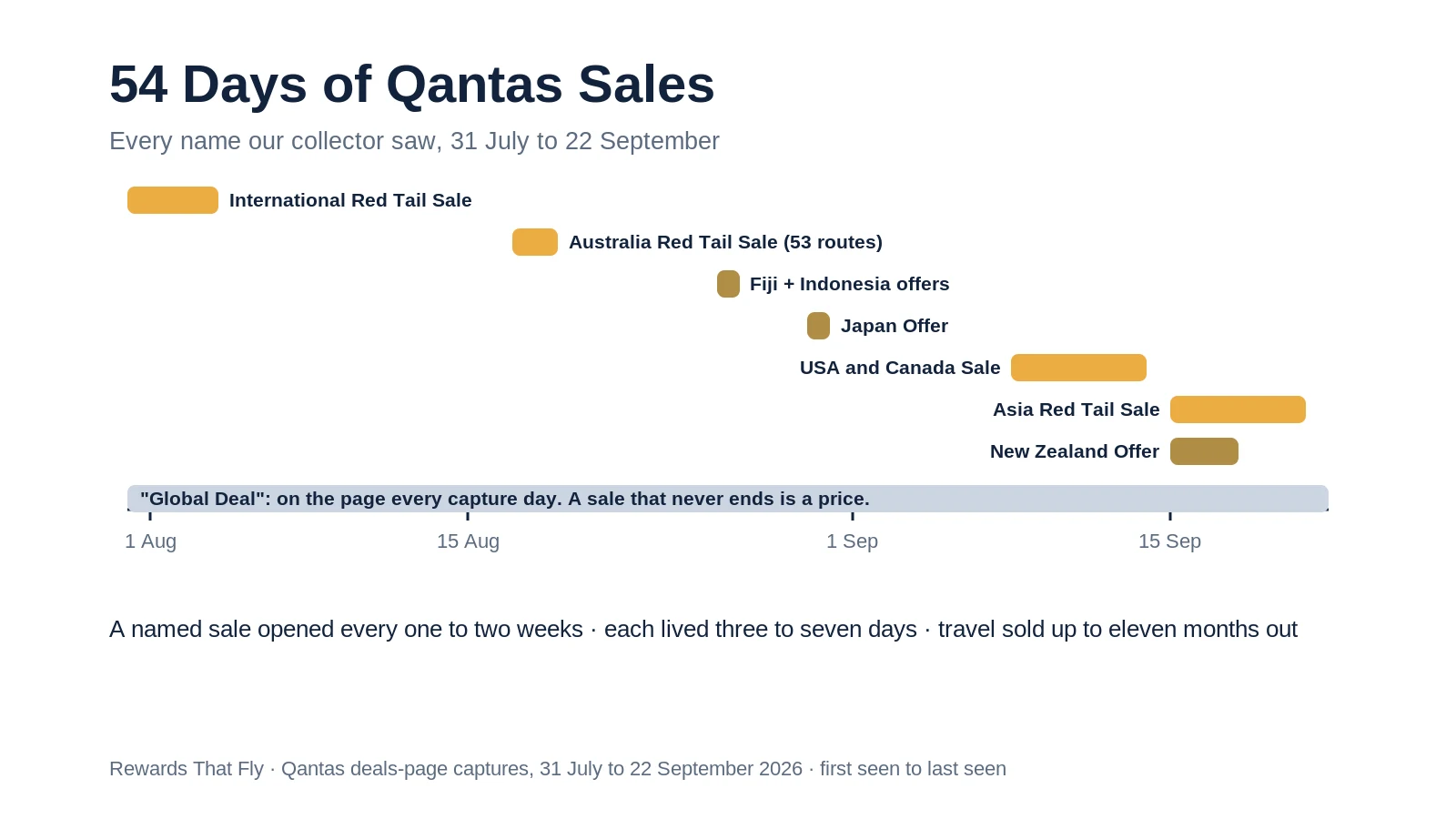
Our own Qantas sale record supports that approach. Since 31 July 2026, a named sale has appeared roughly every one to two weeks, often covering travel many months ahead.
At a glance
- Lead time matters, but the sale calendar matters more. In our own Qantas record, new named sales appeared every one to two weeks.
- Sales can cover travel eight to eleven months ahead. Buying very early at full fare can mean missing several sale windows.
- Peak dates behave differently. School holidays, Christmas and major seasonal events usually reward earlier booking.
- The cheapest day to book barely matters. Google's US data found Tuesday about 1.3% cheaper; Expedia's US data found Friday about 3% cheaper.
- Route-level evidence is more useful than universal rules. Auckland, Bali, Japan, Europe and the US all behave differently.
- Award seats run on a different calendar. Cash fares and reward seats should be monitored in parallel.
This guide covers the when. Our 30-minute cheap-flight method covers the how, while the airfare benchmarks cover what a good fare looks like.
What the major studies actually measure
Several studies attempt to quantify an optimum booking-window number, or the optimal time to book flights:
| Study | Headline finding | Underlying data | Relevance for Australians |
|---|---|---|---|
| Google Flights trends, September 2025 | Domestic fares lowest around 39 days out; international 49 days or more; Tuesday bookings about 1.3% cheaper | US departures, 2021–2025, top 4,000 US markets | Useful for the broad shape of peak-season pricing, but the lead times do not transfer directly |
| Expedia Air Hacks 2026 | Friday cheapest booking day at about 3%; international Economy cheapest 8–15 days out | Expedia US bookings, December 2024–November 2025 | The short international lead time reflects many shorter US international markets and is not a useful default for Australia–Europe or Australia–US |
| Hopper, January 2025 | Asia and Oceania around 5–7 months out; prices can rise sharply in the final weeks | US-origin bookings | The transpacific lead time is one of the more relevant US comparisons |
| Skyscanner Australia, updated June 2026 | Auckland about 8 weeks; Bali 16; Phuket 14; Ho Chi Minh City 19; Delhi 12; Athens 11; Los Angeles 18 | Australian search and fare data, priced in May 2024 | The most useful published route-level Australian data we found, although the pricing snapshot is now dated |
| Skyscanner "22 weeks" rule | Book international flights around 22 weeks out | Traces to a 2018 analysis | Too old to use as a universal current rule |
| Kayak Australia | February cheapest month to fly from Australia; December most expensive; Thursday cheapest day to fly | Australian metasearch data | Directionally useful, but we could not verify the methodology in enough detail to rely on it heavily |
What can you conclude from this information?
There is no useful universal booking day
Google's large US dataset says Tuesday is cheapest by about 1.3%.
Expedia's says Friday is cheapest by about 3%.
Those are small differences compared with the movement caused by route, season and sale timing.
The more useful habit is to monitor the fare, not wait for a particular weekday.
"Book early" and "wait for a sale" can both be right
Different routes have different pricing shapes.
Peak European summer, Christmas and school-holiday travel generally favour earlier booking. Flexible shoulder-season travel gives you more room to wait for a sale.
That is why route-level evidence is more useful than one universal number of weeks before departure.
What our own Qantas sale record shows
Since 31 July 2026, our collector has read the Qantas deals pages twice each day and archived the fares it found, including the sale name, travel window and booking deadline.
As at 22 September, the archive contained 6,728 fare captures across 44 capture days.
| Named Qantas sale or offer | Seen in our captures | Routes captured | Travel sold as far out as |
|---|---|---|---|
| International Red Tail Sale | 31 July–4 August | 23 | May 2027 |
| Australia Red Tail Sale | 17–19 August | 53 | May 2027 |
| Fiji and Indonesia offers | 26 August | Outside our priced routes | Not recorded |
| Double Status Credits | 26 August–2 September | Status promotion rather than fare sale | August 2027 |
| Japan Offer | 30 August | 1 | August 2027 |
| USA and Canada Sale | 8–14 September | 3 | May 2027 |
| Asia Red Tail Sale | 15–21 September | 6 | September 2027 |
| New Zealand Offer | 15–18 September | 6 | September 2027 |
What can we learn from these patterns?
New sales appeared frequently
That is not a promise that Qantas will keep the same rhythm, but over this period it meant another named sale or route offer appeared roughly every one to two weeks.
Most sale windows were short
The Australia Red Tail Sale, which covered 53 of the routes we track, appeared in our feed for only three days.
The practical lesson is not to book immediately because the word "sale" appears. It is to know your target price before the sale starts so you can act quickly if the fare is genuinely good.
Sales reached well into the following year
Every major sale in the record included travel in 2027.
The September offers reached as far as September 2027.
That matters if your trip is still many months away. Booking at full fare very early can mean giving up several potential sale opportunities before departure.
Sale periods often avoid peak dates
The August Australia Red Tail Sale included travel windows such as:
- 1–10 January;
- 19–29 January;
- 18 February–23 March;
- 28 March–6 April; and
- 19 April–25 May.
The gaps between sale dates broadly corresponded with some of the highest-demand holiday periods.
That is the central difference between flexible travel and peak-date travel: the cheapest sale inventory is often designed around the busiest dates rather than through them.
One other pattern is worth noting. A "Global Deal" label appeared on every one of our 44 capture days, largely covering trans-Tasman and Pacific routes.
A permanent deal label is not enough to tell you whether the fare is good. Our live deals board compares each fare with the normal range for that route instead.
When to start watching, by region
Combining the Australian route-level data, our own airfare benchmarks and the broader long-haul evidence gives the following practical starting points.
| Region | When to start watching | Generally better travel periods | What matters most |
|---|---|---|---|
| Europe | About 5 months out; become ready to book from around 4 | February–March, October–November | One-stop competition and seasonal peaks matter more than an exact booking day |
| USA | About 5–6 months out | February, June, August–September | Sale-driven; route competition can move fares materially |
| Japan | About 3–4 months out | Late January–February, May–June | Sales occur regularly, but cherry-blossom and ski dates need earlier action |
| South-East Asia and Bali | About 3–4 months out | Shoulder periods | Strong competition creates frequent sale opportunities |
| New Zealand | About 2 months out | February–March, August | High competition means shorter booking windows can still work |
| India | About 3 months out | Outside the December–January peak | Seasonal demand is more important than weekday timing |
Treat these as monitoring triggers, not booking deadlines.
"Start watching" means:
- set the fare alert;
- check the normal range for the route; and
- understand what a genuinely good fare looks like.
"Ready to book" means that once a fare reaches your airfare benchmark within that period, there may be little benefit in continuing to wait for a marginal improvement.
Australia's useful sales calendar
Australian fares often move around recurring promotional periods.
The exact timing and scope change from year to year, but these are the main periods worth watching based on the last twelve months.
| Period | Typical activity | Recent documented example |
|---|---|---|
| Late December | Boxing Day sales | Qantas, Virgin Australia and Jetstar all ran promotions in late December 2025 |
| February | Large Qantas domestic and international campaigns | Global and domestic Qantas sales in February 2026 |
| Early May | Jetstar Birthday Sale | Return for Free promotion, 4–6 May 2026 |
| Mid-June | End-of-financial-year sales | Qantas mid-year domestic sale in June 2026 |
| August–September | Qantas regional Red Tail sales and route offers | International, Australia, Asia and New Zealand offers captured in 2026 |
| Late November | Black Friday and Travel Week promotions | Virgin Australia, Jetstar and Qantas campaigns in November 2025 |
| Weekly | Short Jetstar and Virgin sale events | Frenzy and Happy Hour-style promotions continue through 2026 |
The useful point to note is that there are multiple promotional periods throughout the year.
If your flexible trip is still six or more months away, ask:
Which likely sale windows have historicall sat between now and departure?
rather than:
How many days before departure should I book?
Set the alert early, know your benchmark and let the sale come to you.
Peak dates are different
The case for waiting weakens significantly once your dates are fixed around a major demand peak.
The ABS recorded international travel and accommodation prices rising 24.4% in December 2025 alone.
US Christmas data also shows the same broad shape: the lower-fare window closes as the holiday period approaches.
For Australian travellers, the same logic applies to:
- Christmas and New Year;
- state school holidays;
- Easter;
- Japan's cherry-blossom season;
- Japan's ski season; and
- other major events where a large number of travellers want the same flights.
Our own sale data reinforces this point because sale windows regularly step around the highest-demand dates.
For peak travel, I would use a simpler rule:
Once you find a fare below the normal range for the route and the dates are important to you, book it.
Waiting for the absolute bottom is much less attractive when the alternatives are rising prices or losing the itinerary altogether.
What about school holidays?
The exact state calendar matters.
For example, in 2026 the NSW winter break ran from 6 to 17 July, while Victoria's ran from 27 June to 12 July.
That overlap helps explain why the first part of July is particularly competitive for international departures.
The same effect occurs around the September–October break and the December summer holidays.
If you must travel during those weeks, start monitoring earlier than the regional table above suggests.
Award seats run on a different calendar
Cash fares and award seats should not be treated as the same market.
Qantas Classic Rewards can become bookable up to 353 days before departure, but premium long-haul inventory is not released consistently at the opening of the schedule.
Our nightly watch across 17 premium routes found Business reward space on about:
- 10% of monitored route-days inside the next three months; and
- 29% beyond three months.
The longer-dated availability was heavily influenced by partner airlines that release seats earlier, while Qantas-operated premium seats were more likely to appear in smaller batches.
The full release-pattern discussion is in our Classic Reward availability guide.
For a trip where you are happy to use either cash or points, a practical strategy is to run both searches in parallel.
Around five months out:
- monitor cash against the airfare benchmarks; and
- monitor reward inventory through Flight & Reward Alerts and the relevant airline search tools.
Take whichever option reaches a level you are happy with first.
Our Points Valuations can help compare the economic cost of the points with the cash alternative.
When this approach works best
The sale-window strategy is most useful when:
- your dates have some flexibility;
- you are travelling outside major peak periods;
- you have at least three or four months before departure;
- a price alert is already running; and
- you know the normal fare range for the route.
It also works well for travellers who want a simple decision rule:
Start watching early, know your benchmark, and book when a suitable fare reaches it.
You do not need to predict the absolute cheapest day of the year.
When it matters less
Peak dates
If your dates fall over Christmas, school holidays or another major demand period, earlier booking becomes more important.
Very cheap domestic routes
On a $100–$150 domestic fare, the potential saving from perfect timing may be smaller than the cost of checked baggage or seat selection.
Set an alert and focus on the total trip price rather than trying to optimise a few dollars.
Genuine last-minute travel
Average data showing that some fares remain reasonable close to departure does not protect you when you need one specific flight on one specific day.
For unavoidable last-minute travel, availability matters more than historical averages.
Undated rules of thumb
"Book 22 weeks out", "always book on Tuesday" and similar rules sound precise because they use a number.
Precision is only useful if the underlying evidence is current and relevant to your route.
What to do next
Start with your next trip.
If the dates are peak and fixed, check the airfare benchmarks and book once you find a fare below the normal range that you are comfortable paying.
If the dates are flexible and long-haul, turn on a price alert now, note your target fare and look at the likely sale periods between now and departure.
Run our 30-minute cheap-flight method once to understand the route, then let the alerts do the ongoing work.
For more complicated itineraries, the Route Strategist compares direct fares, lower-cost carriers, split-ticket options and points on the same trip.
And when a sale appears, test the fare against the live deals board rather than relying on the sale label alone.
The objective is not to book at the theoretically perfect moment.
It is to recognise a good fare when it appears, with enough time left to take it.
Methodology and sources
This guide was rechecked on 23 September 2026.
Our first-hand evidence comes from the Rewards That Fly deals collector, which has read the Qantas deals pages twice daily since 31 July 2026 and archived each captured fare with its sale name, travel window and booking deadline.
As at 22 September 2026, that dataset contained 6,728 fare captures across 44 capture days.
The sale dates, route counts, travel horizons and window observations in this guide come from that archive. A sale's first recorded date is the first time it appeared in our capture, so an offer already running when monitoring began may have started earlier.
The Fiji and Indonesia offers on 26 August appeared in the Qantas offer list but applied to routes outside the status-run universe our collector priced, so no fare observations were archived for them.
The Double Status Credits promotion from 26 August to 2 September 2026 was a status promotion rather than a fare sale and is included only for context.
The external studies table was last reviewed on 12 July 2026:
- Google Flights holiday-travel trends, published 9 September 2025, based on US departures from 2021–2025 across 4,000 markets;
- Expedia Air Hacks 2026, published 17 February 2026, based on Expedia US bookings from December 2024 to November 2025;
- Hopper booking research published 28 January 2025, based on US-origin travel;
- Skyscanner Australia's cheapest-days material, updated 19 June 2026 but using prices accurate as at May 2024; and
- Kayak Australia's dynamically updated metasearch material, which we could not independently verify in enough detail to weight heavily.
Our route benchmarks were re-verified on 14 August 2026 and are published separately in the airfare benchmarks guide.
The sales-calendar examples draw on Qantas, Jetstar and Virgin Australia promotional material and contemporary reporting from late 2025 and 2026. The August and September 2026 Qantas entries come directly from our own captures.
School-holiday dates were checked against the NSW and Victorian education calendars. The December 2025 peak-pricing figure comes from the ABS Monthly CPI release published 28 January 2026.
Award-seat statistics come from our nightly Qantas Flight Reward Finder watch, using the 2 September 2026 snapshot published in our Classic Rewards availability guide.
We could not find a published Australian study comparing sale-window fares and advance-purchase fares for the same routes and travel dates. The sales-calendar conclusions therefore rely on documented sale windows, travel periods and our own captured fares rather than a controlled Australian pricing experiment.
Fares change daily. Treat the booking windows in this guide as planning ranges rather than guarantees, and verify the current fare before booking.