Guides · Strategy
Qantas status runs in 2026–27: costs, routes and strategy
Compare Qantas status run costs, recent fare benchmarks, Double Status Credits and the 2026–27 rule changes, then calculate using our Status Run Builder.
By Rewards That Fly · Updated 26 August 2026 · 20 min read
Reviewed quarterly and whenever Qantas launches a broad Double Status Credits offer. Next scheduled review: November 2026.
Offer note, 26 August 2026. Qantas opened a Twice as Rewarding window this morning: double Status Credits or double Qantas Points, one choice per member, changeable until the window closes. Register in the Qantas app or on qantas.com first, book by 11:59pm 2 September 2026, and travel between 3 September 2026 and 14 August 2027. Only flights marketed and operated by Qantas earn the bonus, including QantasLink and the Finnair wet-lease services; Jetstar and partner-operated codeshares do not, new bookings only, and some fare types are excluded under the Airline Earning Tables. With the offer applied, the screening level below effectively halves: a fare under about $4 per Status Credit is competitive during the window. The Status Run Builder prices any run with its Double Status Credits toggle switched on. Basis: Qantas Newsroom announcement and offer terms, 26 August 2026.
A status run is a flight taken primarily to earn enough Status Credits to reach or retain a Qantas Frequent Flyer tier.
For some travellers, the decision is mainly financial. For others, the flight itself is part of the appeal: the lounge visit, the premium cabin, the aircraft, the sense of progress towards a tier, or simply the enjoyment of spending a day flying. That value is personal and does not need to be justified entirely by the retail value of the benefits.
The useful question is not whether every status run pays for itself in a strict sense. It is whether the cost is reasonable for what you expect to get from it, both practically and personally.
Three questions help frame that decision:
- How many Status Credits do you still need?
- What will each additional Status Credit cost?
- Will the flying and the resulting tier be worth that cost to you?
As a starting point, a fare below about $5 per Status Credit is competitive by recent Australian benchmarks. During an eligible Double Status Credits offer, a figure below $4 per Status Credit is a useful screening level.
Neither number decides the question on its own. An expensive final top-up can still make sense if it protects a tier you use regularly or completes a trip you genuinely want to take. A cheap run can still be poor value if the itinerary is inconvenient, the flying holds little appeal and the benefits will go unused.
The 2026–27 Qantas Frequent Flyer Program transition adds another layer. Status Credit rollover and permanent ground earning are due to begin from late 2026. Later in 2027, the lower retention thresholds will disappear and the Loyalty Bonus will be retired. Qantas has not yet published every implementation date or the permanent mechanics of ground earning, so the timing of a run may matter almost as much as its price.
This guide explains the current rules, recent cost-per-Status-Credit benchmarks and the situations in which a run is most likely to make sense. The Qantas Status Run Builder is our live, fare-backed status run planning tool, not simply a calculator for one flight. It prices complete route and cabin combinations for any status run situation, including your actual Status Credit shortfall, home airport, trip limit and budget, then shows the source behind every fare.
The five-question test
Run these checks before booking any flight primarily for status.
1. What is your exact Status Credit shortfall?
Use the Status Credit balance and membership-year end date shown in your Qantas account.
Make sure you are working towards the correct threshold. Gold currently requires 700 Status Credits to attain and 600 to retain. Platinum requires 1,400 to attain and 1,200 to retain. The lower retention thresholds will increase later in 2027.
2. What will the tier mean to you?
Think about the Qantas and oneworld travel you realistically expect to do while you hold the status, but do not reduce the decision to a tally of lounge visits and priority benefits.
For some travellers, the value is practical: lounge access, priority boarding, baggage allowances, upgrade priority and a smoother airport experience. For others, the value also comes from the enjoyment of reaching the tier, the confidence of travelling with status or simply taking pleasure in the flying itself.
That value is personal. The question is not whether every benefit can be assigned a dollar value. It is whether the tier, and the journey to reach it, will feel worthwhile at the cost involved.
3. What is the cost per Status Credit?
Divide the fare by the Status Credits earned:
Cost per Status Credit = total fare ÷ Status Credits earned
Consider the total cost you will actually pay to take the trip, including positioning flights, accommodation, transfers and baggage where relevant.
For a trip you were taking anyway, base the calculation on the additional cost of the higher-earning option rather than the entire fare. If an extra stop costs $160 more and earns 80 additional Status Credits, the relevant figure is $2 per additional Status Credit.
4. Does the timing work?
The flights must credit within the correct membership year. If a Double Status Credits offer applies, both the booking and travel must comply with that promotion's terms.
The rollover transition also matters. Before rollover applies to your membership year, excess Status Credits will not help with retention in the following year. Once rollover applies, some Status Credits earned above your tier's attainment threshold can carry forward.
5. Does the run unlock anything else?
Under the current rules, every 500 eligible Status Credits earned on Qantas or Jetstar flights can unlock a Loyalty Bonus of 50 Status Credits, up to four times per membership year.
A flight that takes you from 480 to 520 eligible Status Credits may therefore be more valuable than its published earning suggests. The Loyalty Bonus is due to retire during 2027, so this consideration is temporary.
What a Status Credit costs to earn
Status Credits are earned for each eligible flight segment. The amount depends on the route, fare category and airline shown on the ticket.
For domestic Qantas flights, Business Sale and Business Saver fares both map to the standard Business earn category. They earn fewer Status Credits than Flexible Business, but usually cost substantially less.
The middle Economy category applies to international fares such as Economy Saver. No domestic fare type maps to it: domestic economy fares book as Red e-Deal into Discount Economy, or as Flex into Flexible Economy.
The following are the core one-way earning rates used by the Builder:
| Route or distance band | Discount Economy |
Economy | Flex Economy |
Business Sale |
Business Saver |
Business Flex |
|---|---|---|---|---|---|---|
| Domestic short, up to 750 miles | 10 | 10 | 20 | 40 | 40 | 45 |
| Domestic medium, 751–1,500 miles | 15 | 15 | 30 | 60 | 60 | 70 |
| Domestic long, 1,501 miles or more | 20 | 20 | 40 | 80 | 80 | 95 |
| East coast Australia to New Zealand | 20 | 25 | 40 | 80 | 85 | 90 |
| East coast Australia to Asia | 30 | 40 | 60 | 120 | 125 | 135 |
Because earning is calculated by segment, a connecting itinerary can earn more than a non-stop flight.
For example, Sydney to Darwin in Business earns 80 Status Credits each way when flown non-stop. Routing through Melbourne adds a short domestic segment worth another 40, lifting the one-way total to 120.
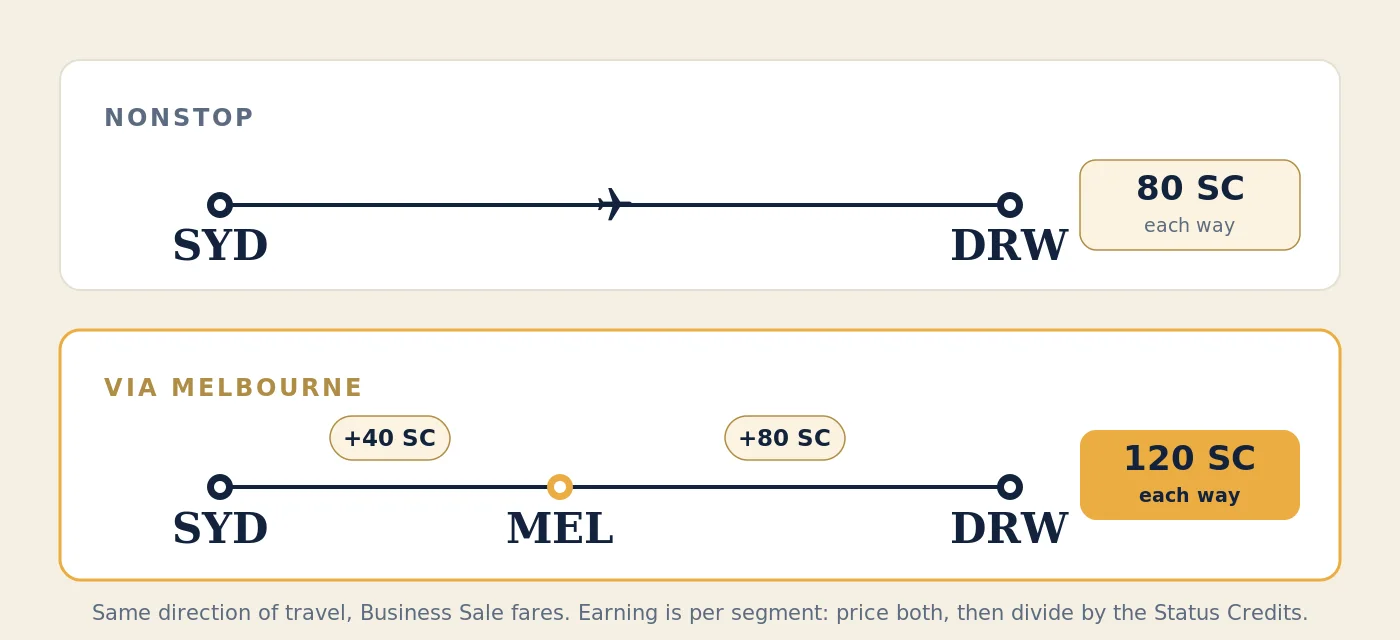 Earning is per segment: the Melbourne connection lifts one-way Business Sale earning from 80 to 120 Status Credits.
The connection is not automatically the better option. Compare the fare difference with the additional Status Credits, travel time and risk of disruption.
The Status Run Builder runs this calculation across eligible routes and can also compare the extra cost per additional Status Credit for trips you were already planning to take.
Recent fare benchmarks
The fares below are dated observations rather than current offers. Sale inventory changes quickly, so use them as benchmarks for recognising a strong fare rather than as prices you should expect to book today. For cash-fare benchmarks beyond status running, including what counts as a good buy in Economy and Business on popular routes, see our 2026 airfare benchmarks from Australia.
| Route and cabin | Observed | Fare | Status Credits |
Cost per SC |
Under DSC |
|---|---|---|---|---|---|
| Melbourne–Sydney Business Sale, one way |
February 2026 sale | $299 | 40 | $7.48 | $3.74 |
| Adelaide–Newcastle Business Sale, one way |
February 2026 sale | $399 | 60 | $6.65 | $3.33 |
| Brisbane–Cairns Business Sale, one way |
February 2026 sale | $459 | 60 | $7.65 | $3.83 |
| Sydney–Melbourne Business, one way |
March 2026 check | $449 | 40 | $11.23 | $5.61 |
| Brisbane–Melbourne–Bali Business Sale, return |
February 2026 check | $2,982 | 360 | $8.28 | $4.14 |
Three points follow from the table.
First, ordinary domestic Business fares often struggle to meet good $-per-Status-Credit thresholds without a promotion. The strongest opportunities usually involve a sale fare, Double Status Credits or both.
Second, medium-distance domestic routes can outperform shorter-distance routes, like the Sydney–Melbourne shuttle. A 60-Status-Credit sector at a reasonable Business fare can produce better value than a cheaper short flight earning only 40.
Third, flying you were already going to do has a different calculation. Moving a necessary trip to an eligible Qantas fare, choosing a higher-earning routing or booking during a Double Status Credits offer may produce Status Credits at a much lower marginal cost than purchasing an entirely new trip.
The best fares we have detected
The benchmarks above are historical examples. The tables below use our own collected data from the Qantas Status Run Builder, a live fare-backed status run planning tool.
Live Qantas deal prices are collected twice daily. Documented fares and researched estimates are labelled separately, so readers can see exactly what each result is based on.
The first table shows the lowest cost per Status Credit we have detected for each run since tracking began on 31 July 2026. This table excludes any Double Status Credit promotions.
| # | Run | Cabin | Return fare | SC | $ per SC | First seen | Sale |
|---|---|---|---|---|---|---|---|
| 1 | ADL–NTL | Business | $658 | 120 | $5.48 | 17 Aug 2026 | Australia Red Tail Sale |
| 2 | BNE–CNS | Business | $798 | 120 | $6.65 | 17 Aug 2026 | Australia Red Tail Sale |
| 3 | BNE–MEL | Business | $798 | 120 | $6.65 | 17 Aug 2026 | Australia Red Tail Sale |
| 4 | MEL–BNE | Business | $798 | 120 | $6.65 | 17 Aug 2026 | Australia Red Tail Sale |
| 5 | ADL–ASP | Business | $838 | 120 | $6.98 | 17 Aug 2026 | Australia Red Tail Sale |
| 6 | BNE–MKY | Business | $598 | 80 | $7.47 | 17 Aug 2026 | Australia Red Tail Sale |
| 7 | BNE–NTL | Business | $598 | 80 | $7.47 | 17 Aug 2026 | Australia Red Tail Sale |
| 8 | BNE–SYD | Business | $598 | 80 | $7.47 | 17 Aug 2026 | Australia Red Tail Sale |
| 9 | MEL–ADL | Business | $598 | 80 | $7.47 | 17 Aug 2026 | Australia Red Tail Sale |
| 10 | MEL–CBR | Business | $598 | 80 | $7.47 | 17 Aug 2026 | Australia Red Tail Sale |
In time, we will show the same observations under an eligible Double Status Credits promotion:
No Double Status Credits window has run since our tracking began on 31 Jul 2026.
The archive is still young. Its usefulness should increase as it captures more sales and shows how often a genuinely competitive fare appears from each city.
Double Status Credits
A Double Status Credits offer can materially change the calculation because the fare stays the same while the eligible Status Credits double.
Qantas ran two broad offers in the first half of 2026:
| Booking window | Eligible travel | Scope |
|---|---|---|
| 24 February–2 March 2026 | 3 March 2026–12 February 2027 | Eligible Qantas-operated domestic and international flights with a QF flight number |
| 5–11 May 2026 | 12 May–31 August 2026 | Eligible Qantas-operated domestic and trans-Tasman flights with a QF flight number |
Both required members to register and make a new eligible booking during the offer period. Existing bookings did not qualify merely because the member registered.
The February offer was particularly useful because its travel period extended for almost a year. Members who were ready to book could bring forward much of their planned Qantas travel into the seven-day booking window.
The May offer had a narrower route and travel period. That difference is a reminder to read the terms of each promotion carefully.
The recent pattern
| Year | Broad public Double Status Credits windows |
|---|---|
| 2026 to date | February and May |
| 2025 | March and August |
| 2024 | February and October |
| 2023 | March |
A broad offer has appeared early in each of the past four years. Qantas has also run second offers in three consecutive years, although their timing and scope have varied.
That history is useful for planning, but it is not a timetable. Register whenever an offer appears, but do not delay travel you need to book solely because another promotion may arrive.
The practical approach is:
- Register for every broad Double Status Credits offer when it appears.
- Check the booking window, eligible operators, flight numbers and travel dates.
- Price travel you already expect to take before considering additional flights.
- Use the Status Run Builder with the Double Status Credits option turned on.
- Do not delay travel you need to book solely in the hope that another promotion will appear.
What a tier year may be worth to you
There is no universal value for airline status.
Part of the value is practical: lounge access, priority boarding, baggage allowances, upgrade priority and a smoother airport experience. Part of it may be personal: the enjoyment of flying, the satisfaction of reaching a tier or simply having status when you travel.
The ranges below are therefore only a guide to the practical benefits a traveller might use during a year. They are not a test that the tier must pass.
| Tier | Indicative practical value |
What drives the range |
|---|---|---|
| Silver | $150–350 | Lounge invitations, priority check-in and modest points benefits |
| Gold | $800–1,500 | Regular lounge use, oneworld access, baggage and airport priority |
| Platinum | $1,800–3,500 | First lounges, stronger upgrade priority and frequent international travel |
| Platinum One | $4,000–8,000 | Very high-frequency Qantas travel and top-tier service benefits |
These figures will vary significantly by traveller.
Someone who takes only a handful of eligible flights may use relatively few of Gold's published benefits. A frequent international traveller may use them repeatedly. Neither calculation captures the full value for someone who also enjoys the flying, the challenge of reaching a tier or the experience that comes with it.
The question is not whether status produces a strict financial return. It is whether the cost feels reasonable for the practical benefits and personal enjoyment you expect to receive.
Compare Gold with Qantas Club
If lounge access is your main objective, compare the cost of the status run with direct Qantas Club membership.
At the time of checking, an individual Qantas Club membership started at $799 a year, plus a $149 joining fee for a new member. Qantas Club Flexible cost $99 every 28 days and also attracted the joining fee for a new member.
Qantas Club is not equivalent to Gold. Gold includes broader oneworld lounge access, priority benefits and a higher points Status Bonus. The comparison is still useful if domestic Qantas lounge access is the main benefit you expect to use.
What about Silver?
A dedicated run for Silver will rarely make sense unless the remaining gap is small.
The benefits are more limited than Gold, and the 300-Status-Credit attainment target can require substantial additional flying. A final short flight may still be worthwhile if you value the lounge invitations, the tier itself or the experience of reaching it. Building a large part of Silver through dedicated runs will be a less compelling proposition for most travellers.
Where you live changes the calculation
Status-run economics depend heavily on the routes and fare competition available from your home airport.
| Home airport | Opportunities seen | Indicative economics | Practical view |
|---|---|---|---|
| Sydney or Melbourne | Short Business sectors, New Zealand and Bali routings | About $7.50–$11 per SC outside DSC | Broadest choice, but sales and DSC matter |
| Brisbane | Cairns and other medium-band sectors, plus international connections | About $7.50–$9.50 per SC outside DSC | Stronger medium-distance options |
| Adelaide | Newcastle, Darwin and Perth Business routes | From about $6.65 per SC in observed sales | Often competitive because 60-SC sectors can price well |
| Perth | Transcontinental and nearby international routes | Domestic Business often expensive | Compare Singapore, New Zealand and other international options |
| Canberra | Limited Business route choice and higher positioning costs | Often above $10 per SC | A positioning flight may be required |
| Regional east coast | Multi-sector routings and positioning options | Frequently above $10 per SC | Organic travel and DSC are usually more attractive |
These figures are indicative. A sale can change the ranking quickly, while the cost of positioning to another city can erase an apparent saving.
The Status Run Builder starts with your home airport and ranks the available combinations within the limits you set.
When a status run may not make sense
You are still a long way from the target
Manufacturing several hundred Status Credits can require thousands of dollars and multiple trips.
The larger the shortfall, the more money, time and additional flying the decision requires. Start by moving planned travel onto eligible fares and testing higher-earning routings before buying dedicated flights.
The tier holds little practical or personal value for you
Status can have value beyond a strict financial calculation, but there still needs to be something about the outcome or the journey that matters to you.
If you expect only two Qantas trips next year and have little interest in the flying itself, a substantial Gold run may be hard to justify. If you fly regularly, enjoy the process and value the tier, the same expenditure may feel entirely reasonable.
The run is in Economy and earns very little
Economy status runs often produce high costs per Status Credit because domestic sectors commonly earn only 10 to 20 Status Credits.
There are exceptions, particularly where a low fare crosses a Loyalty Bonus boundary, completes a small shortfall or involves travel you wanted to take anyway. As a general strategy, Business sale fares tend to produce better Status Credit economics.
You are overshooting before rollover applies
Before rollover applies to your membership year, Status Credits above the annual requirement do not assist with retention in the following year.
They may still contribute towards Lifetime Status and other milestones, but that is a different objective. Do not overshoot accidentally because the itinerary looked efficient on a per-credit basis.
After rollover applies, the annual rollover caps are 100 Status Credits for Silver, 300 for Gold and 500 for Platinum and Platinum One.
For Gold, finishing on 1,000 Status Credits produces a rollover of 150:
(1,000 − 700) × 50% = 150
Finishing on 1,300 reaches the 300-Status-Credit cap. Earning beyond that may still contribute towards Lifetime Status and other goals, but it will not increase the amount rolled into the following membership year.
You are repeatedly paying for small emergency top-ups
A final top-up can be sensible when it protects a tier with substantial practical or personal value.
If the same situation occurs every year, consider whether planned travel can be timed around sales or Double Status Credits, whether a different routing would earn more or whether the tier will remain realistic under the later 2027 thresholds.
The fare is cheap per credit but poor in every other respect
Cost per Status Credit is only one measure.
A route may involve repeated positioning flights, inconvenient schedules, an aircraft you do not want to fly or more trips than you are prepared to take. The lowest mathematical result is not always the best practical result.
How the 2026–27 transition changes the timing
Qantas is introducing the status changes in stages. Our guide to the 2026–27 Qantas status changes covers the full timeline and the implications for each tier. For status runners, the important question is which rules apply when the flights credit.
Before rollover applies to your membership year
The current retention thresholds remain in place: 600 Status Credits for Gold and 1,200 for Platinum. The Loyalty Bonus is also still available.
Status Credits above your annual requirement will not carry into the following membership year, although they continue to count towards Lifetime Status and any applicable current-year milestones. The usual objective is therefore to close your shortfall without unnecessary overshoot.
Check whether the run will also take you across a 500-Status-Credit Loyalty Bonus threshold. A flight that moves you from 480 to 520 eligible Status Credits may unlock an additional 50 Status Credits.
Once rollover applies, but before the higher targets begin
Overshoot can begin to have value, but only after you exceed the attainment threshold for your tier.
For Gold, rollover is calculated above 700 Status Credits, not above the current 600-credit retention threshold. A Gold member finishing on 650 would retain Gold under the current rules but receive no rollover. A member finishing on 1,000 would carry 150 Status Credits into the following membership year.
This may make it worthwhile to place discretionary flying in your first rollover-eligible membership year, particularly where the travel also falls within a Double Status Credits period.
Qantas says eligibility will depend on each member's anniversary date. Wait for confirmation that your membership year qualifies before buying extra flying specifically for rollover.
After the single targets take effect later in 2027
Gold retention will rise from 600 to 700 Status Credits and Platinum from 1,200 to 1,400. The Loyalty Bonus will also be retired.
Rollover and ground-earned Status Credits may offset part of the increase. Qantas has confirmed that members will be able to earn up to 140 Status Credits a year across ten non-flying categories, but it has not yet published the permanent thresholds or earning amounts.
Build the calculation in this order:
- Start with the new annual target.
- Deduct any Status Credits carried into the year.
- Deduct ground-earned Status Credits already received or reasonably expected under the final published rules.
- Deduct eligible flying already booked.
- Price only the remaining gap.
The timing may change the answer, but it does not override the underlying cost and practical considerations. Spending heavily to create rollover credits is not automatically better than earning the credits when they are actually needed.
The minimum requirement of four eligible Qantas or Jetstar Group flight segments will continue to apply.
A separate calculation for Jetstar flyers
Club Jetstar members can purchase Qantas Frequent Flyer Extra for $199 a year, in addition to the underlying Club Jetstar membership.
The add-on earns five additional Status Credits per eligible domestic Jetstar or Jetstar Japan flight and ten per eligible international flight, capped at 75 Status Credits per Qantas Frequent Flyer membership year. Only flights booked through jetstar.com or the Jetstar app are eligible; bookings made through qantas.com do not earn the Extra.
This is most likely to make sense for someone already expecting to take several eligible Jetstar flights. It is less compelling as a reason to book additional flights solely for status.
Recent broad Double Status Credits promotions have excluded Jetstar. Check the terms of each future offer rather than assuming the same treatment will always apply.
Jetstar Business Max
Jetstar's standard Business fare does not currently earn Qantas Points or Status Credits, while Business Max earns at the Business rate. The relevant calculation is therefore the additional cost of Business Max divided by the Status Credits it unlocks.
This can produce very low marginal costs per Status Credit, but the Business Max premium varies by route and travel date. We only include a numerical benchmark where we can reproduce the fare and earning directly.
What to do next
Open your Qantas account and record:
- your current tier;
- your Status Credit balance;
- your membership-year end date;
- your attain or retain target;
- eligible flights already booked; and
- your progress towards the next Loyalty Bonus.
Enter those details into the Status Run Builder. Compare the lowest-cost result with the number of trips required, the fare sources and the practical limits you set.
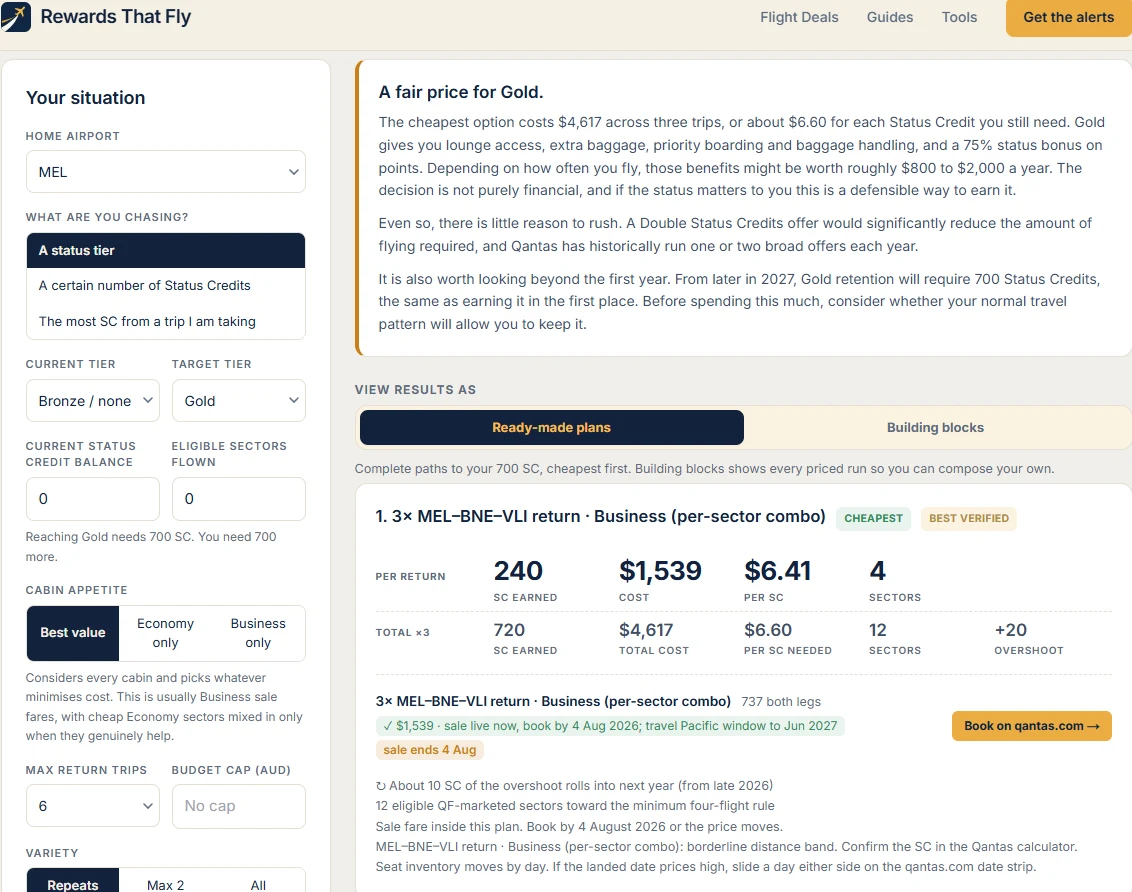 A 700 Status Credit Gold target priced from Melbourne, captured 4 August 2026. The cheapest path costs $6.60 per Status Credit, and every fare shows its source and book-by date.
Register for each broad Double Status Credits offer when it appears, then assess whether planned travel fits the booking and travel windows.
If the result does not feel worthwhile, do not force the run. Keep the airfare for travel you genuinely want to take and reassess when a stronger fare, more appealing itinerary or suitable promotion appears.
Methodology and last checked
Program rules were checked on 4 August 2026 against the Qantas Frequent Flyer program-changes page, the status tiers page, the Qantas and Jetstar airline earning tables and the fare-type earn-category tables. The rollover percentages and per-tier caps, tier thresholds, earning rates and fare-class mappings above matched those pages on that date. Jetstar earning exclusions and Qantas Frequent Flyer Extra mechanics were checked the same day against the Jetstar earning tables and Jetstar's Qantas Frequent Flyer Extra pages, and Qantas Club pricing against the Qantas Club membership page. At verification the International Red Tail Sale was live, ending 4 August 2026, and no Double Status Credits offer was advertised.
Qantas has confirmed that Status Credit rollover and ground-earned Status Credits will begin in phases from late 2026, while the higher retention targets will take effect later in 2027. The first rollover date will depend on each member's membership-year anniversary. Permanent ground-earning thresholds remain unpublished.
The 2026 Double Status Credits terms were checked against Qantas Agency Connect releases for the February and May promotions. Both required registration and a new eligible booking during the stated offer period.
Historical fare observations were drawn from dated airline sales, published fare tables and Rewards That Fly testing. They illustrate recent pricing rather than current availability. The best-fares-detected tables use first-hand data collected from Qantas' advertised deals pages twice daily. Tracking began on 31 July 2026.
Tier-value ranges are Rewards That Fly editorial estimates of practical benefits that may be used during a tier year. They do not capture the personal value of flying, reaching a tier or holding status, and they will differ by traveller.
Fares, availability, earning tables and program rules can change. Confirm the final fare, eligible flight number, Status Credit earning and promotion terms with Qantas before booking.