Guides · Airfares
Cheap flights to Japan from Australia: fares, routes and points
Compare cheap flights to Japan from Australia, including one-stop fares, Jetstar sales, non-stop benchmarks and Business Class rewards using points.
By Rewards That Fly · Updated 2 October 2026 · 9 min read
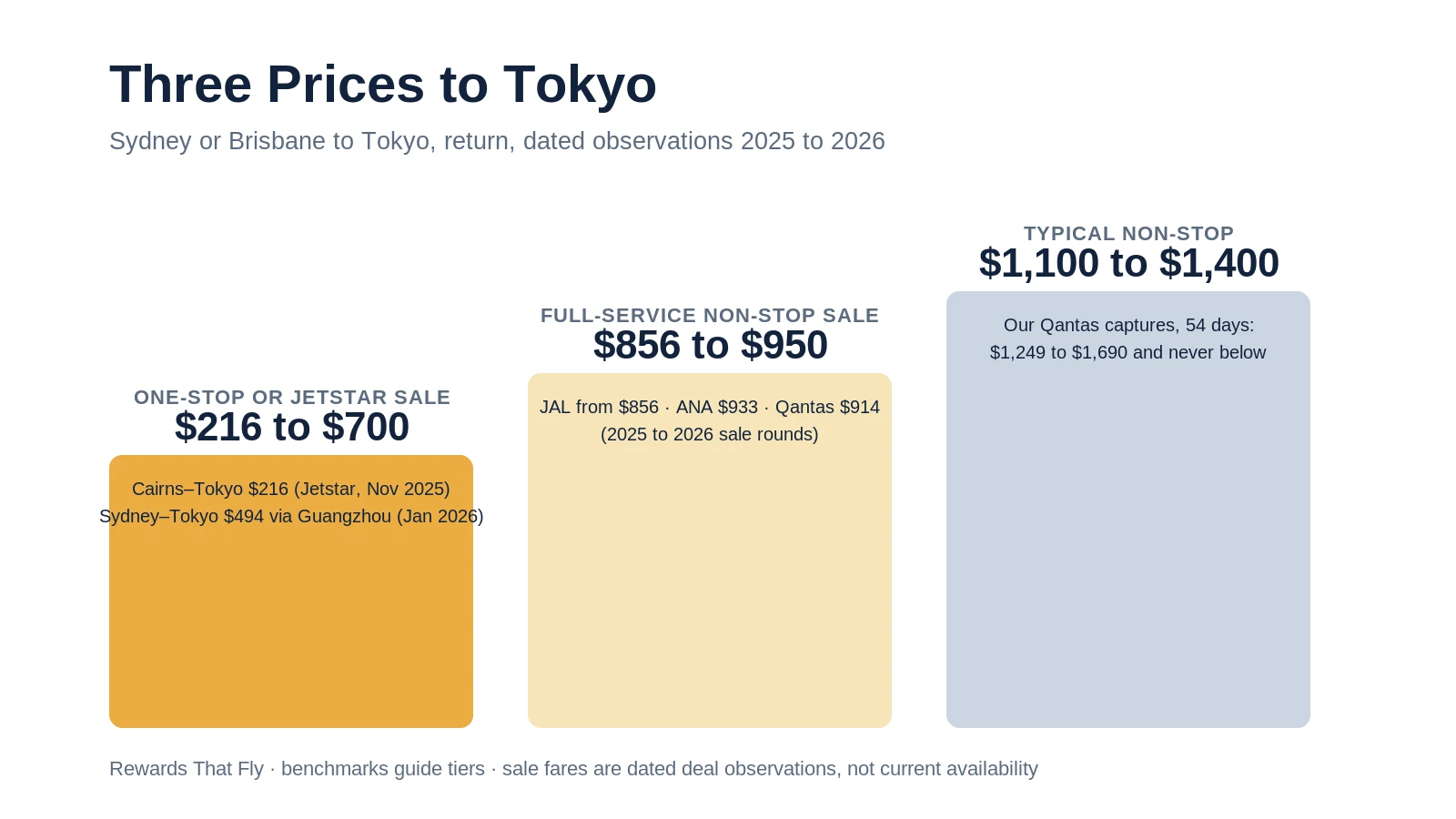
Finding a cheaper flight to Japan usually means comparing three options: a full-service non-stop, a low-cost-carrier sale and a one-stop itinerary through Asia.
Each can be the right choice. A connection may save hundreds of dollars, but a reasonably priced non-stop can be better value once baggage, travel time and the rest of your holiday are considered.
For Business Class, points add another option. ANA through Velocity, Qantas Classic Rewards and Japan Airlines through Qantas Points all deserve a look, provided suitable seats are available.
This guide brings together historical sale fares, our own Qantas price observations and a dated reward-availability snapshot. The aim is to help you recognise a good option, not wait indefinitely for the lowest fare ever advertised.
At a glance
- For Sydney or Brisbane to Tokyo, our good-buy benchmark is $950 return or less for full-service non-stop Economy. A one-stop or low-cost-carrier fare below $700 is particularly strong, before any extras.
- Jetstar can be cheaper without a connection. Compare Tokyo and Osaka, and the Australian departure cities that work for you.
- Our Qantas sample did not reach the $950 benchmark. Sydney–Haneda Economy ranged from $1,249 to $1,690 return during the monitored period. That is a finding about that sample, not every Qantas sale.
- ANA Business from Sydney to Haneda requires 82,000 Velocity Points one way, compared with 98,400 Qantas Points on Qantas and 108,000 on JAL. Availability and cash charges still matter.12
- Match the season to the trip. A cheaper winter fare to Tokyo does not mean Hokkaido is off-peak, and early May includes Golden Week.
What is a good fare to Japan?
Our airfare benchmarks use the following reference points for Sydney or Brisbane to Tokyo:
| Itinerary | Return Economy reference price | How to use it |
|---|---|---|
| Full-service non-stop | Common range: $1,100–$1,400 | A reference range for ordinary dates, not a ceiling for peak travel |
| Full-service non-stop | Good buy: $950 or less | Worth considering when the dates and fare conditions suit |
| One-stop or low-cost carrier | Exceptional: $700 or less | Compare baggage, connections, airport and total journey time |
All figures are Australian dollars, including taxes. Low-cost fares may exclude checked baggage, meals and seat selection.
These are different products, not three prices for an identical journey. A $950 non-stop can be a better choice than a $700 itinerary with a long connection. Equally, a comfortable connection may be an easy trade for a substantial saving.
The main non-stop routes
The departure airport and destination can change the comparison significantly.
| Airline | Routes to consider | Planning note |
|---|---|---|
| Qantas | Sydney–Haneda; Melbourne and Brisbane–Narita; seasonal Sydney–Sapporo | Sapporo provides an alternative to connecting within Japan for a Hokkaido trip |
| ANA | Sydney–Haneda; Perth–Narita | Sydney has two daily services in the published timetable; Perth frequency varies by season |
| Japan Airlines | Sydney–Haneda; Melbourne–Narita | JAL has announced daily Melbourne services for the winter period beginning 25 October 2026 |
| Jetstar | Sydney–Osaka; Brisbane–Tokyo and Osaka; Cairns–Tokyo and Osaka | Some routes operate only on selected days, so compare the full weekly schedule |
Route references: Qantas, ANA, JAL and Jetstar. Check the actual dates before booking; a route listing is not a guarantee of daily service.3456
For a Tokyo search, include both Haneda and Narita if either works for your plans. For a trip combining Tokyo, Kyoto and Osaka, also price Kansai rather than assuming you must arrive and depart through Tokyo.
Cash fares: where the lower prices have appeared
The examples below show what has been advertised, not what is currently available. They come from different dates and travel windows, so they should not be read as a same-day airline comparison.
| Airline and itinerary | Historical return Economy fares | Observation period |
|---|---|---|
| China Southern via Guangzhou | Sydney–Tokyo $494; Melbourne $533; Brisbane $571; Perth $591 | January 2026 listing |
| Jetstar non-stop sales | Sydney–Osaka $399; Cairns–Osaka $429; Brisbane–Tokyo $559 | May 2026 sale examples |
| Qantas non-stop to Tokyo | $914 from Sydney, Melbourne or Brisbane on selected dates | July 2025 listing, including some May 2026 travel |
| Cathay Pacific via Hong Kong | Tokyo or Osaka from about $765–$843 across Melbourne, Sydney and Brisbane | June 2024 listing, included as older context only |
The China Southern, Qantas and Cathay examples are supported by dated deal listings. Jetstar figures come from the May sale examples recorded for this guide. These offers have expired.78910
The useful conclusion is that a connection can produce a substantial saving, but a connection is not always necessary to find a low fare. Jetstar's Sydney–Osaka example was non-stop, while the historical Qantas fare demonstrates that a full-service non-stop can fall below our good-buy benchmark.
Compare the complete itinerary
For a low-cost fare, add the extras you expect to buy before comparing it with a full-service ticket.
As a rough planning allowance, $100–$200 return per person for baggage, meals and seat selection can be useful. It is an estimate, not a standard airline charge. Ski equipment, heavier bags and particular seat choices can cost more.
For a one-stop itinerary, also check the connection length, airport, ticket structure and current transit requirements. A fare with an overnight wait or separate tickets needs a different assessment from a straightforward through-booking.
What our own Qantas captures show
Our 54-day sample beginning on 31 July 2026 included 51 Sydney–Haneda fare captures from Qantas' advertised deals pages.
| Cabin | Lowest return fare captured | Highest return fare captured | Lowest-fare observation |
|---|---|---|---|
| Economy | $1,249 | $1,690 | International Red Tail Sale, 31 July |
| Business | $6,498 | $7,425 | Asia Red Tail Sale, 15 September |
A Japan Offer recorded on 30 August priced Business at $6,706 return.
None of the Economy observations reached our $950 good-buy benchmark. Some sat within the $1,100–$1,400 common range; others were above it.
That supports checking other airlines rather than assuming a Qantas sale is the cheapest option. It does not establish that Qantas never offers a stronger fare, or that another airline was cheaper on every matching date.
The live deals board shows the Qantas fares we are currently tracking. Use it alongside a wider search, not as a complete view of the market.
When to travel
The sale examples reviewed for this guide include cheaper travel in late January and February, May and June, and selected dates later in the year. That is useful evidence of opportunity, but not a universal low-season calendar.
City holidays and ski holidays have different peaks
Late January or February can be worth checking for Tokyo and other city itineraries. It is not a general off-peak recommendation for Japan: January and February are prime ski months, particularly in Hokkaido.11
Similarly, May needs to be split into two parts. Golden Week falls around late April and early May and is one of Japan's busiest domestic travel periods. Later May is a different proposition. June can offer attractive fares, but rainy-season conditions may affect the holiday you want to take.1213
Paying more for the season can be reasonable
Cherry blossoms, skiing and school-holiday travel are often the purpose of the trip, not an inconvenience to avoid.
If those dates matter, start comparing earlier and judge the fare against alternatives for the same period. Do not reject a workable itinerary simply because it does not match an off-peak benchmark.
For flexible travel, our when-to-book guide sets out the recurring sale periods worth monitoring. Past campaigns are reminders to check, not promises of another sale on the same dates.
Business Class using points
For non-stop Sydney–Haneda travel, three options provide a useful starting comparison:
| Airline and booking program | Points, one way in Business | Cash component |
|---|---|---|
| ANA through Velocity | 82,000 Velocity Points | About $91 in the historical worked example used for this guide; confirm at booking |
| Qantas Classic Reward on Qantas | 98,400 Qantas Points | About $250 as an editorial planning estimate, not a current quote |
| JAL through Qantas Frequent Flyer | 108,000 Qantas Points | Confirm taxes and carrier charges at booking |
Points requirements follow the relevant Velocity and Qantas reward tables. Cash components are separate and can change.12
ANA requires fewer points numerically, which makes it an attractive option to check. But Qantas and Velocity Points are different currencies, and the available seats, balances you hold and transfer options can change the practical answer.
An available JAL seat on dates you need may be preferable to waiting for a lower-priced reward that never appears.
Qantas Business from Brisbane to Narita requires 82,100 points one way because it falls in a shorter distance band. Include any positioning costs before comparing that with a departure from home.2
Use Points Valuations to compare the cash fare replaced after deducting the reward's cash charges. For a return trip, compare complete return options rather than using an unusually expensive standalone one-way fare to inflate the apparent saving.
What our reward-availability watch shows
Our 1 October 2026 Flight Reward Finder snapshot recorded the following availability across the next twelve months:
| Search route | Dates showing Business availability | Of those, dates before 1 January 2027 | Dates showing Economy availability |
|---|---|---|---|
| Sydney–Haneda | 31 | 3 | 249 |
| Melbourne–Narita | 31 | 2 | 209 |
| Brisbane–Narita | 82 | 4 | 247 |
These are dates with availability visible in the search, not seat counts or a probability that a particular traveller will secure a booking.
The Finder can include Qantas and partner airlines. Unless the underlying results are filtered and checked, the totals should not be described as Qantas-operated availability alone. Its results also carry a last-checked timestamp and must be confirmed in the booking flow.14
Brisbane showed more Business dates in this snapshot. That makes it worth checking, not an automatic instruction to position there. Confirm the airline, stops, cabin on every sector and number of seats before comparing the total trip.
Our Classic Rewards availability guide explains the search process. Flight & Reward Alerts includes selected openings from our nightly watch in the weekly email; it is not an immediate seat notification.
Economy rewards still deserve a comparison
A $500–$700 return cash sale can be difficult for an Economy reward to beat once points and charges are included. The answer can reverse when cash fares are expensive or the reward offers dates you otherwise could not afford.
Compare what is actually bookable. Neither the cheapest historical sale nor an unavailable reward seat is a useful substitute for the trip in front of you.
Upgrades: an option, not a confirmed Business seat
If you are already buying an eligible Qantas fare, a Classic Upgrade Reward is worth checking. Eligibility, points required and confirmation depend on the fare and available inventory; some international discount Economy booking classes are excluded.15
Compare the cost of the original fare plus the points with an outright reward or Business fare. Do not buy an expensive Flex or Premium Economy ticket solely because the upgrade requires fewer points.
The sensible starting point is a ticket you would be comfortable flying without an upgrade. Our Qantas Frequent Flyer guide covers the trade-offs.
Three itinerary changes worth testing
Position to Cairns or Brisbane
A particularly low Jetstar fare can justify checking another Australian departure city.
The calculation must include the Japan ticket, positioning flights in both directions, baggage, any hotel and the additional time. Price a through itinerary as well as separate tickets before assuming the split is cheaper.
Do not combine the lowest domestic fare from one promotion with a Japan fare from another unless both are available for workable dates. A cheap historical pair is not a bookable itinerary.
An overnight stop can reduce connection risk, but it also costs money and may shorten the time available in Japan. Our separate-ticket guide covers the wider considerations.
Fly into Osaka and home from Tokyo
For a trip covering both regions, arriving in Osaka and departing from Tokyo, or the reverse, can remove an unnecessary return journey across Japan.
Compare a multi-city ticket and two one-way fares with a conventional return. The airfare may be higher, but the overall trip can still cost less once the avoided train journey, hotel or travel time is included.
Do not assume return-sale pricing will apply to two independently booked one-ways.
Compare Sapporo with Tokyo plus a domestic connection
For Hokkaido, price Qantas' seasonal Sydney–Sapporo service against Tokyo plus an onward flight. Qantas lists the seasonal route from December 2026 to March 2027.3
Include ski baggage, connection time and the domestic fare. Check the Tokyo airport carefully rather than assuming the international arrival and onward departure use the same one.
If the domestic flight is separately ticketed, avoid relying on a tight connection to the final departure of the day. An overnight stop or a through-booking may suit the trip better.
When the lowest fare is not the best choice
The extras remove most of the saving. Compare the final price for everyone travelling, particularly with children, checked bags or ski equipment.
The itinerary uses too much of the holiday. A long connection or positioning stop may be acceptable for a three-week trip and poor value for a short break.
The dates are the reason for travelling. Paying more for cherry blossoms, skiing or a family event can be entirely reasonable. Compare within that period rather than against the cheapest month of the year.
The points option is not actually available. Do not transfer a large balance simply because the chart price is attractive. Check seats and transfer timing first.
You are waiting for an outlier. Very low promotional fares do occur, including on non-stop low-cost services. They are not the price every traveller should expect to obtain.
What to do next
Set a target for each itinerary type you would genuinely use. For flexible Sydney or Brisbane–Tokyo Economy searches, our starting references are $950 for a full-service non-stop and $700 for a strong one-stop or low-cost option, before extras.
Search Tokyo and Osaka, compare nearby dates, and add another Australian departure city only if positioning is practical. Run the 30-minute method, then leave fare alerts active.
For Business Class, check ANA through Velocity alongside Qantas and JAL rewards. Search both directions before committing to an itinerary that depends on a second reward appearing later.
Use the Route Strategist to compare the main structures, then confirm the final fare or reward through the relevant booking site.
The cheapest useful flight is the one that fits the trip after every extra cost, connection and points charge is included.
Methodology and sources
This guide combines Rewards That Fly's fare and availability records with published airline schedules, reward tables and dated sale listings. Selected official references and historical listings were reviewed on 2 October 2026. The underlying observations retain their original dates; this review does not turn historical fares into current offers.
Qantas fare observations: the 54-day sample beginning 31 July 2026 contains 51 Sydney–Haneda captures. Economy ranged from $1,249 to $1,690 return and Business from $6,498 to $7,425. Repeated captures are not necessarily unique itineraries or independent pricing events. The sample covers advertised Qantas deals, not every airline or every fare available for Japan.
Historical sales: the China Southern figures come from a January 2026 listing; the Jetstar examples are from RTF's May 2026 sale records. The $914 Qantas example was advertised in July 2025, with selected travel extending into May 2026. The Cathay Pacific figures trace to June 2024 and are expressly labelled older context. Historical listings do not prove that an identical fare remains available directly from the airline.
Reward availability: counts are from the Flight Reward Finder snapshot of 1 October 2026. They describe search dates with visible availability. The aggregate counts are not treated as an exclusively Qantas-operated or non-stop subset. A positive date does not establish how many passengers can book, availability in the reverse direction or availability when the reader searches.
Points and charges: reward points are checked against the applicable program tables. The approximately $91 ANA cash amount is a historical worked-example figure. The $250 Qantas amount is an editorial estimate. Neither is presented as a current checkout quote. Points comparisons must account for the different currencies and the cash fare the traveller would actually replace.
Seasonality and limitations: travel dates in past sales identify opportunities, not guaranteed cheap months. Japan National Tourism Organization guidance supplies the Golden Week, rainy-season and ski-season context.
We review this guide quarterly and following material route or program changes. Updates are recorded in the Program Change Log. Confirm current schedules, fares, baggage, reward availability and booking conditions before paying or transferring points.
Sources and notes
-
Qantas Classic Flight Reward tables, including the separate partner table used for Japan Airlines. ↩ ↩2 ↩3
-
Qantas international flight routes, including Tokyo and the seasonal Sydney–Sapporo service. ↩ ↩2
-
ANA international route information. Check the applicable seasonal timetable for the dates you intend to travel. ↩
-
JAL's 2026 international schedule announcement, including Melbourne's winter frequency increase. ↩
-
Jetstar flights to Japan. Confirm route availability and operating days in the booking search. ↩
-
China Southern January 2026 sale listing, including the Tokyo fares from Sydney, Melbourne, Brisbane and Perth. ↩
-
Jetstar May 2026 Return for Free listing, including Sydney–Osaka at $399. Other May examples are drawn from RTF's sale records. ↩
-
Qantas Flight Reward Finder, including its operating-airline, last-checked and availability information. ↩
-
Qantas Classic Upgrade Rewards, including fare eligibility and confirmation conditions. ↩