Guides · Points
Velocity Frequent Flyer in 2026: where it beats Qantas, and where it does not
A 2026 guide to Velocity Frequent Flyer, including Qatar and ANA rewards, domestic Reward Seats, status changes, Family Pooling and how it compares with Qantas.
By Rewards That Fly · Updated 20 August 2026 · 23 min read
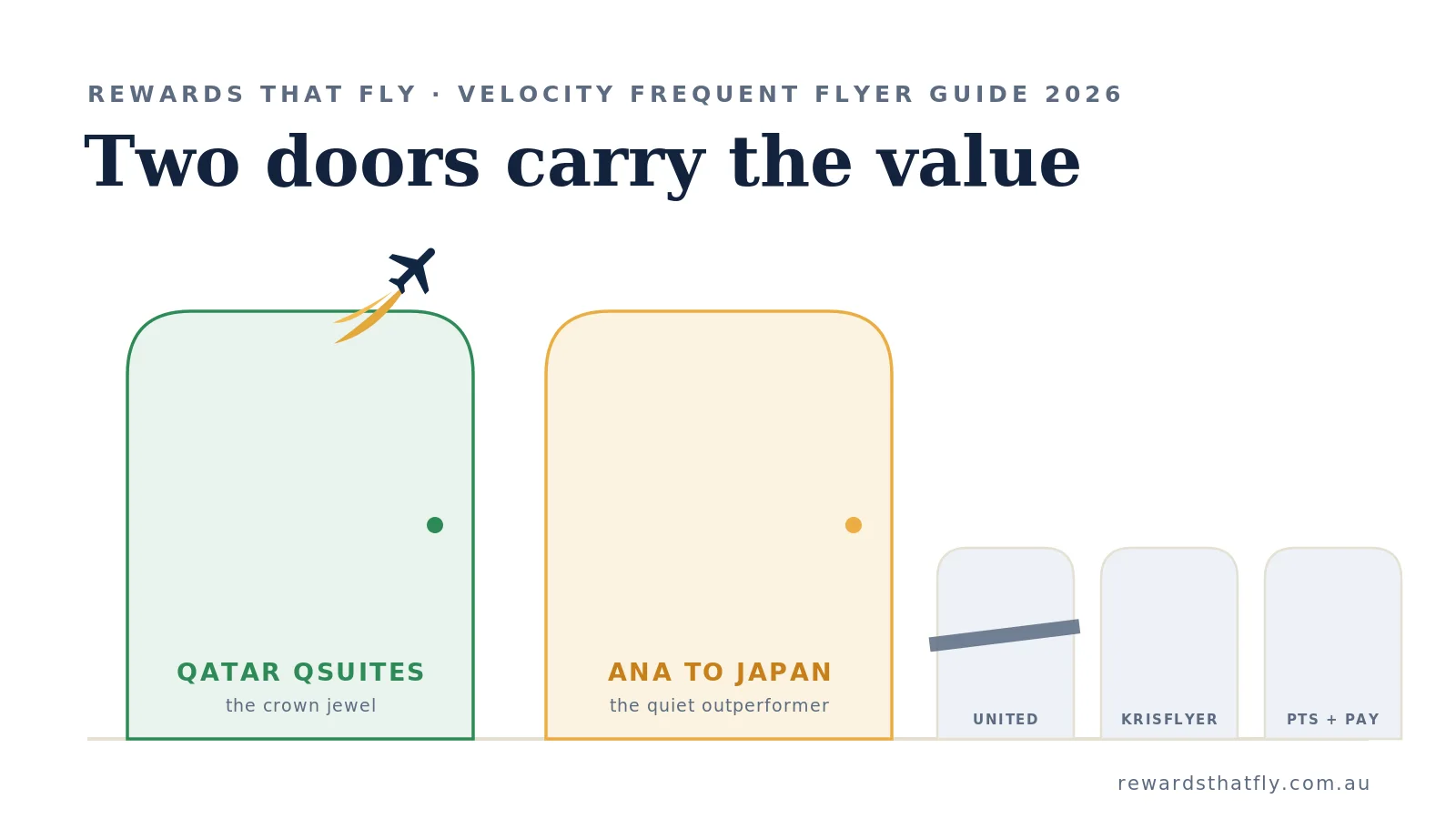
Velocity in 2026 is a program with concentrated strengths.
Its best uses are genuinely strong: Qatar Airways and Virgin Australia's Doha services for long-haul premium travel, ANA to Japan, fixed-price domestic Business Reward Seats and Family Pooling for households. Its status system has also become unusually transparent on Virgin Australia's domestic and short-haul network, where most fares now earn Status Credits according to the amount spent.
The weaknesses are just as clear. Velocity has a smaller airline partner network than Qantas, premium reward availability can be patchy outside its strongest partners, and the former United Business Class path to the US has largely disappeared from partner inventory.
That makes the choice more personal than simply asking which program is better.
If your travel patterns line up with Qatar, ANA, Virgin Australia's network and a household that can pool, Velocity can be an excellent primary program. If you want a much broader partner map, particularly for complex international redemptions or travel to the US, Qantas generally gives you more options.
Our current benchmark is 1.3 cents per Velocity Point, with 1.9 cents or more a level which we consider a strong redemption. Those are benchmarks, not rules. A 0.6c Points + Pay redemption may still be useful to someone who wants to reduce a cash fare, while a theoretically high-value Business reward has little practical value if the destination, dates or availability do not work.
The aim is to understand the trade-off. This guide works through the strongest and weakest uses of Velocity Points, the status changes now in force, and the situations where Velocity has a genuine advantage over Qantas.
The verdict table
The methodology behind our 1.3c benchmark and 1.9c strong-redemption level is set out on the Valuations page.
Here is how the main Velocity redemption options compare as at August 2026:
| Redemption | Realistic value per point | Our view |
|---|---|---|
| Qatar Airways and VA Doha Business rewards |
Often 2c+ | A standout long-haul use. Strong points pricing, with carrier charges and availability to consider |
| ANA Business to Japan | ~2c+ | Another standout. Sydney–Tokyo at 82,000 points compares very well with Qantas |
| VA domestic Business Reward Seats |
~2–3.7c in our live captures | Excellent when available. Fixed Business pricing can produce strong value |
| VA domestic Economy Reward Seats |
~0.9–1.9c in our captures | Published demand-based bands. Compare with the actual cash fare after charges |
| Singapore Airlines | Route and cabin dependent | Useful partner access, although premium availability can be patchy |
| United Airlines | Availability constrained | Still a partner, but do not build an Australia–US Business strategy around it without finding the seat first |
| Velocity to KrisFlyer | Situational | 1.55:1 conversion. Use where the KrisFlyer redemption justifies the smaller resulting balance |
| Points + Pay | 0.6c | Low redemption value, although the eligible fare can still earn Points and Status Credits |
| Velocity Store and other cash-like redemptions |
~0.5–0.6c | Convenience rather than maximum point value |
The pattern is more concentrated than Qantas.
Velocity does not need dozens of outstanding redemption options to be useful. A handful of strong ones can be enough if they match where you actually want to travel.
The important question is therefore not how many airline partners Velocity has. It is whether the routes and products you want sit behind the doors that work well.
Qatar and Doha: one of Velocity's strongest premium uses
Qatar Airways is one of the main reasons Velocity deserves serious consideration for international premium travel.
Velocity Points can be used for Qatar Airways rewards across the Qatar network, while Virgin Australia's own Doha services operate with Qatar Airways aircraft and crew under VA flight numbers.
The current Business Reward pricing is particularly strong:
| Route or destination | Business, one way |
|---|---|
| Perth–Doha | 89,500 points |
| Sydney–Doha | 119,500 points |
| Brisbane–Doha | 119,500 points |
| Melbourne–Doha | 119,500 points |
| Perth to much of Western Europe via Doha | 139,000 points |
| East coast Australia to much of Western Europe via Doha | 158,500 points |
That puts destinations such as London, Paris, Frankfurt, Barcelona and Zurich within reach at points levels that compare well with many other Australian premium-cabin options.
Carrier charges are the main cash cost.
Qatar applies additional charges to reward bookings, including up to US$200 per long Business Class sector over 4,000 miles, before government taxes. A Business reward from the east coast of Australia to Europe can therefore still require several hundred dollars in cash.
That matters, but it does not erase the underlying points value. The correct comparison is:
(cash fare you would otherwise pay − reward taxes and charges) ÷ Velocity Points used
A current service note
As at August 2026, Virgin Australia's Sydney and Melbourne services to Doha are operating.
The Virgin Australia-branded Brisbane and Perth Doha services are scheduled to resume in December 2026 following disruption to Middle East flying earlier in the year.
Check the current timetable before building a trip around these services.
Why the old numbers can mislead
The Qatar partner chart changed in January 2025.
One figure still appearing in older articles is 139,000 points from the east coast of Australia to London in Business. That is no longer the relevant current price for many east coast to Western Europe itineraries. The present Zone 12 Business price is 158,500 points.
Perth remains cheaper because the shorter distance places many European itineraries in a lower zone.
That distinction can be worth tens of thousands of points for two travellers, so check the current zone before transferring anything.
Charges can change too
Reward pricing is only half the equation.
In January 2026, Qatar briefly imposed much larger fuel surcharges on reward bookings before reversing the change shortly afterwards. That episode is a useful reminder that the points chart can remain unchanged while the cash component moves materially.
We track material changes in the Program Change Log, but the final co-payment shown at booking remains the figure that matters.
Availability is still the scarce part
Strong chart pricing does not guarantee a seat.
Qatar Business availability tends to appear in waves and can disappear quickly on popular dates. Virgin Australia has also released additional reward inventory on its own Doha services at different points since launch.
The practical approach is to know the points requirement in advance, keep enough Velocity Points available for the redemption and check regularly.
Do not transfer points from another program purely because the chart price looks attractive. Find the seat first wherever possible.
What about Economy?
Qatar does not offer Premium Economy.
That means the next option below Business is Economy, and on a very long Australia–Europe itinerary the points saving needs to be weighed against the cash fare you could simply buy.
Before using a large Velocity balance for Economy to Europe, check our airfare benchmarks. Cheap one-stop cash fares can materially reduce the cents-per-point value of the reward.
ANA, Singapore Airlines and the wider partner map
ANA to Japan
ANA is another Velocity standout.
A Sydney–Tokyo Haneda Business Reward currently requires:
82,000 Velocity Points one way, plus taxes and charges
The comparable Qantas Business Classic Reward to Tokyo requires 98,400 Qantas Points. That is a difference of more than 16,000 points each way before considering the cash component.
ANA also tends to have relatively modest reward charges compared with some long-haul partners.
Availability is the constraint. Business seats can appear unevenly and may disappear quickly once released.
For someone specifically targeting Japan, however, ANA is one of the clearest examples of Velocity offering a compelling redemption without needing to route through Doha.
Older guides may show 78,000 points for this route. That pricing predates the January 2025 partner-chart changes.
Singapore Airlines
Singapore Airlines gives Velocity members another useful international outlet.
Sydney–Singapore Economy Reward pricing begins around 29,000 Velocity Points one way, plus taxes and applicable charges.
Business availability through Velocity is less predictable. Seats do appear on selected routes and dates, but Singapore Airlines naturally makes more premium inventory available through its own KrisFlyer program than it does to partners.
That leads to the question of whether to move Velocity Points into KrisFlyer.
Velocity to KrisFlyer
Velocity Points can currently be converted to KrisFlyer miles at:
1.55 Velocity Points = 1 KrisFlyer mile
That means 155,000 Velocity Points become 100,000 KrisFlyer miles.
Your balance therefore falls by 35.5% in numerical terms when converted. That is not automatically a 35.5% economic loss because a KrisFlyer mile and a Velocity Point do not have identical redemption value. The conversion can still make sense.
A transfer can make sense where:
- you can see a specific Singapore Airlines reward that Velocity cannot access;
- the KrisFlyer pricing is attractive after allowing for the conversion;
- your travel dates are fixed enough to justify committing the points; and
- the resulting redemption is clearly better than the alternatives available through Velocity.
What we would not do is convert speculatively.
Once Velocity Points become KrisFlyer miles, you have exchanged a flexible balance inside one program for a smaller balance inside another.
Also distinguish this conversion from occasional bank rewards transfer bonuses into Velocity. Those promotions can improve the economics of moving external rewards points into Velocity, but they do not change the standard 1.55:1 Velocity-to-KrisFlyer conversion itself.
United and the US problem
United remains a Velocity airline partner.
The problem is reward availability, not the existence of the partnership.
Velocity's partner chart still prices United awards, but long-haul United Business saver availability from Australia largely disappeared from partner channels during 2025.
That means the old strategy of building a Velocity balance around a 95,500-point Polaris reward to the US is no longer something we would rely on.
The distinction matters:
United is still a Velocity partner. Australia–US Business reward inventory through partners is the part that has become extremely difficult to find.
If you find a suitable seat, the published partner chart can still be used. We would not accumulate or transfer points on the assumption that the seat will eventually appear.
For travel to the US, Qantas currently offers a broader set of options through its own flights and wider partner network. Cash fares can also be unusually competitive during trans-Pacific sales, so compare with our airfare benchmarks before assuming points are the answer.
The breadth trade-off
Velocity's strongest partners are valuable, but the overall international map is smaller than Qantas Frequent Flyer.
That matters if you:
- build complex multi-stop itineraries;
- want several alternative routings to the same destination;
- rely heavily on oneworld airlines;
- travel frequently to destinations outside the Qatar, ANA and Singapore Airlines networks; or
- value having several backup programs when one airline releases no seats.
Velocity can be excellent when its strongest partners match your destination.
Qantas is generally more flexible when the exact routing matters less than having many ways to reach the destination.
That is one of the central differences between the two programs.
Domestic Reward Seats: one of Velocity's strongest everyday uses
Velocity's domestic reward pricing became much easier to understand after the January 2025 changes.
Business Reward Seats returned to fixed zone pricing, while Economy Reward Seats now price within published demand-based bands.
For example:
| Route type | Economy Reward Seat | Business Reward Seat |
|---|---|---|
| Short domestic, Zone 1 | 5,900–12,900 points | 15,500 points |
| Medium domestic | Demand-based band | 23,500 points on relevant zones |
| Transcontinental, such as Sydney–Perth | Demand-based band | 35,500 points |
Taxes and charges are additional.
The important phrase is Reward Seat. The published pricing only applies when Virgin Australia has released Reward Seat inventory.
If no Reward Seat is available, the points price can be much higher.
What we found live
We checked the pricing directly on virginaustralia.com on 9 August 2026.
| Flight | Reward price | Same-flight cash fare | Value per point |
|---|---|---|---|
| Sydney–Melbourne Business | 15,500 + $43.33 | $385 | ~2.2c |
| Sydney–Brisbane Business | 15,500 + $46.48 | $359 | ~2.0c |
| Sydney–Perth Business | 35,500 + $52.02 | $1,359.01 | ~3.7c |
| Sydney–Melbourne Economy | 7,900 + $43.33 | $135 | ~1.2c |
| Sydney–Gold Coast Economy | 7,900 + $45.01 | $119.01 | ~0.9c |
| Sydney–Brisbane Economy | 9,900 + $46.48 | $230 | ~1.9c |
The Sydney–Perth Business example is particularly strong.
At 35,500 points plus $52.02 against a $1,359 same-flight fare, it produced the highest domestic cents-per-point result in our current Velocity test basket.
But the same searches also showed why the chart cannot be read in isolation.
Reward Seat availability changes the result
On one Sydney–Melbourne service, Business was available for 53,500 points rather than the 15,500-point Reward Seat price.
Same route, same cabin, very different redemption.
Our first Sydney–Perth search date also showed no 35,500-point Business Reward Seat at all. Suitable fixed-price inventory appeared on the following day.
That is the practical lesson:
The published chart tells you what a Reward Seat costs. It does not tell you whether Virgin Australia has released one on the flight you want.
Look for the Reward Seat pricing before transferring points or making the rest of the itinerary around it.
Economy needs more care
The low end of the Economy band can undercut Qantas' fixed domestic Classic Reward pricing, but charges matter much more when the cash fare is cheap.
A $45 co-payment on a $119 cash fare removes a large part of the value before a single point is counted.
That is why our Sydney–Gold Coast example returned only around 0.9c per point, while Sydney–Brisbane on a more expensive cash fare produced about 1.9c.
As with the Qantas guide, the same principle keeps appearing:
A reward is only as valuable as the cash fare it replaces.
Upgrades: useful where the fare already makes sense
Velocity's UpgradeMe Points system can provide good value, particularly where the underlying fare was going to be bought anyway.
Domestic and short-haul
Domestic UpgradeMe Points currently start at around 10,000 points, while short-haul international upgrades can begin from around 8,000 points, depending on route and fare type.
Availability is not guaranteed, so the value is partly dependent on whether the request clears.
Doha upgrades
Virgin Australia's Doha services have their own published upgrade structure.
For eligible VA1–29 flights:
- members travelling on Flex can request Business upgrades from 69,000 Velocity Points; and
- Gold, Platinum and Platinum Plus members travelling on eligible Choice fares can request upgrades from 99,000 points.
The strongest use is similar to the one we identify in Qantas Frequent Flyer:
Upgrade a fare that already made sense to buy.
A work-paid Flex fare combined with your own Velocity Points can be far more attractive than buying Business outright.
By contrast, paying a much higher cash fare purely to access an upgrade pathway can undo the value.
If travelling in Business is essential rather than a bonus, compare the confirmed Reward Seat or cash fare instead of valuing an upgrade request as though it were guaranteed.
Points + Pay: low value, but not the same as a Reward Seat
Velocity is unusually clear about Points + Pay.
Every 2,500 Velocity Points reduces the fare by $15, equivalent to:
0.6 cents per Velocity Point
That is well below our 1.3c benchmark.
There is, however, an important difference from a Reward Seat.
Points + Pay is used against an eligible revenue fare. Where the underlying booking qualifies, the traveller can still earn Base Points, Tier Bonus Points and Status Credits.
That can make Points + Pay more useful than the raw 0.6c figure suggests for someone who:
- wants to reduce the cash component of a fare;
- still wants the booking treated as an eligible revenue ticket;
- has points they are unlikely to use for a higher-value reward; or
- values immediate cash savings more than maximising cents per point.
It is still a low-value redemption.
The important distinction is that low theoretical value does not mean nobody should use it. If the alternative is holding points indefinitely for a premium redemption you will never book, reducing the cost of a flight you genuinely need can still be a reasonable use.
Use the 0.6c rate knowing what you are giving up.
Velocity Store, hotels and other cash-like redemptions
Velocity Points can also be used for products, gift cards and other non-flight rewards.
These generally produce values around 0.5 to 0.6 cents per point, depending on the product and promotion.
That puts them near the bottom of the redemption-value range.
As with Points + Pay, that does not make them inherently wrong.
A traveller who rarely flies, has no realistic premium reward target and values a gift card today may reasonably prefer to realise 0.5c per point rather than preserve a balance indefinitely.
The best theoretical redemption is not always the best practical redemption for the person holding the points.
Our view is simply:
Know the exchange rate before you use them.
If the choice is between a 0.5c gift card and a 2c reward flight you will genuinely book in six months, keep the points.
If the flight is a hypothetical trip you have been talking about for five years, the comparison is different.
How Velocity status works after the overhaul
Velocity's status model changed substantially between April and October 2025.
For Virgin Australia's domestic and short-haul international network, most status earning is now linked directly to the fare paid.
Eligible bookings made under the new structure earn:
- 1 Status Credit per $12 of the all-inclusive fare on Choice, Flex, Group and Business fares; and
- 1 Status Credit per $24 on Economy Lite.
Extras do not generate additional Status Credits.
A $300 eligible Choice fare therefore earns:
$300 ÷ $12 = 25 Status Credits
That relationship makes much of domestic Velocity status unusually easy to model.
It does not apply universally across the program. Virgin Australia's Doha services and partner airlines continue to use separate earning structures based on factors such as distance, airline and fare class.
What happened to status running?
The old ability to find a disproportionately cheap domestic fare that still earned a generous distance-based Status Credit amount has largely disappeared on Virgin Australia's domestic and short-haul network.
Cheap fares now earn fewer Status Credits because the fare itself is the principal input.
That does not make status harder for everyone.
Someone whose employer regularly buys expensive Flex or Business fares may earn more Status Credits than under the old system. Someone who previously built status through inexpensive Choice fares is likely to earn less.
The new model rewards spend much more directly.
The tier gates
Eligible Sectors have also disappeared.
Instead, each tier now requires a minimum proportion of Status Credits to come from eligible Virgin Australia flying completed by the member.
| Tier | Attain | Maintain | Personally earned VA component |
|---|---|---|---|
| Silver | 250 SC | 200 SC | At least 50% |
| Gold | 500 SC | 400 SC | At least 50% |
| Platinum | 1,000 SC | 800 SC | At least 50% |
| Platinum Plus | 2,000 SC | 2,000 SC | At least 75% |
For illustration only, if every Status Credit were earned from eligible non-Lite Virgin Australia fares at exactly $12 per Status Credit, the attainment thresholds would correspond to approximately:
| Tier | Illustrative eligible VA fare spend |
|---|---|
| Silver | ~$3,000 |
| Gold | ~$6,000 |
| Platinum | ~$12,000 |
| Platinum Plus | ~$24,000 |
Those are not literal prices for status.
Partner flights, Family Pooling, Doha flights, Lite fares and other earning categories can change the relationship between Status Credits and dollars spent.
The useful point is simpler: for someone whose flying is predominantly domestic Virgin Australia, status is now much easier to forecast from the annual travel budget.
Rolling qualification
Tier upgrades are assessed using the relevant Status Credits earned over the preceding 365 days.
You therefore do not need to wait until the end of a fixed annual cycle to move up a tier. Once the required Status Credits and Virgin Australia component are satisfied, the upgrade can occur.
Retention is then assessed over the applicable Benefit Period.
That is another meaningful difference from thinking about status purely as a calendar-year target.
Forever Gold
Forever Gold is one of the more distinctive additions to Velocity.
To qualify, a member needs:
12,000 lifetime Status Credits earned since 1 February 2013
with at least:
9,000 of those Status Credits earned personally from eligible Virgin Australia flights
Once achieved, Gold status is retained for life under the program rules.
This is not something most members should try to manufacture deliberately.
The lifetime requirement spans years under different Status Credit earning systems, so it cannot sensibly be converted into one dollar-spend figure.
The better way to think about Forever Gold is as a reward for a long history of genuine Virgin Australia travel.
If you are already well advanced towards the threshold through years of flying, it may influence which airline you choose for future trips.
If you are starting from zero, it is not a reason to spend heavily for the sake of the milestone.
Platinum Plus
Platinum Plus sits above Platinum and requires:
2,000 Status Credits
with at least 75% of the qualifying Status Credits meeting the applicable Virgin Australia flying requirement.
Unlike the lower tiers, there is no reduced retention threshold.
Benefits include premium servicing, a Companion Platinum benefit and additional upgrade and travel flexibility.
The tier is clearly designed around very high levels of Virgin Australia travel.
For a traveller whose employer naturally generates that volume, the benefits can be meaningful.
For a self-funded traveller considering additional flights purely to reach 2,000 Status Credits, the economics are much harder to support.
Family Pooling: a genuine Velocity advantage
Family Pooling deserves more attention than a footnote because it materially changes how a household can use Velocity.
Eligible households can pool Velocity Points, or Points and Status Credits, from up to six family members living at the same address, generally consisting of up to two adults and four children, into one nominated beneficiary account.
That can turn several modest balances into one usable redemption balance without requiring repeated manual transfers.
It is particularly useful for families where:
- one person does most of the reward booking;
- children earn points from travel but are unlikely to use them independently;
- several household members fly occasionally; or
- one member is the logical status beneficiary.
There are limits.
Pooled Status Credits do not satisfy the portion of a tier requirement that must be personally earned from eligible Virgin Australia flying by the member.
They also do not count towards the personally flown Virgin Australia component of Forever Gold.
Family Pooling helps consolidate the household's earning. It does not remove the personal-flying requirements built into status.
Points expiry
Velocity Points generally expire after 24 months without qualifying activity.
Eligible activity on the account can reset the expiry period.
Family Pooling and Family Transfers are treated differently. Points received through those mechanisms may extend expiry only briefly rather than resetting the full 24-month clock.
The practical approach is to ensure that the beneficiary account has genuine qualifying earning or redemption activity of its own.
Do not assume that a large stream of pooled points automatically keeps the receiving balance alive indefinitely.
Where Velocity beats Qantas, and where it does not
Neither program wins every category.
The more useful question is which program better matches the flights and rewards you are actually likely to use.
Velocity has the stronger case when
Qatar and Doha fit your international travel. Velocity's Qatar relationship gives it a compelling long-haul Business option to Europe and the Middle East at published points prices.
Japan matters. ANA Business at 82,000 Velocity Points from Sydney to Tokyo is one of the program's strongest partner redemptions.
You fly Virgin Australia domestically. Fixed Business Reward Seat pricing can produce very strong value, while the spend-based Status Credit model makes status easier to forecast.
Your household can pool. Family Pooling is materially simpler than managing several disconnected balances and can accelerate both usable points balances and status progress.
You prefer a smaller number of strong redemptions to a very broad partner network. Velocity can work extremely well when the routes you need align with its best partners.
Qantas has the stronger case when
You need a much broader international partner map. Qantas provides more options for complex routings and destinations outside Velocity's strongest partnerships.
The United States matters. Velocity's former United Business strategy has become extremely unreliable because partner premium inventory from Australia has largely disappeared.
You like optimising Status Credits through routing and fare category. Qantas still provides more opportunity to vary Status Credit earning through route, cabin and fare selection, while Velocity's domestic and short-haul system is now more closely linked to fare spend.
You regularly use oneworld airlines. Qantas status and points naturally integrate more deeply with that network.
You do not necessarily need to choose one forever
A traveller can use Velocity for the things it does particularly well without treating it as a lifetime commitment.
Likewise, a Qantas member does not need to ignore an attractive Velocity reward simply because most of their flying sits elsewhere.
If you already hold points in a flexible rewards program, keeping them untransferred until a specific redemption is available can preserve your ability to choose between programs. Transfer ratios and eligibility vary, so check the applicable terms before moving anything.
Program loyalty is useful when it creates benefits. It should not stop you comparing the alternatives.
What to do next
If Velocity looks like the better fit, start with the redemption rather than the earning.
Pick a real target and write down:
- the points required;
- the taxes and carrier charges;
- whether Reward Seat inventory currently exists;
- your present Velocity balance;
- how quickly you can realistically close the gap; and
- whether another program offers a better way to book the same trip.
For long-haul premium travel, start with Qatar and ANA.
For domestic travel, search the actual Virgin Australia flight and look for Reward Seat pricing rather than assuming the published chart will be available on every service.
If status matters, estimate how much of your normal Virgin Australia domestic and short-haul spend falls into the $12-per-Status-Credit categories, then add any partner or long-haul earning separately. Do not treat the illustrative spend equivalents as a requirement to spend more.
If you live in an eligible household, review Family Pooling before allowing several small balances to accumulate independently.
Before transferring points from another program, find the redemption first and check the final transfer ratio. A strong chart price is not useful if the seat is unavailable.
If you are deciding between Velocity and Qantas rather than evaluating Velocity in isolation, read our Qantas Frequent Flyer guide alongside this one. The programs now have meaningfully different strengths, which is exactly why comparing them can be more useful than committing reflexively to either.
Methodology and last checked
Program rules and reward charts were rechecked on 16 August 2026 against current Velocity Frequent Flyer and Virgin Australia material, including domestic Reward Seat pricing, international partner charts, Status Credit earning, tier thresholds, Forever Gold, Platinum Plus, Family Pooling and UpgradeMe Points.
Our live booking captures on 9 August 2026 included Sydney–Melbourne Business Reward at 15,500 points + $43.33 against a $385 same-flight cash fare; Sydney–Brisbane Business at 15,500 + $46.48 against $359; and Sydney–Perth Business at 35,500 + $52.02 against $1,359.01. Economy captures included Sydney–Melbourne at 7,900 + $43.33 against $135; Sydney–Gold Coast at 7,900 + $45.01 against $119.01; and Sydney–Brisbane at 9,900 + $46.48 against $230.
The same capture session also found a Sydney–Melbourne Business flight priced at 53,500 points rather than the fixed 15,500-point Reward Seat level, and a Sydney–Perth date with no fixed-price Business Reward Seat available. Those examples are retained as evidence of the difference between published Reward Seat pricing and actual inventory.
Cents-per-point calculations use (comparable cash fare − unavoidable taxes and charges) ÷ points. Where stated, the cash fare was captured on the same flight at the same time. Values are route-and-date observations rather than fixed values for a Velocity Point.
The 1.3c benchmark and 1.9c strong-redemption level are Rewards That Fly editorial benchmarks derived from our August 2026 redemption basket and published on the Valuations page.
Qatar reward pricing was checked against the current Velocity international partner charts. Current Business anchors include Perth–Doha at 89,500 points, Sydney/Brisbane/Melbourne–Doha at 119,500, relevant Zone 11 itineraries at 139,000 and Zone 12 at 158,500. Carrier charges are additional and can change independently of the points chart.
ANA Sydney–Tokyo Business pricing of 82,000 points reflects the current post-January-2025 partner chart. United remains a Velocity partner, but commentary on Australia–US Business reflects the severe reduction in partner-accessible premium reward inventory observed since 2025.
The Velocity-to-KrisFlyer conversion is stated at the current 1.55:1 program ratio. References to transfer bonuses distinguish between external rewards programs transferring into Velocity and the separate Velocity-to-KrisFlyer conversion.
Partner reward availability can change independently of published charts. Where we discuss availability on United, Singapore Airlines, Qatar Airways or ANA, the comments reflect recent searches and published availability evidence rather than a guarantee that seats will remain available.
Program rules, reward inventory, transfer ratios, carrier charges and schedules can change. Confirm the current points requirement, cash co-payment and availability with Velocity before transferring or redeeming points.