Guides · Airfares
How to find cheap flights from Australia: a 30-minute method
A practical 30-minute method for finding cheap flights from Australia using Google Flights, Skyscanner, fare alerts and separate ticket checks.
By Rewards That Fly · Updated 16 August 2026 · 21 min read

Cheap flights from Australia are not found through luck, a secret website or booking on a particular day of the week. They are usually found by following the same search process each time, knowing what a good fare looks like before you start and being ready to book when the price reaches your target.
This guide sets out our six-step, 30-minute method. It also covers two more advanced options, split-ticketing and starting a long-haul itinerary in Asia, including the risks and the circumstances in which the saving is not worth it.
One limitation is worth stating up front: the method cannot create a cheap fare where none exists. If you need to fly from Sydney to London on 20 December and your dates are fixed, the trip is likely to be expensive regardless of how many websites you search.
What the method can do is show you the lowest available price for your trip, help you decide whether it is worth booking and put you in a better position when a genuine sale appears. For a flexible trip, that can save hundreds of dollars. For fixed peak dates, the useful conclusion may simply be: book now and stop searching.
The method at a glance
| Time | What to do | What you should have |
|---|---|---|
| 0–3 min | Set your dates, flexibility, cabin, baggage needs and target price | A clear search brief and one price to beat |
| 3–10 min | Search Google Flights using the date grid, price graph and nearby airports, then turn on price tracking | A view of the normal price range for your trip |
| 10–15 min | Cross-check Skyscanner using whole-month or Explore everywhere search | The lowest broadly available fare |
| 15–20 min | Compare non-stop and one-stop itineraries, check low-cost carriers, and use ITA Matrix for complex trips | Your best standard itinerary |
| 20–26 min | Check split tickets, fares beginning in Asia and current deal alerts | Your best alternative itinerary |
| 26–30 min | Compare the results with your target price, then book, track or reconsider the trip | A decision, not a shortlist |
If you have only five minutes, set your search brief and run the Google Flights check. Note the typical price range, turn on price tracking and record the price at which you would be comfortable booking.
The 30-minute sequence
Minutes 0–3: set the brief
Write down four things before you search:
- your route, including any nearby airports you would genuinely use;
- how flexible your dates are;
- your cabin and baggage requirements; and
- your target price.
For nearby airports, think beyond the obvious only where it is practical. Avalon may work for some Melbourne travellers, while Gold Coast may be a realistic alternative to Brisbane. Include the cost and inconvenience of reaching the alternative airport in your comparison.
Your target price is the fare at which you would be comfortable booking. Use our route benchmarks where available. Otherwise, Google Flights' typical-price range is a useful starting point.
This step matters because it gives you a decision rule before you see the available fares. Without one, it is easy to hesitate when a good price appears or convince yourself that an expensive fare is reasonable.
Minutes 3–10: use Google Flights to understand the market
Start with Google Flights, but do not go straight to the individual flight results.
Open the date grid to compare nearby departure and return dates. Moving a trip by a few days can make a substantial difference, particularly around weekends, school holidays and major events.
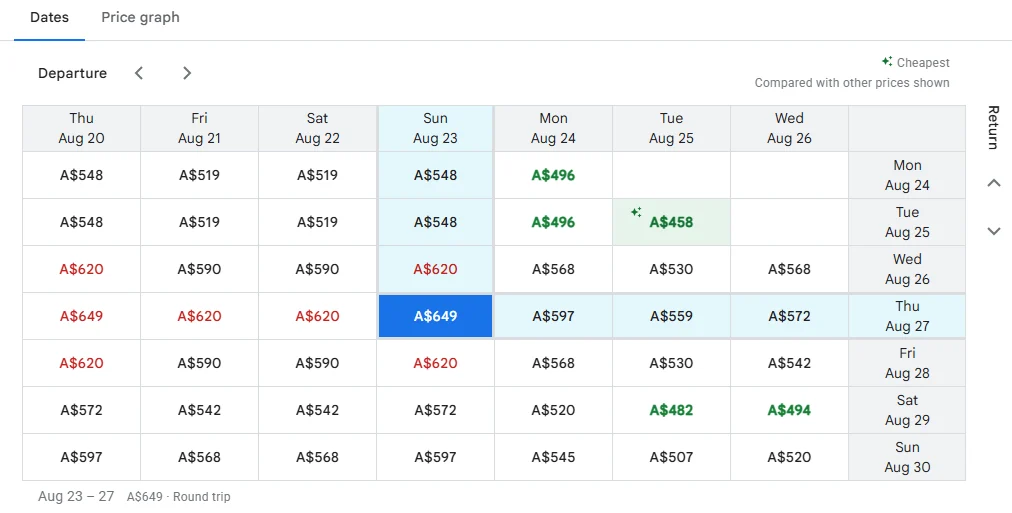 The date grid for a Sydney–Perth return: scan for the cheaper combinations before looking at any individual flight.
Then check the price graph. This is especially useful if you can travel at any point within a month or season, as it shows where the lower-priced periods sit.
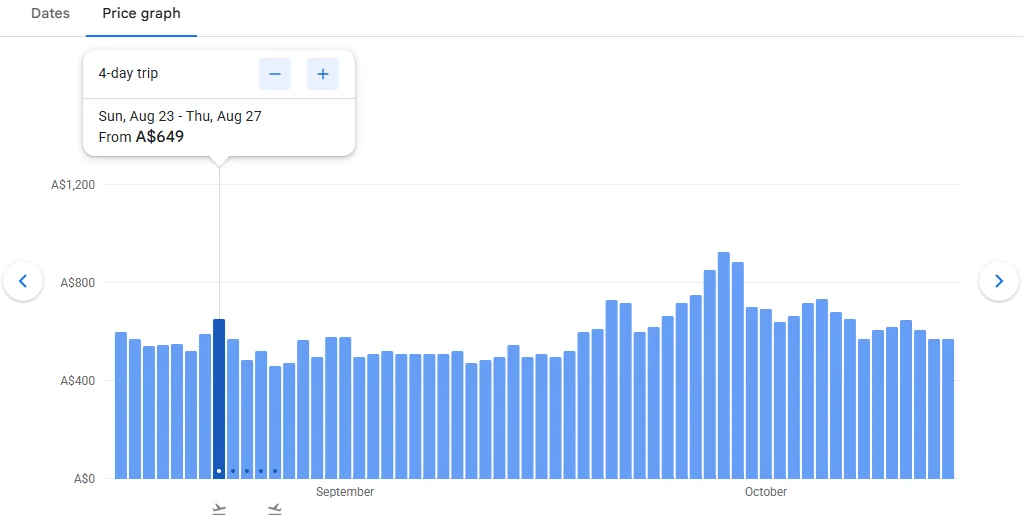 The price graph: the lower-priced periods stand out immediately when your dates are flexible.
Add any nearby airports you would realistically consider at both ends of the trip. Then review Google's typical-price indicator for your preferred dates. It provides a quick indication of whether the current fare is low, typical or high for that route.
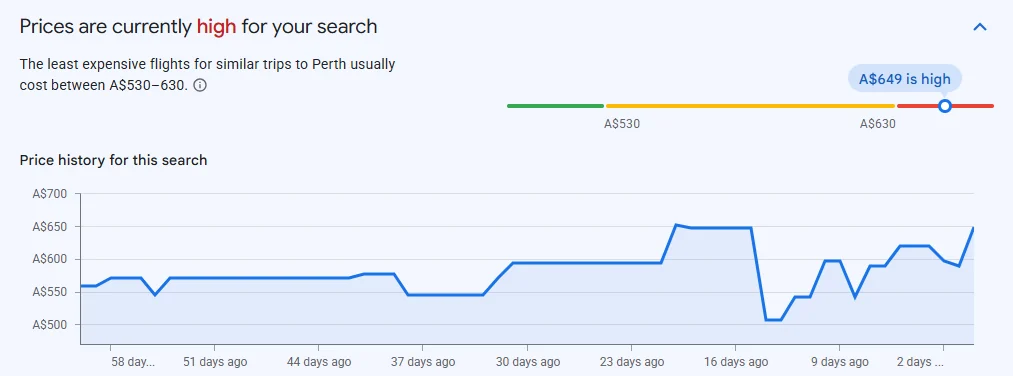 The typical-price indicator: a quick read on whether the fare in front of you is normal for the route.
Finally, turn on price tracking for your preferred dates. Where your travel plans are flexible, also track broader date options so you are notified when a lower fare becomes available.
 Price tracking on: the search now keeps working after you close the tab.
Two limitations are worth noting. Google's Price Guarantee remains limited to eligible US itineraries, so it is not relevant to most Australian bookings. Google's newer Flight Deals tool can be useful when your destination or dates are flexible, but it is still experimental. Use it to identify possibilities, then verify them through the normal search results and the airline's website.
Minutes 10–15: cross-check with Skyscanner
Use Skyscanner to check whether Google Flights has missed a lower fare.
Its whole-month search is useful when your dates are flexible, while Explore everywhere search can show which destinations are cheapest from your home airport during a particular period.
 Explore everywhere search: the cheapest destinations from your home airport, ranked — five well-spent minutes on any flexible trip.
Skyscanner may also surface low-cost carriers and online travel agents that are less prominent in Google Flights. This is often where the lowest advertised price appears, but make sure you compare like with like. Add baggage, seat selection, payment fees and any other charges you expect to incur.
As a general rule, use aggregators to find the fare, then check the price directly with the airline. For a small difference, booking directly is usually worthwhile because schedule changes, cancellations and refunds are generally easier to manage. For a larger saving through an intermediary, decide whether the discount justifies the additional layer of support risk.
Minutes 15–20: test the itinerary structure
Next, check whether changing the structure of the trip produces a better result.
Compare non-stop and one-stop itineraries. A connection can materially reduce the fare on long-haul routes. Compare the saving with the extra journey time rather than rejecting a stop automatically. A $500 saving may be worthwhile for one traveller and poor value for another.
Check the airlines' own websites. Sale fares and bundles do not always appear cleanly in search aggregators, particularly when baggage or other inclusions differ. If an airline has recently been promoting your route or destination, price the itinerary directly.
Use ITA Matrix for complex trips. It remains useful for multi-city itineraries, mixed cabins and searches where you want to force or exclude particular connection points. It does not sell tickets, so once you find a suitable routing, reproduce it through the airline or a reputable travel agent. For a simple return trip, Google Flights and Skyscanner will usually be enough.
For a multi-stop trip, or where several routing strategies could work, our Route Strategist compares the main options for the specific itinerary.
Minutes 20–26: check the alternatives
Only move to the more complicated options if the standard search has not reached your target price.
First, check whether buying separate tickets would reduce the total cost. That might mean positioning to another Australian departure city or combining an Australia–Asia ticket with a separate onward fare.
For premium-cabin travel to Europe, also check whether beginning the long-haul ticket in an Asian city produces a meaningful saving after the positioning flights, accommodation and foreign-currency costs are included.
These strategies introduce additional risk, so do not compare the headline fares alone. Price the entire trip and consider what would happen if the first ticket were delayed. The split-ticketing and ex-Asia sections below explain when these options are worth considering and when they are not.
Finish with a quick check of current airline sales and reputable Australian deal sites. This should be a short sweep, not another full search.
Minutes 26–30: make the decision
Compare the best available itinerary with your target price and make one of three decisions.
At or below your target price: book if the itinerary, baggage allowance and fare conditions suit your needs. Before paying, confirm the final price directly with the airline and check the change and cancellation rules.
Above your target, with time and flexibility remaining: leave price tracking on and set a date to review the fare again. Consider changing the travel dates, departure airport or connection pattern rather than repeatedly running the same search.
Above your target, with fixed dates or peak travel: compare the least expensive acceptable options and consider booking. Waiting is not automatically the better strategy, particularly for school holidays, Christmas travel and routes with limited competition.
The aim is to finish with a decision, not a collection of browser tabs. In about 30 minutes, you should know the current market price, the realistic alternatives and whether to book or keep tracking.
Two ways to use separate tickets
What it is: buying two or more cheaper separate tickets instead of a single, more expensive, through-fare. For travellers departing Australia, there are two main versions:
- using a separate domestic flight to reach a cheaper Australian departure city; and
- combining an Australia–Asia ticket with a separate onward international fare.
Alternative one: position to another Australian departure city
International sale fares are often limited to particular departure cities. A strong fare from Brisbane, Sydney or Melbourne may not be available from Adelaide, Canberra or Hobart, even when inexpensive domestic flights are available on the same dates.
Suppose a Brisbane–Tokyo sale is available for about $670 return, while the through-fare from Adelaide is around $1,100. Adding separate Adelaide–Brisbane positioning flights for about $80 each way brings the total to roughly $830, before allowing for baggage or an overnight stay. That is a saving of about $270 per person.
Compare the full cost of the separate tickets with the through-fare, including baggage, airport transfers and accommodation where required. A positioning flight only makes sense if the remaining saving is large enough to justify the added time and connection risk.
An example of positioning where the maths says no
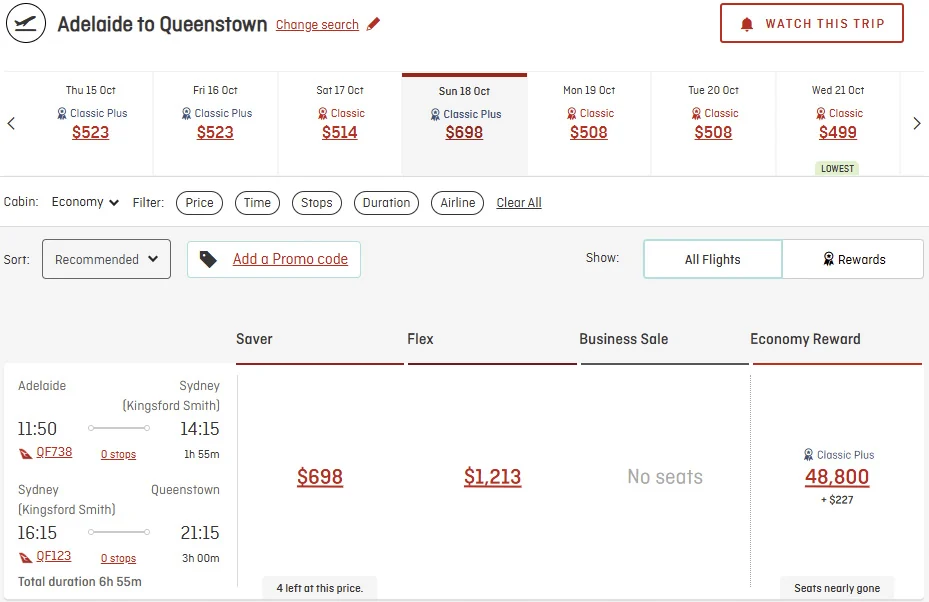
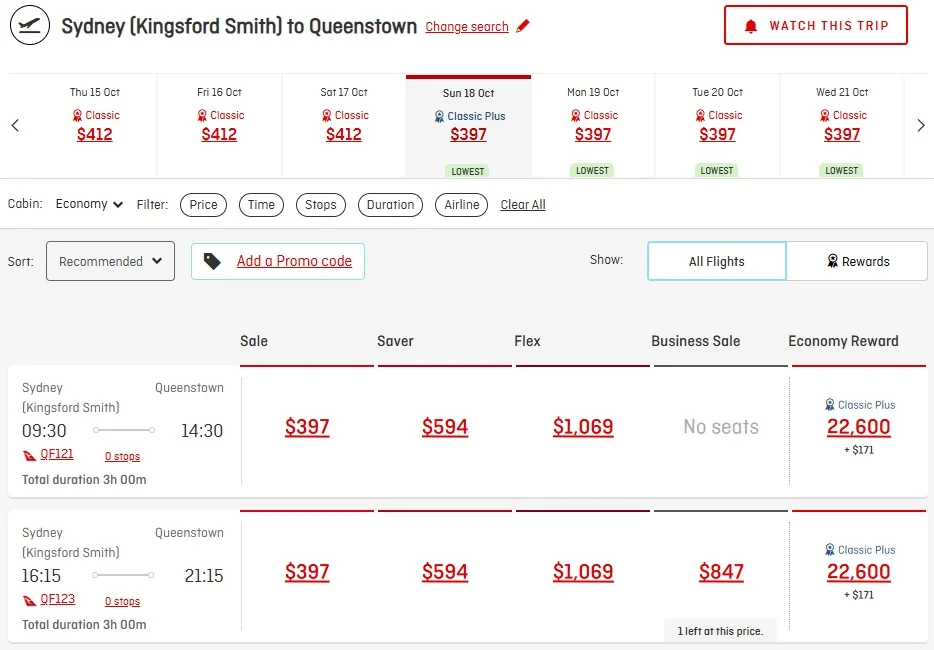
When we checked Adelaide–Queenstown fares for travel on 18 October 2026, the through-fare was $698 one way. Booking the Sydney–Queenstown sector separately cost $397, creating an apparent saving of $301 before the positioning flight was added.
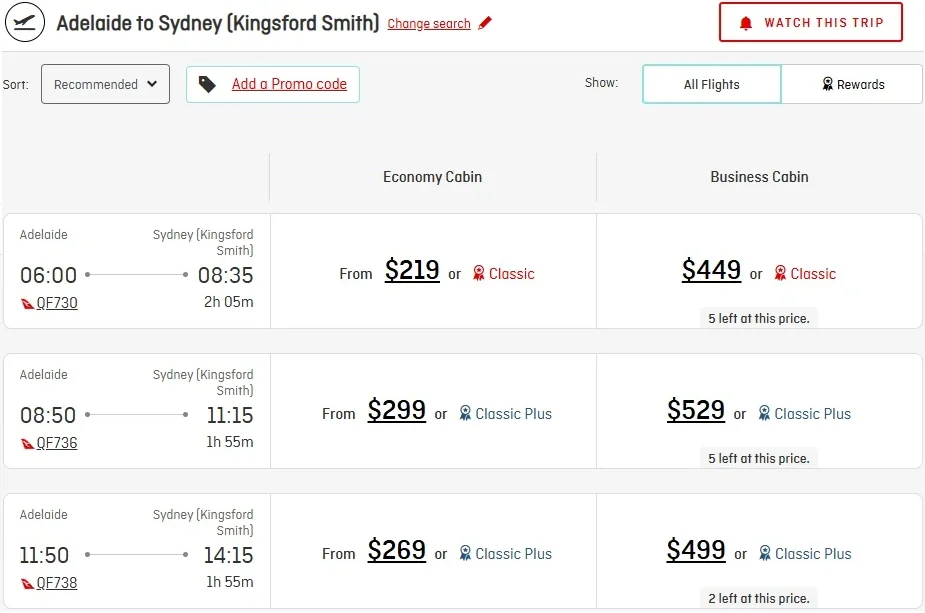
The Adelaide–Sydney flight cost $269 on the same service included in the through itinerary, or $219 on an earlier departure. That brought the total cost of the separate tickets to between $616 and $666, a saving of only $32 to $82.
That is before allowing for baggage fees, additional transfer time and the risk of travelling on separate tickets. It is also well below our $150-per-person threshold (see below), so the option we would recommend in this case is the $698 through-fare.
This is how the check will often end. Split-ticketing is worth testing because it can produce substantial savings, but the full calculation also tells you when the added complexity is not worthwhile.
Alternative two: combining separate international tickets through Asia
The second version is to combine an Australia–Asia fare with a separate onward ticket to Europe or another long-haul destination.
This can work because airlines price fares according to the origin market, local competition and expected demand. As a result, fares beginning in cities such as Singapore, Kuala Lumpur, Bangkok, Jakarta or Manila can sometimes be materially cheaper than equivalent fares beginning in Australia.
This strategy is particularly useful for premium cabin travel to Europe. First and Business Class fares from Asia can be far below the equivalent ex-Australia fare, while relatively inexpensive positioning flights may be available from Australia.
The saving calculation, however, must include the complete journey: positioning flights in both directions, baggage, accommodation, card and foreign-exchange fees, airport transfers and the additional risk created by travelling on separate bookings.
Price the whole trip before comparing it with the ex-Australia fare. If the saving is modest, the protection and simplicity of a single through-fare will usually be worth more.
Important: understand the risks before booking separate tickets
Separate tickets are separate contracts. If the first flight is delayed and you miss the second, the airline operating the onward ticket is generally not required to rebook you.
Your baggage may not be checked through. You may need to clear immigration, collect your bags and check in again, subject to the entry and transit rules of the connecting country.
Travel insurance treatment for missed connections varies. Some policies cover missed connections on separate tickets only in limited circumstances, impose minimum connection times or cap the expenses they will reimburse. Check the policy's Product Disclosure Statement (PDS) rather than assuming you are covered.
Our rules: do not schedule less than four hours between separately ticketed international flights. Consider an overnight stop as it is materially safer. Avoid split tickets for travel to important events or if you need to be somewhere at a fixed start time. Before booking, check the price of a replacement onward fare so you understand the cost if the connection fails.
We would not bother when: the saving is less than about $150 per person, if you are checking bags with a tight connection, or arriving on time is more important than the saving.
Where it works best
This strategy is most useful for First Class or Business Class travel to Europe, particularly where:
- the fare from Asia is substantially below the Australian price;
- you are happy to spend a day or more in the departure city;
- cheap positioning flights are available in both directions; and
- your dates are flexible enough to match a good fare window.
Treat the Asian stop as part of the trip rather than an inconvenient connection. That reduces the connection risk and makes any accommodation cost easier to justify.
An example of ex-Asia where the maths says yes
We ran a comparison for peak Christmas travel from 19 to 28 December, pricing Sydney–London in premium cabins against an itinerary beginning in Manila.
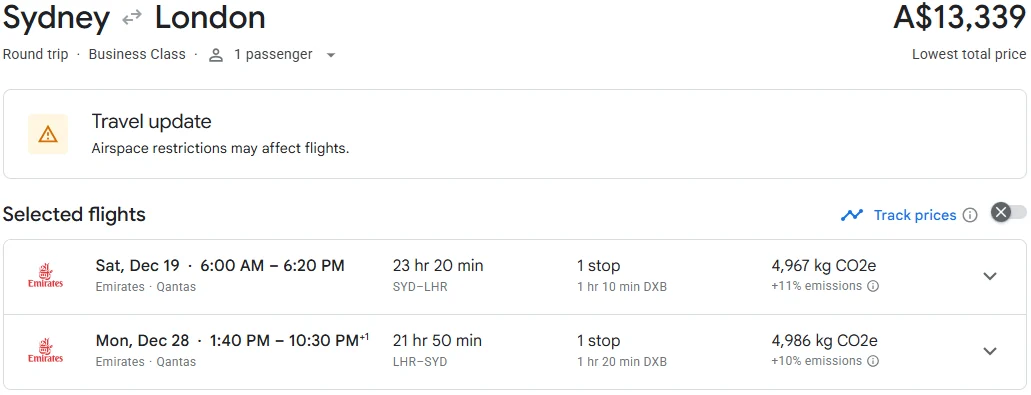
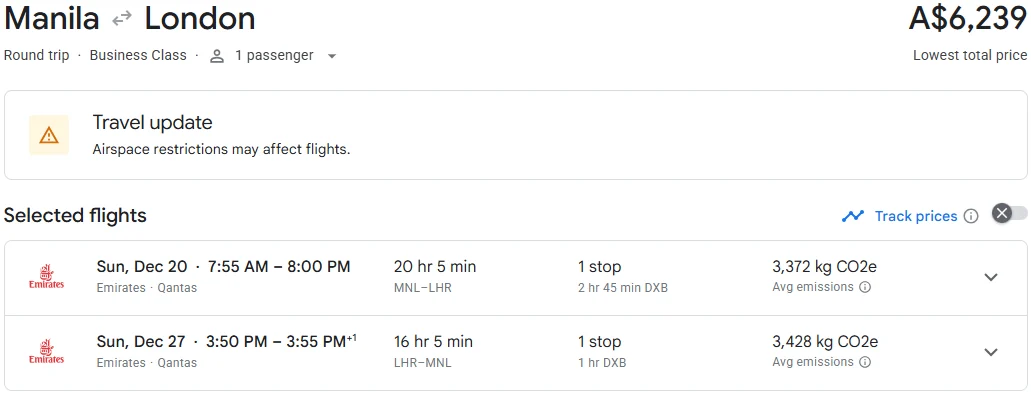
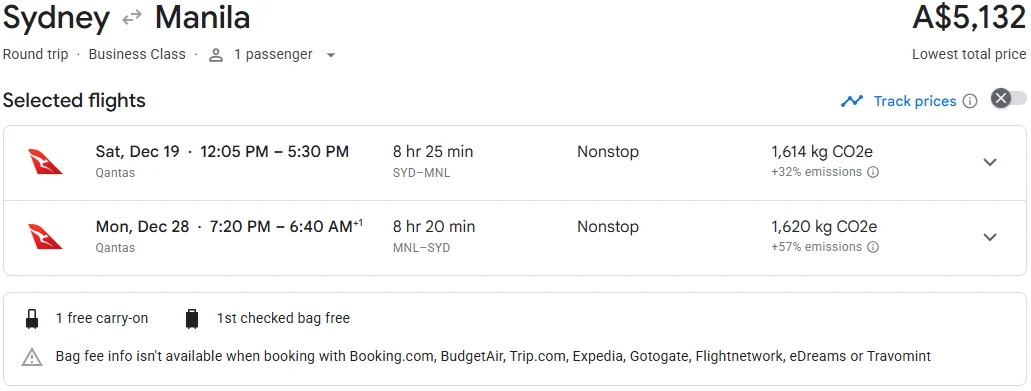
In Emirates Business Class, the Sydney–London through-fare was A$13,339 return. Alternatively, the Emirates Business Class Manila–London fare was A$6,239, while a separate nonstop Sydney–Manila return in Qantas Business Class cost A$5,132. That brought the total cost of travelling via Manila to A$11,371, a saving of A$1,968.
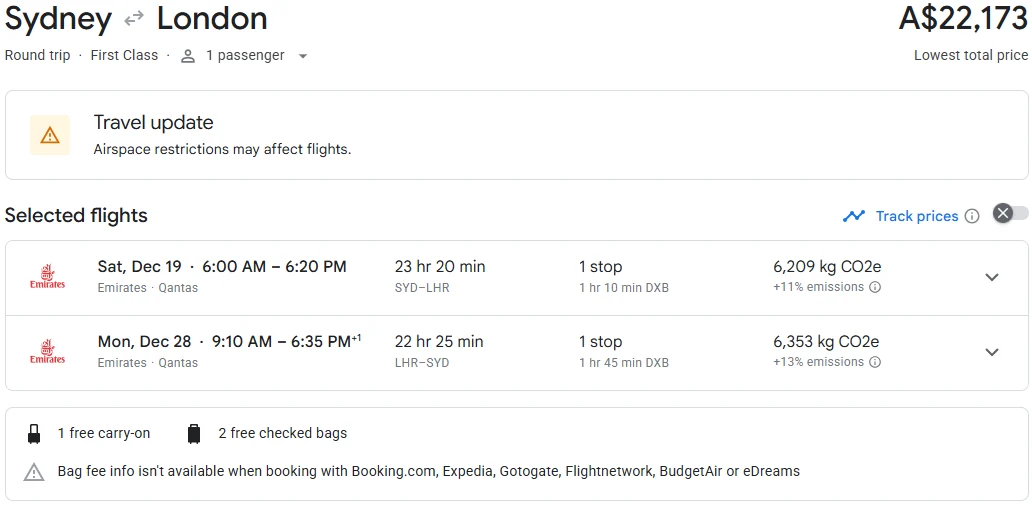
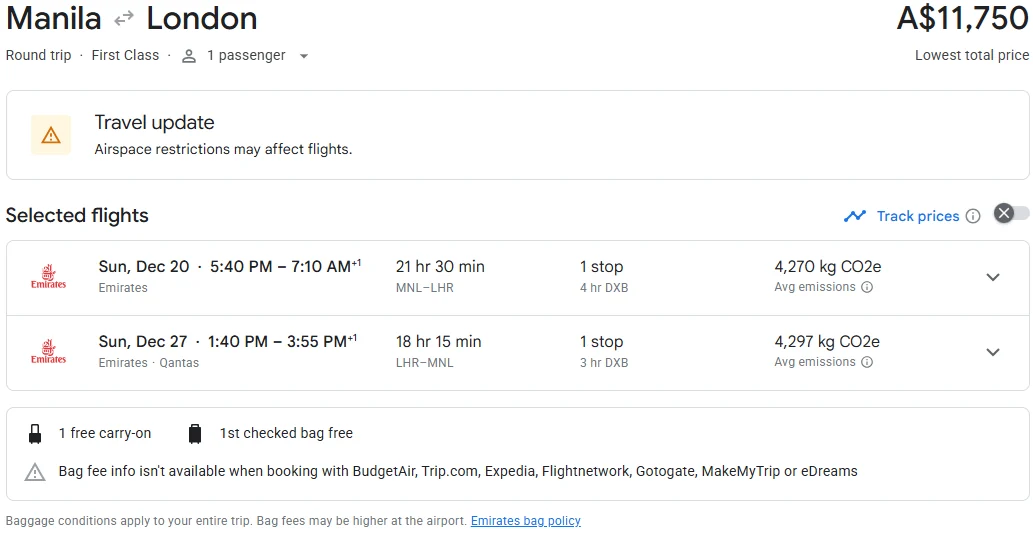
The saving was even larger in First Class. The Emirates First Class Sydney–London through-fare was A$22,173 return, compared with the Emirates First Class Manila-London fare of A$11,750. Adding the same Business Class positioning flights brought the total to A$16,882, a saving of A$5,291.
| Emirates Cabin | Sydney–London through-fare |
Via Manila, including Qantas Business Class positioning |
Saving |
|---|---|---|---|
| Business | A$13,339 | A$11,371 | A$1,968 |
| First | A$22,173 | A$16,882 | A$5,291 |
Two points are worth noting.
First, the saving increases with the cabin price, which is why starting a long-haul ticket in Asia is primarily a premium-cabin strategy.
Second, we priced the Sydney–Manila positioning flights in Business Class to keep the Business Class comparison broadly like for like. Using Economy for the positioning sectors would increase the saving, but at the cost of comfort on an approximately eight-hour flight. In the First Class example, the long-haul ticket is in First, while the positioning sectors remain in Business as First Class is not available on this sector.
Every risk associated with separate tickets still applies. Those risks deserve particular weight during the Christmas peak, when replacement flights may be expensive or fully booked.
The saving is large enough to justify arriving in Manila a day early and paying for a hotel, which materially reduces the connection risk. The trade-off is time: adding an overnight stop shortens the period spent at your final destination. Whether the strategy is worthwhile therefore depends not only on the dollars saved, but on how much of your holiday you are prepared to give up to make the separate tickets work safely.
What the evidence says about timing and sales
There is no consistently reliable best day to book
Expedia's 2026 Australian Air Hacks report found that Thursday was the cheapest booking day in the transactions it analysed, with fares up to 7% lower than bookings made on Saturday.
That is useful evidence, but not a rule that Thursday will always produce the lowest fare. The nominated day changes between reports, markets and years. Google's US-based analysis has also found only a small difference between weekday and weekend bookings.
The practical lesson is to search when you are ready to book rather than waiting for a particular day of the week. Your route, travel dates and flexibility usually matter far more.
There is no universal booking window
Published studies disagree on the ideal time to book, and much of the available data is based on US departures or bookings made through a particular platform.
For long-haul travel from Australia, start tracking fares several months ahead. Begin earlier for Christmas, school holidays, major events and routes with limited competition.
Comparing the ticket price to the route's normal price range is more useful than a universal rule. Once a suitable fare reaches your target, there may be little value in waiting for a theoretical sweet spot.
Seasonality matters more than most booking tricks
Moving the trip can save more than changing the way you search.
Europe is generally more expensive during the Australian winter, the European summer and the Christmas period. Travel during February and March or October and November is often cheaper, subject to school holidays and major events.
Having flexibility in the timing of your trip is likely to have a much greater effect on price than booking on a different weekday or checking another comparison site.
Sales are frequent and short
The table below shows promotions available in the months before this guide was checked. The fares are included to illustrate how often sales appear and the level of discount available, not as a list of current deals.
The most recent example was Qantas' International Red Tail Sale, launched on 28 July and scheduled to end at 11.59pm AEST on 4 August 2026, unless sold out earlier. It covered destinations across the Americas, Asia, Europe and beyond, with selected return Economy fares including Sydney–Los Angeles from $999, Sydney–Bali from $699 and Sydney–London from $1,898.
| Seen in 2026 | Promotion | Sample fares |
|---|---|---|
| July | Qantas International Red Tail Sale | Sydney–Los Angeles from $999 return; Sydney–Bali from $699; Sydney–London from $1,898 |
| July | Jetstar Weekend Fare Frenzy | Selected domestic one-way fares from $38 to $92 |
| July | Virgin Australia Happy Hour | Selected domestic one-way fares from $45 |
| July | Emirates featured fares | Australia to Europe from about $1,899 return |
| June | Qantas mid-year domestic sale | Selected one-way fares below $150 |
| May–July | Jetstar Japan and Korea promotions | Brisbane or Sydney to Tokyo from about $670 return; Sydney to Seoul from about $359 |
| May–July | Jetstar Return for Free | Melbourne to Bali from about $219 return |
The useful pattern is not that one airline is always cheapest. It is that major airlines and low-cost carriers run promotions regularly, often with narrow booking periods and limited availability at the lowest prices.
You cannot make a sale appear when you need it. What you can do is set a price alert, know the fare at which you are prepared to book and act when a suitable promotion appears.
The five-minute weekly alternative: alerts and deal sites
The 30-minute method shows you the best price available today. Price alerts and deal sites help you catch fares that appear later.
Turn on Google Flights tracking for any trip you are seriously considering. Once a week, skim a small number of Australian deal sources rather than repeating the full search:
- I Know The Pilot;
- OzBargain's travel section;
- Beat That Flight; and
- Secret Flying, which publishes global mistake fares.
Avoid following so many sources that every promotion begins to look urgent. Most sales are not relevant to your route, dates or baggage needs.
Don't treat mistake fares as locked-in
A mistake fare is an erroneous price published because of a currency, filing or system error. Airlines sometimes honour them, but they may also cancel the ticket, offer an alternative or provide a refund.
The 2024 Qantas First Class pricing error is a useful example. Qantas did not provide the originally ticketed First Class travel, but offered affected passengers Business Class at the mistaken price or a refund.
Our approach is simple:
- book directly with the airline where possible;
- do not contact the airline to ask whether the fare is a mistake;
- avoid making non-refundable accommodation, positioning flight or activity bookings around it; and
- treat the itinerary as uncertain until the airline confirms or operates it.
A refund does not necessarily leave you in exactly the same position. Card holds, exchange-rate movements and arrangements made in reliance on the fare can still cost money.
When our methods may not be worth running
Fixed peak dates
If you need to fly from Sydney to London immediately before Christmas, or to Bali during the busiest school holiday period, the available market may simply be expensive.
Start early, compare the acceptable options and book when the fare is reasonable for those dates. Repeating the same search will not create cheaper flights.
Very cheap domestic trips
For a fare below about $150, spending additional time to save another $20 may not be worthwhile. Run a quick Google Flights or airline-site check, confirm the baggage cost and make a decision.
Complex multi-country itineraries
Manual searching becomes less reliable once the trip includes several destinations, open-jaw sectors, mixed cabins or competing route strategies.
Use our Route Strategist, ITA Matrix or an experienced travel agent where the complexity justifies it.
Trips where points may be better
A cash fare search cannot tell you whether 90,000 points represents better value than a $1,400 fare. That requires a separate comparison of points, taxes, availability and the value of keeping the points for another trip.
When you are checking the same fare every day
Once Google Flights price tracking is active, repeatedly running the same search is usually wasted time. Check again when the alert fires, when your plans change or when you reach a decision date you set in advance.
There is no strong evidence that an airline raises the fare simply because the same person searched for it previously. Prices move because inventory, demand and fare availability change.
What to do next
Run the sequence on your next real trip, even if you are still several months away from travelling. An early search gives you a baseline and makes later sale prices easier to recognise.
Before you begin, set your target using our 2026 route benchmarks. When you finish, download the one-page checklist so you can repeat the process without reopening this guide.
Thirty minutes should be enough to understand the market and make a decision. That is how to find cheap flights from Australia consistently.
Methodology and last checked
The fares and product details in this guide were checked on 28 July 2026, with the main tools, sources and link targets checked on 25 July 2026.
The historical sale examples were drawn from airline sale pages, airline announcements and dated posts from Australian deal-tracking sites between April and July 2026. Those fares have expired and are included only to show the frequency and range of recent promotions. The Qantas International Red Tail Sale was live when this guide was last checked.
The discussion of booking days and timing draws on Expedia's 2026 Australian Air Hacks report and published Google Flights analysis. The studies use different markets, time periods and booking datasets, so we treat their findings as indicative rather than universal rules.
Ex-Asia premium-cabin fares were checked against live fare windows in July 2026. We did not find sufficiently consistent evidence that ex-Asia economy fares remained cheaper after positioning costs, which is why the strategy is presented primarily as a premium-cabin option.
Travel insurance cover for separate tickets varies by insurer and policy. Always check the current PDS, minimum connection requirements and benefit limits.
Google Flights Price Guarantee remained limited to eligible US itineraries when checked in July 2026. ITA Matrix remained available as a search tool but did not sell tickets directly.
We review this guide quarterly. Material changes are recorded in the Program Change Log.
Fares and availability change frequently. Check the final price, baggage allowance, fare conditions, entry requirements and connection arrangements before booking.