Guides · Points
How to find Qantas Classic Reward seats in 2026
Premium Qantas Classic Reward seats now appear in batches and close to departure. Learn which partners open earlier, how to use the Flight Reward Finder and how to search more effectively.
By Rewards That Fly · Updated 4 September 2026 · 18 min read
Classic Reward seats do exist. The harder part is that the old advice to simply book at the 353 day mark when seats are often released is no longer enough, particularly for premium long-haul travel on Qantas.
Qantas can still make reward bookings available up to 353 days before departure, with access varying by status. But Business and First Classic Rewards on many popular Qantas-operated international routes are no longer released consistently when the schedule opens. They can instead appear in batches, often much closer to departure.
Partner airlines behave differently. Some still make premium reward seats available close to a year ahead, while others release them in waves or only at short notice.
That changes the search strategy.
If your dates are fixed, particularly around school holidays or another event, start with partners that make seats available well in advance. If you specifically want Qantas-operated Business or First, flexibility and repeated checking matters more. Use the Flight Reward Finder for the broad search, alerts for the ongoing monitoring, and the live Qantas booking flow before treating any seat as yours.
The hard part of a premium redemption is often not the points, but finding a seat you can actually book.
What our searches show
We queried the Qantas Flight Reward Finder on 2 September 2026 for two routes that readers regularly ask about.
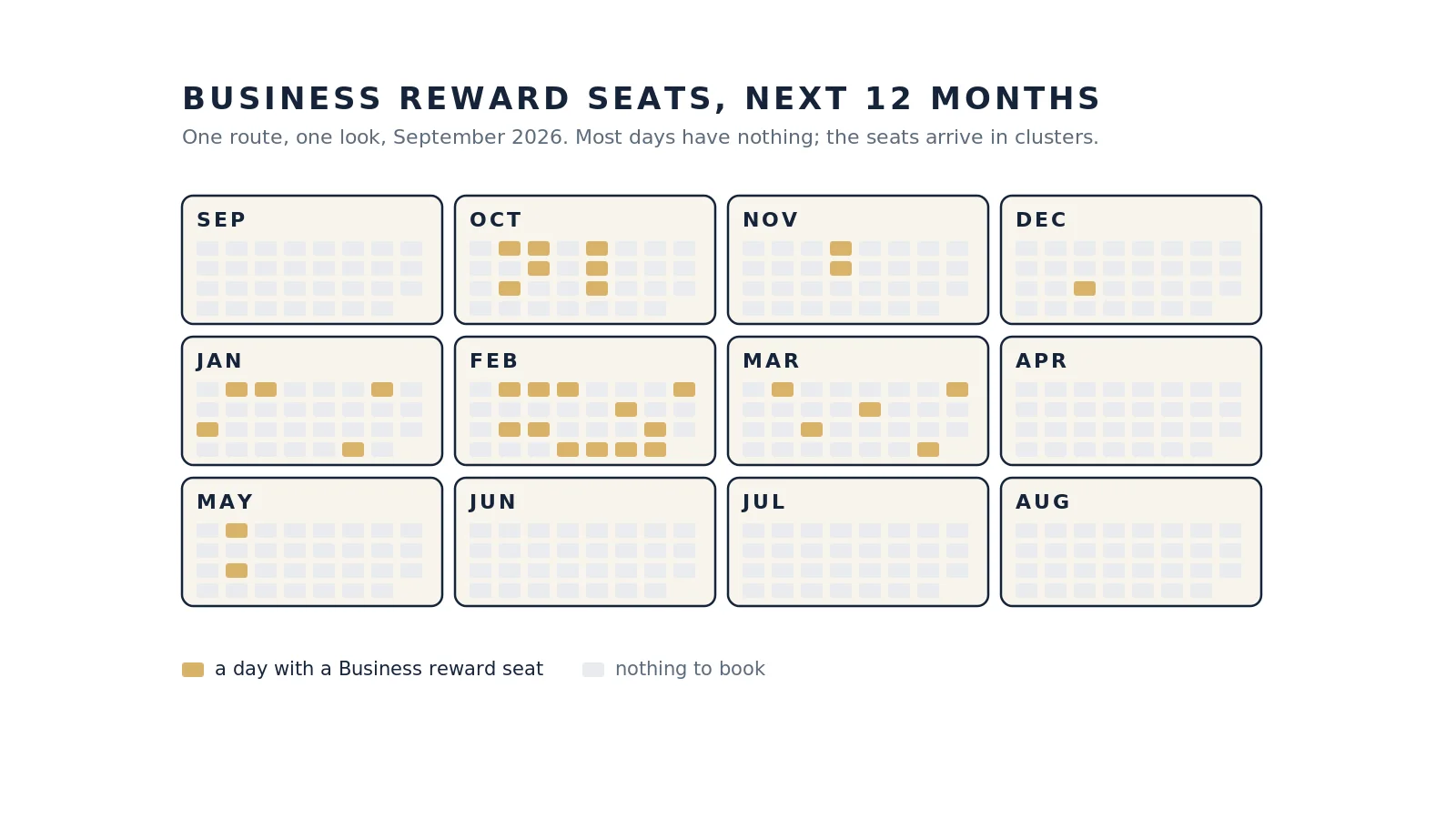
Perth to Paris showed Business Classic Reward availability on only five days across the following twelve months.
Sydney to Johannesburg was much better, with Business availability on 34 days, including twelve days in February. Four entire months showed no Business availability at all.
Our separate nightly watch across 17 premium international routes also shows how different the market looks depending on the airline and departure horizon.
On 2 September 2026, Business availability was visible on about:
- 10% of the route and date combinations we monitored inside the next three months; and
- 29% beyond the next three months.
That does not mean seats become easier to find the further ahead you search.
The longer-dated results are heavily influenced by partner airlines that release inventory earlier. Qantas-operated premium seats are more likely to appear irregularly and closer to departure.
The practical distinction is important:
Choosing partner airlines can provide the planning certainty. Qantas provides opportunities when a release appears.
Why the 353-day strategy is no longer enough
Qantas still allows Classic Flight Rewards to be booked up to 353 days in advance.
Access to some Qantas-operated reward seats also remains tier-dependent. Bronze members generally gain access later than Silver, while Gold, Platinum and Platinum One members can receive earlier or preferential access to selected Qantas reward inventory.
Historically, that made the opening of the booking calendar one of the most important times to search. Premium seats could appear when a flight first went on sale, with access progressively widening to lower status tiers.
That model has become much less reliable for long-haul premium cabins.
Qantas does not consistently release Business and First Classic Rewards on its own international flights when the schedule opens. Instead, premium availability can appear later in batches, sometimes across a run of dates and sometimes only close to departure.
That does not make the 353-day horizon irrelevant. It means:
- check it if you have access;
- do not assume an empty result at 353 days means the route is lost for the year; and
- do not make it your only search strategy.
A seat may appear months later.
Status can still help
The Flight Reward Finder itself does not reflect all status-based availability because it is not linked to your Qantas Frequent Flyer login.
A logged-in Gold, Platinum or Platinum One member may therefore see additional Qantas-operated Classic Rewards through the standard Qantas booking search.
Platinum and Platinum One members can also request the release of additional Classic Reward seats on selected Qantas-operated flights, subject to Qantas' availability and revenue-management rules.
If you hold higher status, use both the Finder and a logged-in Qantas search rather than assuming they will always show the same result.
Batch releases and Points Planes
Qantas increasingly uses targeted releases rather than relying only on predictable schedule-opening inventory.
Sometimes these are unannounced batches. A route that showed almost no premium availability can suddenly show several dates.
Qantas also uses Points Planes, where every available seat on a designated flight can be booked as a Classic Flight Reward. These releases can create unusually good opportunities because the normal scarcity of premium reward seats is temporarily removed. Qantas maintains a dedicated Points Planes page. As at 4 September 2026, no current Points Planes were listed, but it is worth checking whenever you are actively planning a redemption.
The broader lesson is that premium inventory is no longer something you can search once and forget.
The Flight Reward Finder: useful, but not live availability
Qantas launched the Flight Reward Finder in March 2026 to make international Classic Rewards easier to find across Qantas, Jetstar and around 30 partner airlines.
It is now the best starting point for a broad international search. Using the Flight Reward Finder you can:
- search a specific route or an entire region;
- search up to twelve months at once;
- view availability by cabin;
- filter by number of stops;
- search for up to five seats; and
- compare different travel periods without opening each date individually.
For example, instead of searching Sydney to London one day at a time, you can search Australia to Europe and see where Business availability exists across the year.
That is far more useful for discovering an itinerary you had not originally considered.
The results are cached
The Finder does not perform a new live booking search every time you load the page. Each result carries a Last Checked time. In our own use, those timestamps have ranged from very recent to several hours old. A seat shown in the Finder may therefore have been booked by someone else since the last check.
Therefore, treat every result as a lead, not a confirmed booking.
Once you find something suitable, use the availability check and confirm the seat through qantas.com before moving points, booking positioning flights or making other non-refundable arrangements.
It only searches international rewards
The Flight Reward Finder is designed for international Classic Rewards.
For domestic Qantas rewards, use the standard Qantas booking search with the Rewards option selected.
It does not show Classic Plus
The Finder focuses on fixed-price Classic Rewards rather than filling the results with Classic Plus inventory that tracks the underlying cash fare.
If you want to compare Classic Plus with cash, use our Points Valuations and Qantas Frequent Flyer guide.
There is still no airline filter
As at September 2026, the Finder does not let you filter results by operating airline.
That can matter on broad searches.
An Australia-to-Europe Business search may return a large number of Emirates options when what you actually want is Japan Airlines, Finnair or Malaysia Airlines.
You can narrow the airports and connections to reduce the noise, but the lack of a direct airline filter remains one of the tool's main limitations.
It does not show all status-based availability
The Finder is not connected to your Qantas Frequent Flyer login. Its results therefore reflect availability accessible without higher-tier preferential access.
If you hold Qantas status, particularly Gold or above, repeat promising searches through the standard logged-in Qantas booking flow.
There are no built-in alerts
The Finder is excellent for discovery but does not continuously monitor a route for you. That matters because batch releases can appear between searches.
Rewards That Fly currently monitors 17 high-value premium routes each night through the Finder and includes notable openings in our Flight & Reward Alerts. Join the list if one of those routes is relevant to you.
For broader monitoring, third-party tools such as Seats.aero and AwardFares can also provide reward-seat alerts.
The process is:
Finder for discovery, alerts for monitoring, qantas.com for confirmation.
Which partners release seats early?
There is no universal release calendar.
Airlines control their own reward inventory, and those patterns can change without notice. The table below should therefore be treated as a planning guide rather than a promise.
| Airline | Recent Qantas reward availability pattern | How to use it |
|---|---|---|
| Japan Airlines | Can release premium seats near the opening of the schedule, but Australia–Japan Business availability has been less consistent in 2026 | Check early, but do not assume a year-out seat will appear every day |
| Finnair | Finnair opens its own award calendar around 360 days out and guarantees minimum award inventory on many flights; Qantas partner access can still vary | One of the better airlines to check early for Europe via Helsinki |
| Malaysia Airlines | Often makes inventory available well in advance and has released substantial Australia–Kuala Lumpur Business availability during 2026 | Strong candidate for fixed-date travel to Asia or onward to Europe |
| China Airlines | Has historically released partner inventory well in advance | Worth checking early for Taipei and onward connections |
| Fiji Airways | Premium reward seats can appear close to a year ahead, including Australia–Nadi and onward US routings | Useful for Pacific and North American itineraries |
| Philippine Airlines | New Qantas partner from May 2026; there is not yet enough history for a reliable release pattern | Search it, but do not build a strategy around an assumed release date |
| Qantas | Premium long-haul inventory is increasingly released in irregular batches rather than consistently at schedule opening | Flexibility and repeated checking matter |
| American Airlines | Premium Australia–US availability often appears closer to departure | Useful for flexible US travel rather than fixed-date planning |
| Emirates | Additional Business and First inventory often appears close to departure | Better for flexible or last-minute travel |
| Cathay Pacific | Premium partner availability is sporadic and can appear several months or weeks out | Check periodically rather than relying on one release date |
| United and Hawaiian | Premium partner inventory has tended to appear in batches closer to departure | Opportunistic rather than highly predictable |
| Qatar Airways | Business and First rewards made available to Qantas members are generally extremely close to departure | Not a practical basis for fixed-date planning |
This leads to a simple distinction.
If your dates are fixed
Start with airlines that give you a realistic chance of booking well in advance.
For example:
- Malaysia Airlines or Finnair towards Europe;
- Japan Airlines or other Asian partners towards Japan and Asia;
- Fiji Airways across the Pacific.
Then keep watching Qantas.
If a better Qantas-operated seat appears later, you can decide whether changing the booking is worthwhile.
If your dates are flexible
The close-in market becomes much more useful.
Someone who can travel on several dates over the next six weeks has access to opportunities that simply do not exist for a traveller who needs one particular Saturday in the school holidays.
Flexibility in date, airline and connection point is often more valuable than another 50,000 points in the account.
A six-step Classic Reward search process
One: search each direction separately
Start with one-way searches.
Qantas prices most Classic Flight Rewards as one-way Trips, and separating the outbound and return makes it easier to mix airlines and availability.
For example, you might find:
- Japan Airlines outbound and Qantas home;
- Malaysia Airlines to Europe and Finnair back; or
- a Business reward in one direction and Economy in the other.
If you book the directions separately, you also gain some flexibility to change one without necessarily disturbing the other.
Check the final points, taxes and conditions before booking because different routings can produce different totals.
Two: break a difficult journey into useful sectors
A through-search can miss combinations that become obvious when you search the component sectors.
Instead of searching only:
Sydney to London
also try:
Sydney to Singapore
Singapore to London
or:
Sydney to Kuala Lumpur
Kuala Lumpur to London
or:
Sydney to Tokyo
Tokyo to Europe
This does not mean the final points price is simply the sum of the individual sector prices.
Qantas calculates Classic Rewards using its definition of one-way trips, including the total distance and airlines involved. Once you find workable sectors, assemble the itinerary in the multi-city search or through Qantas and confirm the final points requirement before booking.
The purpose of splitting the search is to expose availability that a through-search may not surface clearly.
Three: monitor rather than repeatedly starting from zero
If the seat is not available today, decide whether the route is important enough to monitor. For the routes we cover, Flight & Reward Alerts can do part of that work.
For other routes, third-party alert services can monitor reward inventory continuously.
The batch-release model rewards persistence, but the persistence does not have to be manual.
Four: consider a backup on travel you cannot miss
If your dates are fixed and you need to travel regardless, securing an acceptable fallback can reduce the pressure on the premium search. That could mean:
- an Economy Classic Reward;
- a good cash fare; or
- a different partner itinerary.
A Classic Flight Reward cancellation currently costs 6,000 Qantas Points per passenger, so a backup reward is not costless. But on an important trip, the flexibility to secure travel now and change course if Business appears later can be worth considering. Do not make a backup booking you would be unhappy to use.
Five: use the Qantas contact centre where it adds something
Some multi-sector and partner itineraries are easier to construct by phone than online. A Reward Assistance Fee normally applies to Classic Reward bookings completed through Qantas Contact Centres, although fee waivers and other treatment can depend on your status and circumstances.
Platinum and Platinum One members should also be aware of their ability to request additional Classic Reward seats on selected Qantas flights.
Use the phone where it provides access or functionality you cannot obtain online, rather than as the first step for every search.
Six: make flexibility part of the search
Premium reward availability is generally better when you can move:
- the travel date;
- the departure city;
- the connection point;
- the airline; or
- the direction in which you use points.
The difference between "Sydney to London on 18 December" and "Australia to Europe sometime in November" is enormous.
Start broad, then narrow the itinerary once you know where the seats are.
Corridor guide
Japan
Japan remains one of the more workable premium Qantas Points destinations because there are several airline options.
Japan Airlines is worth checking early, although its Australia–Japan Business release pattern has been less consistent during 2026 than the traditional year-out strategy suggests.
There is also an important pricing difference.
Under the current tables:
- Sydney–Tokyo Business on Qantas: 98,400 Qantas Points one way; and
- Sydney–Tokyo Business on Japan Airlines: 108,000 Qantas Points one way.
The partner award costs 9,600 more points, but an available seat can be more useful than a cheaper Qantas reward that cannot be booked.
The strategy is therefore:
Check JAL early, keep watching Qantas, and choose the seat that works when it appears.
Europe
Europe is a harder case.
Qantas-operated Business Classic Rewards to London and much of Western Europe are valuable when available, but premium inventory can be difficult to plan around.
Sydney–London Business currently requires 166,300 Qantas Points one way, plus taxes and carrier charges. Our recent Qantas capture showed around $648 in charges one way.
For fixed dates, partner airlines can be more useful.
Malaysia Airlines via Kuala Lumpur and Finnair via Asia or Helsinki are both worth searching early. The final Qantas Points requirement depends on the complete itinerary, distance and partner table, so price the full trip rather than relying on a single-sector example.
If no sensible reward exists, compare the points strategy with a cash Business fare or an ex-Asia itinerary.
The Route Strategist is designed for exactly that comparison, while Points Valuations provides the benchmark value of the points you would use.
United States
The US has opportunities but requires flexibility.
Qantas premium seats can appear in batches, while American Airlines has often released partner-accessible Business inventory closer to departure.
Fiji Airways can provide another route via Nadi, while Philippine Airlines adds a newer option via Manila.
Do not build your entire plan around one airline. Search the destination from several gateways and allow the available reward seat to determine the routing.
New Zealand and shorter international routes
Trans-Tasman and shorter international routes are generally easier.
Sydney–Auckland Business on Qantas requires 43,600 points one way, and reward availability is usually less constrained than on the marquee long-haul routes.
When to stop searching for one particular seat
A good reward strategy also requires knowing when to move to the next option.
Fixed peak dates to Europe on Qantas Business
If you need Qantas-operated Business on one exact peak-period date, the release model is working against you. Keep the alert running, but secure an acceptable alternative rather than allowing the entire trip to depend on a batch release that may never arrive.
Qatar Airways using Qantas Points
Qatar Business and First availability for Qantas members has generally been released only very close to departure. That can be useful for a flexible last-minute traveller, but it is not a sound basis for planning school holidays or fixed annual leave several months ahead.
Velocity has a materially different relationship with Qatar Airways, which we cover in our Velocity Frequent Flyer guide.
The Finder shows nothing and your dates cannot move
At some point the relevant comparison is no longer another reward search. It is considering:
- Classic Plus;
- a cash fare;
- a different airline or routing; or
- changing the trip.
Classic Plus provides much broader availability but at a points price linked to the cash fare. In our recent captures it has produced around 0.9c per point in Economy and 1.25c in premium cabins, below the stronger Classic Reward outcomes in our Points Valuations.
Compare it with the cash fare before redeeming.
You are accumulating points for a trip you are unwilling to book flexibly
Qantas Points have experienced several redemption changes since mid-2025, and future pricing is not guaranteed.
That does not mean points should be spent badly simply to get rid of them, but it does mean that a large balance without a realistic redemption plan can lose purchasing power over time.
The objective is not accumulating a large points balance but is using your points for a reward seat you actually want to fly.
What to do next
Start with one target trip and write down:
- where you want to go;
- the cabin you want;
- how flexible your dates are;
- how many seats you need; and
- which partner airlines you would genuinely be willing to fly.
Then classify the search.
If your dates are fixed, start with airlines that release inventory well in advance and secure a workable option when you find it.
If your dates are flexible, search the Flight Reward Finder broadly, then monitor the route for later Qantas and partner releases.
Use one-way and sector-by-sector searches to expose more combinations, but price the final itinerary before committing.
If the trip matters and you find an acceptable backup, consider securing it rather than leaving yourself with nothing while you wait for a perfect Business seat.
Join Flight & Reward Alerts for the premium routes we monitor, and use a third-party alert service where your route falls outside our current coverage.
Finally, compare any Classic Plus or cash alternative against the Points Valuations benchmark before using a large points balance simply because no Classic Reward appeared.
Classic Reward availability is difficult, but it is not random in the sense that nothing can be done about it.
The useful strategy is to know which airlines to search early, which to watch close-in, how broad your search should be and when to take the good seat in front of you.
Methodology and last checked
This guide was rechecked on 4 September 2026.
Our first-hand availability evidence includes Flight Reward Finder searches conducted on 2 September 2026. Perth–Paris showed Business availability on five days across the following twelve months. Sydney–Johannesburg showed Business availability on 34 days and First on 17 days. We also retain a nightly monitoring dataset across 17 premium international routes. On 2 September, Business availability appeared on about 10% of the route/date combinations monitored inside the following three months and 29% beyond that period.
Flight Reward Finder functionality was checked through direct use and current Qantas material. The tool searches international Classic Flight Rewards across Qantas, Jetstar and participating partner airlines over a twelve-month window. Results are cached and carry a Last Checked timestamp; availability should be confirmed through the live Qantas booking flow. The Finder does not currently search domestic rewards or Classic Plus and does not provide an airline filter or built-in alerts.
Qantas currently permits Classic Flight Reward bookings up to 353 days before departure, with access to selected Qantas-operated inventory varying by status. The historical 353/323/297-day access pattern remains relevant to tier-based availability, but long-haul premium Qantas seats are no longer released consistently at the opening of the schedule. Release-pattern commentary is based on current Rewards That Fly observations and Australian Frequent Flyer availability audits and strategy reporting.
Partner release patterns are tendencies rather than guaranteed schedules. Malaysia Airlines, Japan Airlines, China Airlines and Fiji Airways have historically made some reward inventory available close to a year ahead, while 2026 evidence shows that individual routes can vary materially. Finnair opens its own award calendar 360 days before departure and guarantees minimum award inventory on many Finnair flights, although partner access through Qantas can differ.
Current Qantas Classic Reward pricing was rechecked against the post-5-August-2025 tables. Examples used in this guide include Sydney–Tokyo Business at 98,400 Qantas Points on Qantas and 108,000 on Japan Airlines, Sydney–London Business at 166,300 on Qantas and Sydney–Auckland Business at 43,600.
The current Flight Reward cancellation fee is 6,000 Qantas Points per passenger. Qantas Contact Centre Reward Assistance Fees may also apply to assisted bookings. Higher-status members can receive preferential access to selected Qantas Classic Rewards, and Platinum and Platinum One members may have additional options to request reward-seat releases on selected Qantas-operated flights.
Points Planes are flights where all available seats can be booked as Classic Flight Rewards. Qantas maintains a dedicated Points Planes page; no current Points Planes were listed when checked on 4 September 2026.
Reward availability is inherently perishable. Every release pattern in this guide is an observed tendency, not a promise. Confirm the seat, points requirement, taxes and booking conditions with Qantas before transferring points or making non-refundable arrangements. We recheck this guide quarterly and after material changes to Qantas reward availability.