Guides · Points
Qantas Frequent Flyer in 2026: where your points go furthest
Compare Qantas Classic Rewards, Classic Plus, upgrades, Points Plus Pay and more, with 2026 redemption values and worked examples.
By Rewards That Fly · Updated 16 August 2026 · 18 min read
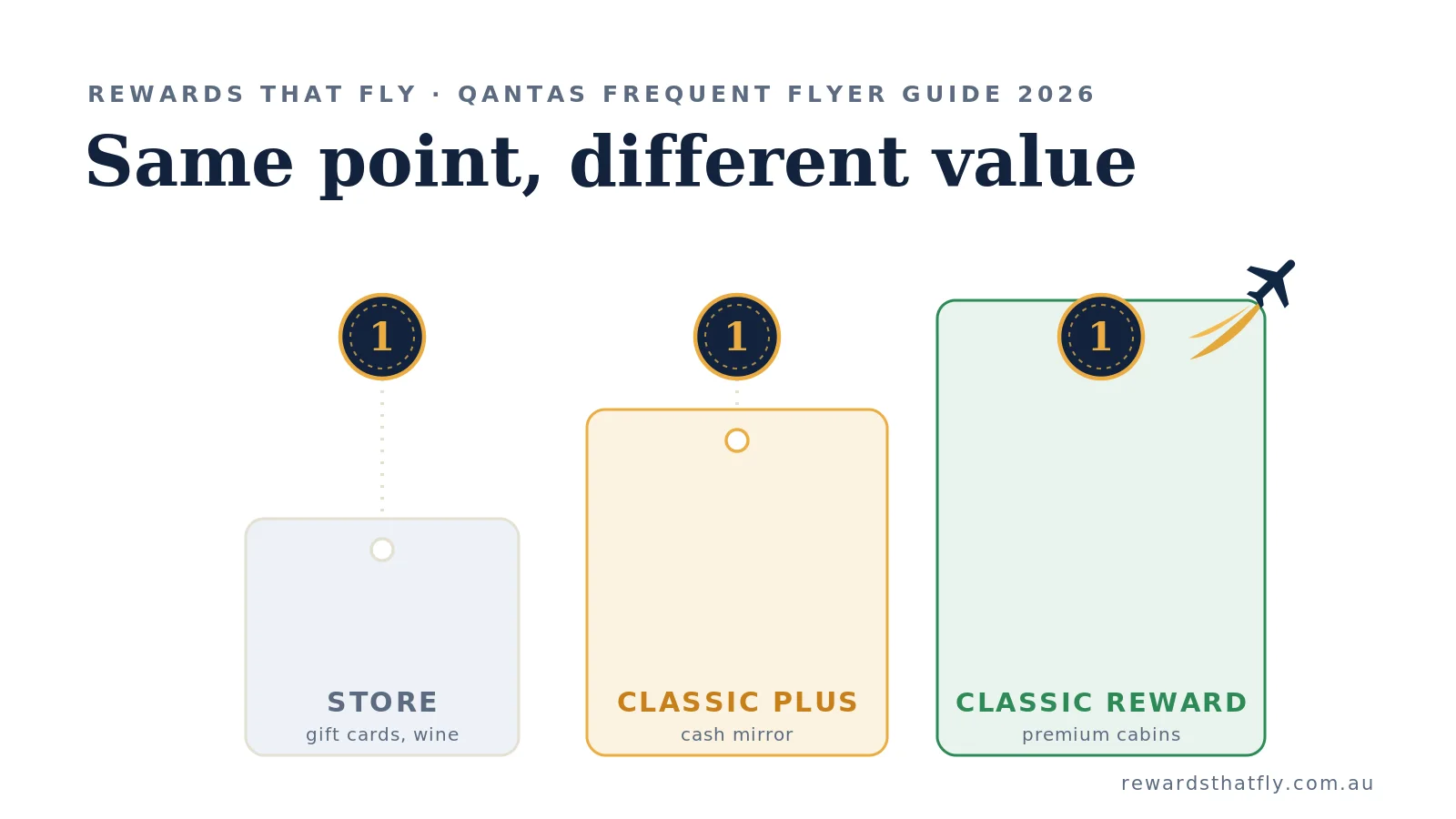
Qantas Points can be redeemed in several very different ways, and the value you get from the same balance can vary dramatically.
At one end are Classic Flight Rewards and well-targeted upgrades, where a point can be worth several cents when compared against the cash fare you would otherwise pay. At the other end are Points Plus Pay, gift cards and many retail redemptions, where the value tends to be less compelling and can sit around half a cent per point.
The practical lesson is not that there is only one correct way to use Qantas Points. It is to understand what you are giving up when you choose one redemption over another. A gift card may offer weak cents-per-point value, but for someone who rarely flies it can still be better than leaving points unused indefinitely. The best redemption is not always the one with the highest theoretical value, but the one that gives you useful value from points you will actually use.
Our current benchmark is 1.3 cents per Qantas Point. A redemption above that is generally doing useful work, while 2.4 cents or more is a level at which we are usually comfortable encouraging frequent flyers to use points rather than cash. Those are benchmarks, not rules. An Economy Classic Reward against an expensive last-minute fare can be excellent, while a premium redemption can still be poor if the cash fare is unusually cheap.
The strongest uses of Qantas Points remain premium-cabin Classic Rewards, selective Economy Classic Rewards and well-priced upgrades. Classic Plus can be useful where availability matters and conserving cash is more important than maximising cents per point. Points Plus Pay and most retail redemptions generally offer much less value.
There is also a reason not to accumulate points indefinitely without a plan. Since mid-2025, several important redemption options have become more expensive or less valuable. A fixed points balance can therefore lose purchasing power even though the number in your account does not change.
This guide works through each redemption option, shows the maths behind our verdicts and explains the cases where the obvious answer changes.
The verdict table
The full methodology behind our 1.3c benchmark and 2.4c strong-redemption level is set out on the Valuations page.
Here is how the main Qantas Points redemption options compare as at August 2026, sorted from strongest to weakest redemption category:
| Redemption | Realistic value per point | Our view |
|---|---|---|
| Classic Rewards: international Business and First |
2.5–7c | Usually the strongest use. Availability is the main constraint |
| Classic Rewards: Economy | ~1–2c, sometimes higher | Can be excellent against expensive cash fares; often weaker against sales |
| Classic Upgrade Rewards | Potentially 5c+ when confirmed | Highly route, fare and status dependent |
| Classic Plus | ~0.9–1.0c Economy / ~1.25c premium | Useful for availability and conserving cash, but generally below our benchmark |
| Jetstar Classic Rewards | ~1–1.5c | Useful on selected short-haul routes and positioning flights |
| Qantas Hotels | ~0.7c | Convenience rather than strong redemption value |
| Points Plus Pay: flights | ~0.5–0.6c | Generally poor value |
| Store, gift cards and similar retail redemptions |
~0.5–0.6c | Generally among the weakest uses of Qantas Points |
The spread is significant. The same 100,000-point balance might replace several hundred dollars of retail spending or several thousand dollars of premium-cabin airfare.
That does not mean every member should hold points indefinitely waiting for a perfect First Class seat. However, it does mean that your redemption method deserves more attention.
Classic Flight Rewards: usually the place to start
Classic Flight Rewards are fixed-price award seats on Qantas and partner airlines. In premium cabins, they remain the main reason Qantas Points can deliver substantially more value than cash-like redemptions.
We calculate redemption value as:
(comparable cash fare − taxes and carrier charges) ÷ points used
Using current post-August-2025 reward pricing and recent cash fare observations:
| Redemption, one way | Points + charges | Cash comparator | Value per point |
|---|---|---|---|
| Sydney–Singapore Business | 82,100 + ~$250 | ~$2,550 | ~2.8c |
| Sydney–Tokyo Haneda Business | 98,400 + ~$250 | ~$2,850 | ~2.6c |
| Sydney–London Business | 166,300 + ~$648 | ~$4,900 | ~2.6c |
| Sydney–Auckland Business | 43,600 + ~$175 | ~$1,150 | ~2.2c |
| Sydney–Melbourne Economy | 9,200 + $61 | $185 sale fare | ~1.3c |
| Sydney–Melbourne Economy | 9,200 + $61 | $329 flex fare | ~2.9c |
The bottom two rows are important because they show why a Qantas Point has no single redemption value.
It is the same 9,200-point reward on the same route. Against a $185 cash fare, the redemption is reasonable but unremarkable. Against a $329 fare you would otherwise pay, it is excellent.
That is why we compare points with the cash fare being replaced, not with an arbitrary average fare.
The catch is availability
Premium-cabin Classic Rewards on popular routes can be difficult to find, particularly where your dates are fixed.
Qantas makes millions of Classic Reward seats available across the network, but that does not mean a Business seat will exist on the exact Sydney–London flight you want. Availability can be much stronger on partner airlines, off-peak dates and less obvious routings.
Our own August searches showed the same pattern. On some domestic routes, Economy Classic Rewards appeared only on selected services while other flights were Classic Plus only. On Sydney–Singapore, direct Business Classic availability was scarce across the dates we checked.
Finding a Classic Reward seat
For international travel, start with the Qantas Flight Reward Finder, which searches Qantas and participating partners across a rolling 12-month period.
Then broaden the search:
- Check partner airlines individually. JAL, Malaysia Airlines, Finnair and Philippine Airlines can open routings that a Qantas-only search misses.
- Break the trip into sectors. Sydney–Singapore and Singapore–London may show availability that a Sydney–London through-search does not.
- Start early if your dates are fixed. Qantas flights can be booked around 353 days ahead, so begin checking from the opening of the booking horizon rather than waiting until your points balance is complete.
- Remain flexible on routing. A connection in Tokyo, Kuala Lumpur, Singapore, Manila or Helsinki may be the difference between finding Business and finding nothing.
- Keep checking. Reward inventory can change as schedules are loaded, seats are cancelled or airlines release additional inventory.
Carrier charges still matter
Classic Rewards are not free flights.
For example, a Sydney–London Business Classic Reward currently requires 166,300 points plus substantial taxes and carrier charges. We deduct those cash charges when calculating cents per point, but you still need to pay them.
A redemption can therefore look excellent on a points basis while still requiring several hundred dollars in cash.
Emirates is now a separate calculation
Emirates awards became materially more expensive in 2026.
From 18 February 2026, Emirates First Classic Rewards require the booking member to hold at least Qantas Silver status. All passengers travelling on an Emirates First reward must also be aged nine or older.
From 31 March 2026, Emirates reward pricing increased again. At the top end of the chart, a Zone 10 Emirates First reward now requires 299,300 Qantas Points.
Emirates can still be worth using, particularly where the product or routing matters to you. It should no longer be assumed to offer the same value as older Qantas Points examples still circulating online.
When Classic Rewards work best
Classic Rewards are particularly strong when:
- you can find Business or First availability on a flight you would otherwise pay substantial cash for;
- your dates and routing are flexible;
- partner-airline availability opens a better itinerary;
- an Economy reward replaces an expensive last-minute or peak-period cash fare; or
- the redemption comfortably exceeds your own points-value benchmark.
They are less compelling where a cheap cash sale is available and the reward still attracts meaningful taxes and charges.
Before using points for Economy, check our airfare benchmarks and compare the reward with the fare you can actually buy.
Classic Upgrade Rewards: potentially excellent, but not guaranteed
Classic Upgrade Rewards can produce some of the highest cents-per-point outcomes in Qantas Frequent Flyer.
The difficulty is that you are not simply buying an upgrade. You are requesting one.
Qantas processes international upgrade requests broadly according to status priority. Under the current published arrangements:
- Platinum One international requests can begin clearing from around seven days before departure;
- Platinum requests can begin clearing from around three days;
- Gold, Silver and Bronze requests generally clear from within 24 hours; and
- remaining requests are prioritised by status and other applicable factors.
Domestic upgrades can also begin clearing earlier for Platinum One and Platinum members than for lower tiers.
A strong theoretical redemption therefore has less value if there is little prospect of it clearing.
The fare you start from matters
Upgrade pricing varies significantly according to the original fare.
For Sydney–Melbourne Economy to Business:
- from a Flex fare: 6,200 points;
- from a Red e-Deal: 12,500 points.
Internationally the difference can be much larger.
Sydney–Los Angeles from Discount Economy to Business currently requires 117,700 points. That is close to the 130,100 points required for an outright Business Classic Reward on the same distance band.
By contrast, upgrading from Premium Economy to Business requires around 52,900 to 64,800 points, depending on the fare.
That leads to a useful rule:
Upgrades are strongest where the underlying fare is already relatively high-earning or was going to be purchased anyway.
A work-paid Flex or Premium Economy fare that you upgrade with your own points can produce excellent value.
Using nearly the price of a full Business Classic Reward to request an upgrade from Discount Economy is much harder to justify, particularly without high status.
When upgrades make sense
They are most attractive when:
- you are already travelling on a Flex or Premium Economy fare;
- you hold higher status and therefore have a stronger position in the queue;
- the premium cabin has reasonable availability; or
- the points cost is materially below the equivalent outright Classic Reward.
If sitting in the higher cabin is important rather than optional, compare the cost of booking the cabin outright rather than relying on an upgrade request.
Bid Now Upgrades are a separate product and should be evaluated separately.
Classic Plus: useful availability, weaker point value
Classic Plus Rewards are dynamically priced from the underlying cash fare and have much broader availability across Qantas-operated flights than Classic Rewards.
That solves the main Classic Reward problem: finding a seat.
The trade-off is value.
Current pricing behaves at roughly 1.0 cent per point in Economy and 1.25 cents in premium cabins before applying our cash-versus-points valuation convention. Once the unavoidable cash component is deducted from the fare being replaced, our live Economy captures have produced values around 0.9c per point.
The mechanics are fundamentally different:
- Classic Reward: fixed points price, limited inventory. Value rises when the comparable cash fare rises.
- Classic Plus: points requirement moves with the cash fare. More seats are available, but the cents-per-point outcome remains relatively constrained.
A worked comparison
On Sydney–Singapore Business, suppose the cash fare is $3,226.
A Classic Reward, if available:
82,100 points + around $311
At a Classic Plus rate around 1.25c per point, the same underlying fare requires roughly:
233,000 points + around $311
That is close to three times the points.
A live Sydney–Los Angeles Business capture on 8 August 2026 showed the same relationship. The Classic Plus fare was 630,900 points + $777 against an $8,662 cash fare, equivalent to approximately 1.25c per point before our adjustment for the cash component.
When Classic Plus can still make sense
Classic Plus is not inherently a bad redemption.
It can be useful when:
- you are definitely taking the flight;
- no suitable Classic Reward exists;
- conserving cash matters more to you than maximising point value;
- you have a large balance and no realistic higher-value target; or
- a low cash sale means the corresponding Classic Plus points requirement also falls.
The mistake is treating Classic Plus as a target to save towards in the same way as a premium Classic Reward.
Our view: compare it at checkout. Do not build your points strategy around it.
We are developing a points-versus-cash tool to automate the comparison between cash, Classic Reward and Classic Plus.
Points Plus Pay, hotels and retail: convenience over value
These redemptions are easy to understand because the values are relatively stable and relatively low.
Points Plus Pay on flights generally converts Qantas Points at around 0.5 to 0.6 cents each.
Qantas Hotels generally produces around 0.7 cents per point based on recent observations.
Gift cards and many Marketplace redemptions often sit around 0.5 cents per point. For example, a $100 gift card priced at 20,000 points equates to exactly 0.5c per point.
Other retail products vary, but the pattern is similar.
Against our 1.3c benchmark and the 2.4c-plus outcomes available from stronger flight redemptions, these options sacrifice a substantial amount of potential point value.
That does not mean nobody should use them.
They can make sense where:
- you have a small balance with no realistic flight target;
- conserving cash is more important than cents per point;
- you consciously prefer the convenience; or
- you simply want to use the points rather than optimise them indefinitely.
These options prioritise convenience over redemption value. Use them deliberately, not by default.
What has changed since 2025
Several important redemption options have become more expensive or less valuable since mid-2025.
| When | Change | What it meant |
|---|---|---|
| June 2025 | Points Plus Pay and Qantas Hotels redemption value reduced | Lower value for cash-like redemptions |
| 5 August 2025 | Classic Reward chart repriced, with increases across many zones and cabins | More points required for many flight rewards |
| September 2025 | Premium Classic Plus value fell from around 1.5c to around 1.25c per point | More points required for the same premium fare |
| 18 February / 31 March 2026 | Emirates eligibility and reward pricing changed | First Class access narrowed and premium awards became more expensive |
The August 2025 Classic Reward changes were significant. Sydney–London Business, for example, rose from 144,600 to 166,300 points one way, while carrier charges also increased.
The important conclusion is not that Qantas Points have become worthless. They have not. Premium Classic Rewards can still produce excellent value.
The lesson is that a points target should have a time horizon. Holding a large balance for years without a planned redemption exposes you to future chart and pricing changes.
A related status change
Points Club and Points Club Plus retire in late 2026, but the benefits do not necessarily disappear on the retirement date.
Members who qualify before retirement can retain their benefits for the remainder of their current membership year and through the end of the following membership year.
While the benefit remains active, eligible Qantas-marketed Classic and Classic Plus Flight Rewards can continue earning Status Credits.
For the broader status changes, including rollover, ground-earned Status Credits and the later increase in retention thresholds, see our Qantas status changes guide.
Who Qantas Frequent Flyer works best for
Qantas Frequent Flyer is most useful when you have a realistic way to reach and use one of its stronger redemptions.
That might mean:
- you can build towards a premium-cabin Classic Reward within a reasonable period;
- you fly enough for upgrades and status benefits to matter;
- you have enough flexibility to use partner-airline reward availability;
- you regularly face expensive Economy fares where Classic Rewards can be valuable; or
- your normal spending already earns Qantas Points without requiring you to change behaviour substantially.
It can be less compelling where you fly infrequently, usually buy cheap sale fares and accumulate points slowly.
The key is not whether Qantas Frequent Flyer is universally "worth it". It is whether the way you earn and travel gives you access to the parts of the program that produce useful value.
Small balances
A small balance does not need to be converted immediately into gift cards simply because a premium Business reward is out of reach.
A short-haul Jetstar or Qantas reward may provide a more achievable target. Alternatively, keep the balance active while you decide whether future earning will make a larger redemption realistic.
Large balances without a target
A six-figure balance held indefinitely is not automatically an achievement.
If there is a trip you genuinely want to take, work backwards from the reward availability and current points requirement. A redemption target with a date is more useful than accumulating points for "someday".
A worked example: an achievable Business Class target
Rather than assuming large sign-up bonuses or unusually high spending, consider a simple target using ordinary ongoing earning.
Suppose one traveller wants a one-way Sydney–Singapore Business Classic Reward:
82,100 Qantas Points + taxes and carrier charges
Assume annual earning of:
- 55,000 points from $55,000 of eligible spend on a generic points-earning card at one point per dollar;
- around 6,000 points from eligible supermarket and partner activity;
- around 4,000 points from online shopping through Qantas Shopping for purchases that were being made anyway; and
- around 2,500 points from several Qantas flights during the year.
That totals approximately:
67,500 Qantas Points per year
At that rate, the 82,100-point target takes roughly 15 months from zero.
The exact mix will differ for every household, and none of those assumptions is a recommendation to choose a particular financial product or change where you spend money. The example simply shows the value of connecting ordinary earning to a defined redemption.
Three lessons follow.
First, choose the redemption before optimising every earning opportunity. The goal is the seat, not the largest possible balance.
Second, allow a buffer. Points requirements can change. If your target requires 82,100 points today, do not assume that exact number will still apply several years from now.
Third, start checking availability before the balance is complete. If your dates are fixed, understanding when and where seats appear is as important as earning the final few thousand points.
We are developing a Points Runway tool to model these earning timelines against a specific redemption target.
Make sure you protect your points balance
A good redemption strategy still fails if the points expire or remain scattered across accounts.
Expiry
Qantas Points expire after 18 consecutive months without eligible activity.
Eligible earning or redemption activity resets the clock. Family Transfers do not count as activity for this purpose.
The easiest approach is simply to keep some genuine Qantas Points earning or redemption activity flowing through the account rather than waiting until expiry is close.
Family Transfers
Qantas currently allows eligible family members to transfer 1,500 points or more between accounts, with transfers subject to the current Qantas family-transfer rules.
This can be useful where several household accounts each hold balances too small for the intended redemption.
A transfer received from another family member does not reset the recipient's points-expiry clock, so the receiving account still needs separate eligible activity.
Top-up Points
Members can currently purchase between 1,000 and 150,000 Qantas Points per transaction, with up to four purchases in a rolling 12-month period.
Buying points speculatively is rarely attractive at standard pricing.
The more sensible use is to bridge a relatively small gap where:
- suitable reward availability already exists;
- you are close to the required balance; and
- the value of securing the reward exceeds the cost of buying the missing points.
A short note on earning
Qantas Points generally come from three broad sources:
- flying;
- cards and financial-service partners; and
- everyday partners such as shopping, hotels and other Qantas-linked categories.
Qantas increased base points earning on domestic flights in July 2025, including increases of up to 25% on domestic fares, while premium-cabin Status Bonuses were also improved.
From late 2026, activity across ten non-flying categories will also be able to contribute towards Status Credits under the new ground-earning arrangements. Qantas has not yet published the permanent earning thresholds or category amounts.
The broader pattern is that earning has become easier in some parts of the program at the same time that several redemption options have become more expensive.
That makes a redemption target more important, not less.
Do not judge progress solely by the size of the balance. A booked seat that you wanted is the outcome.
What to do next
Start with one redemption you actually want.
Write down:
- the current Qantas Points requirement;
- the taxes and carrier charges;
- the comparable cash fare;
- your current points balance; and
- how quickly you can realistically close the gap.
For international travel, start checking the Flight Reward Finder well before you intend to book.
Before redeeming, compare the points required with the cash fare for the same or a genuinely comparable flight. Our Valuations page provides the benchmarks, while the airfare benchmark guide helps establish whether the cash fare itself is unusually strong.
If status also matters to you, read our Qantas status changes guide before planning travel across the late-2026 and 2027 transition.
We are also developing tools to automate points-versus-cash comparisons, redemption targets and award sweet spots. Until those are live, this guide and the Valuations page provide the underlying framework.
Methodology and last checked
Classic Flight Reward and Classic Upgrade Reward prices were rechecked on 14 August 2026 against Qantas' current post-5-August-2025 reward and upgrade tables. Core route anchors include Sydney–Melbourne Economy at 9,200 points, Sydney–Auckland Business at 43,600, Sydney–Singapore Business at 82,100, Sydney–Tokyo Business at 98,400, Sydney–Los Angeles Business at 130,100 and Sydney–London Business at 166,300.
Live booking captures between 7 and 9 August 2026 included Sydney–Melbourne Economy Classic at 9,200 points + $61 against a $185 cash fare, Sydney–Melbourne Classic Plus at 13,900 points + $61 against the same $185 fare, and Sydney–Los Angeles Business Classic Plus at 630,900 points + $777 against an $8,662 cash fare.
Cents-per-point calculations use (comparable cash fare − unavoidable taxes and charges) ÷ points. Where possible, the cash comparator is the same flight captured at the same time. Otherwise we use our current route-fare evidence. Values are route-and-date observations, not fixed properties of a Qantas Point.
The 1.3c benchmark and 2.4c strong-redemption level are Rewards That Fly editorial benchmarks derived from our current redemption basket and published on the Valuations page.
Classic Plus values are based on current observed pricing behaviour and live captures. Qantas does not publish an official cents-per-point exchange rate. Points Plus Pay, hotel and retail ranges are based on current Qantas pricing and independent cross-checks.
Points Club transition rules, points expiry, Family Transfers and Top-up Points were checked against current Qantas program pages and Terms and Conditions. Family Transfers do not count as activity for points-expiry purposes.
We re-verify this guide quarterly; changes are logged in the Program Change Log.
Program pricing, availability and rules change. Check the current points requirement, taxes, availability and terms with Qantas before redeeming.