Guides · Tools
Qantas Status Run Builder: how it works and what testing found
Use the Qantas Status Run Builder to compare routes, fares and Status Credits. See how it works, where the prices come from and what launch testing found.
By Rewards That Fly · Updated 4 August 2026 · 7 min read
Most status run advice starts with a list of routes that worked well for someone else. That can be useful, but only until your circumstances differ: a different home airport, Status Credit balance, budget, trip limit or destination.
The Qantas Status Run Builder replaces the standard list with a calculation tailored to you. It models Qantas routes with a Business cabin, applies the current Status Credit earning tables and tier rules, and compares documented fares from recent sales and Qantas deal pages.
You enter your situation. The Builder calculates the gap and assembles the lowest-cost options within the limits you set.
Three questions the Builder can answer
What is the cheapest way to reach a status tier?
Select your current tier, target tier and Status Credit balance. The Builder calculates how many Status Credits you still need and produces complete route combinations to close the gap.
It can mix routes and cabins where that lowers the total cost. It also applies relevant program requirements, including the minimum four eligible flight segments needed to attain or retain a Qantas status tier.
What is the cheapest way to earn a set number of Status Credits?
You do not need to model the entire climb to Silver, Gold or Platinum.
Enter the number of Status Credits you want to earn and the Builder will compare the available routes and combinations. This is useful when you already have a specific gap to close or want to add a buffer before the end of your membership year.
How can I earn more Status Credits from a trip I am already taking?
Enter the destination and the Builder compares alternative routings with the most direct option.
It ranks them by the additional cost for each extra Status Credit earned. This shows whether a connection or detour produces worthwhile status value without treating the entire cost of a trip you were already taking as a status-run expense.
Where an itinerary requires separate tickets, the Builder provides a booking link for each component. Suggested dates are selected within the documented travel window for the relevant fare where possible.
What launch testing found
The examples below were checked on qantas.com during the week ending 31 July 2026. Fares and availability change, so treat them as worked examples rather than prices that remain available indefinitely.
A Darwin detour produced extra Status Credits for about two dollars each
At the fares checked, flying from Sydney to Darwin via Adelaide rather than non-stop increased the return earning from 160 to 240 Status Credits.
The alternative routing cost about $160 more, equivalent to roughly two dollars for each of the additional 80 Status Credits.
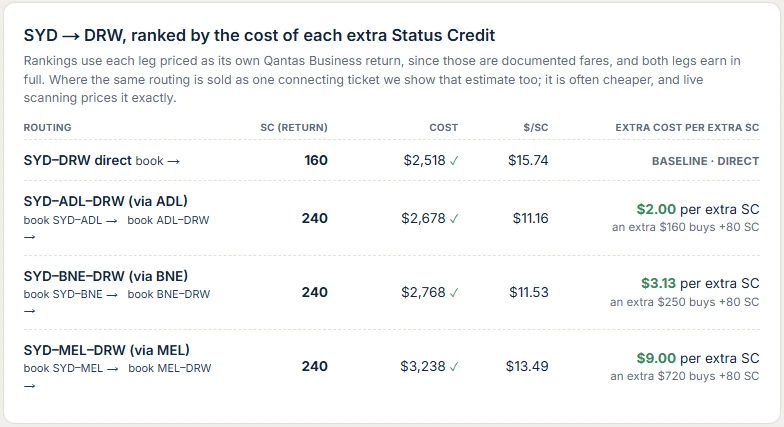 The Builder's Sydney to Darwin routing table, captured 31 July 2026. Each leg is priced as its own documented return.
The itinerary used documented Qantas deal fares with published travel windows. At the time of testing, it was one of the strongest incremental Status Credit opportunities identified by the Builder.
This is an important distinction. The entire fare was not being spent to earn status because the traveller was already flying to Darwin. The relevant calculation was the additional fare paid for the additional Status Credits.
A known benchmark remained competitive
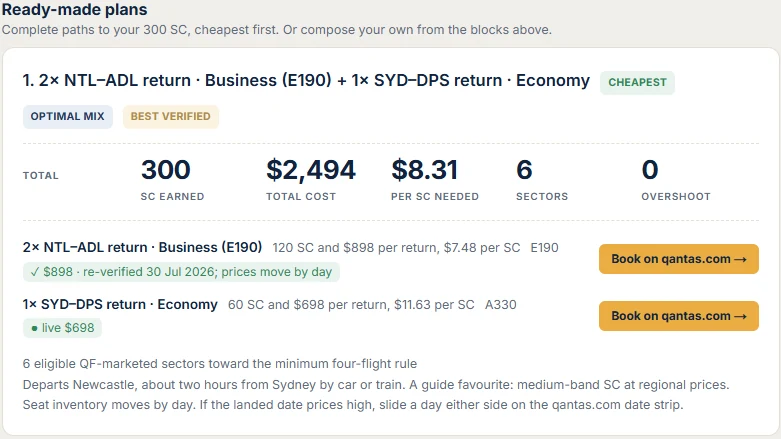
Newcastle to Adelaide in Business was still pricing at about $449 each way on the E190.
At that fare, a return trip earned 120 Status Credits for approximately $7.48 per Status Credit. It remains a useful benchmark against which other dedicated status runs can be compared.
We also checked the frequently discussed Brisbane-Melbourne-Christchurch itinerary against Qantas' own fare grid. The grid supported an earning rate of 140 Status Credits each way in Business Sale under the standard tables.
Any higher earning figure depends on a separate promotion, such as Double Status Credits, and should be identified as such rather than presented as the normal earning rate.
The live price feed reproduced the airline price
The Builder collected a Brisbane-Rockhampton Business return fare of $878 from Qantas' deals page.
We then reproduced the itinerary manually on qantas.com at $439 each way, or $878 return, for the same travel dates.
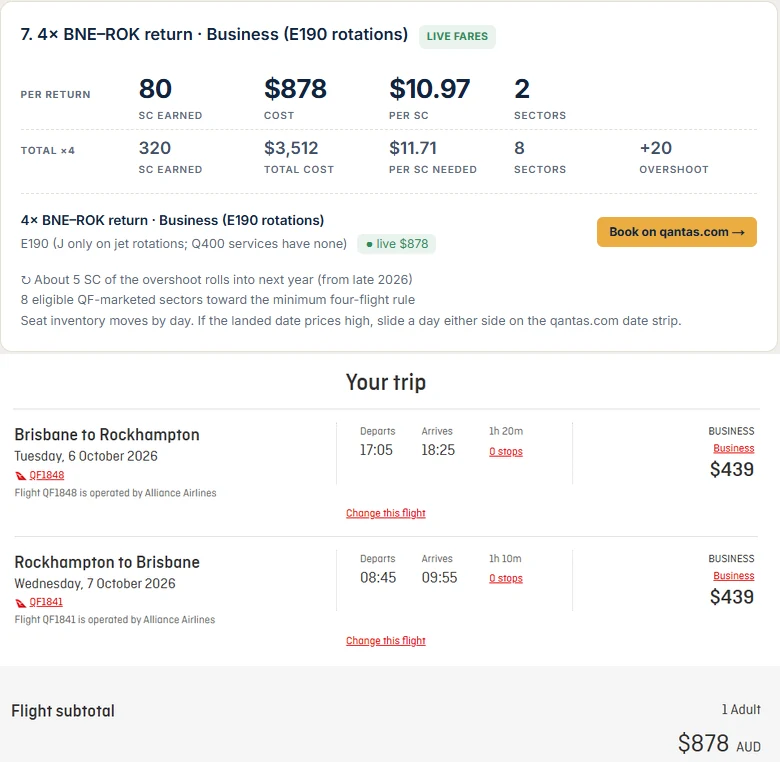 Top: the Builder's live-fare block. Bottom: qantas.com pricing the same route and dates. Captured 31 July 2026.
That is what the green-dot label is intended to represent: a current price collected from Qantas' own deal pages rather than an estimate or historical fare.
Testing also found an error in the route data
During testing, the route set included a non-stop Adelaide-Gold Coast service that Qantas does not operate.
The invalid route was removed and replaced with the genuine connection via Melbourne at its documented through-fare. A regression test was also added so the same error cannot re-enter the route set unnoticed.
This is part of the purpose of public testing. When a reader identifies an error, we correct the data, acknowledge the issue and add a control designed to prevent it from returning.
The upper tiers require combinations, not just repetition
The optimisation becomes particularly useful when the target is large.
Platinum One requires 3,600 Status Credits. The highest-earning Business return in the Builder's current route set earns 560 Status Credits. Six returns would earn 3,360, leaving a gap of 240.
Simply repeating the highest-earning Business itinerary is therefore not enough. The Builder calculates the combination of routes and cabins needed to reach the target within the user's trip, budget and cabin limits.
Depending on those limits, a higher cabin or a different route combination may form part of the result.
How to read the results
Each plan shows both the economics of an individual return trip and the totals for the full proposed combination.
You can see:
- the fare and Status Credits earned per return trip;
- the number of trips required;
- the total fare and Status Credits;
- the cost per Status Credit;
- the relevant travel window; and
- the source and status of each fare.
What the fare labels mean
Every fare carries a visible label:
- A green dot is a live price collected from Qantas' deals pages, which Rewards That Fly checks twice daily.
- A tick is a documented fare supported by a published source and travel window.
- A tilde is a researched estimate and is clearly identified as such.
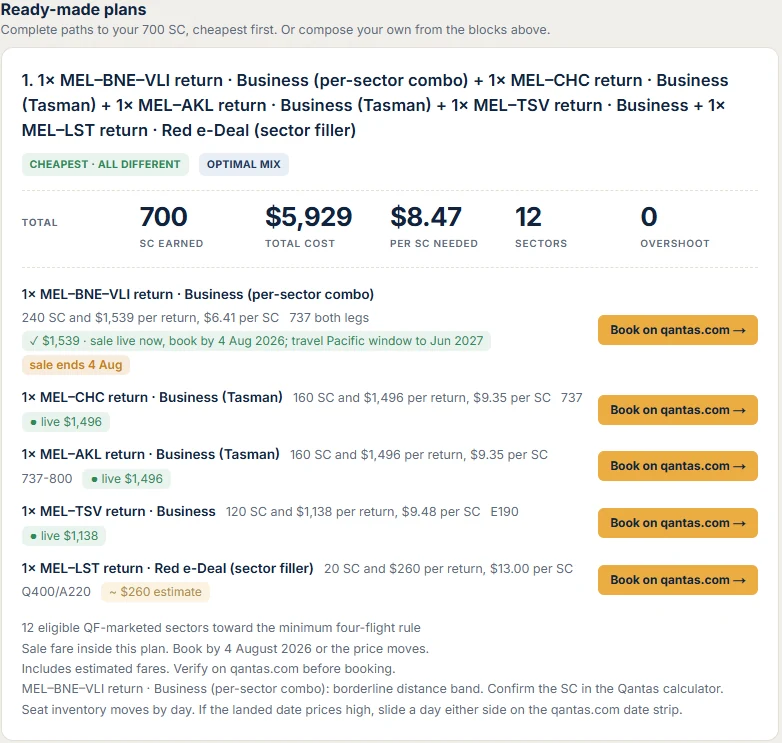 One plan, every label type: a documented sale fare with its booking deadline, live prices and a clearly marked estimate. Captured 31 July 2026.
Sale fares display their booking deadline. After the sale ends, the fare returns to the applicable everyday level, while the expired price may remain visible as historical context.
An estimate never receives a verified label, and a historical fare is not presented as though it remains bookable.
Building your own combination
Below the recommended plans, the Builder displays the available route building blocks ranked by cost per Status Credit.
This allows you to create your own combination where your preferences differ from the optimiser's result. You may prefer fewer trips, a particular aircraft, more route variety or a higher total cost in exchange for a more appealing itinerary.
Booking a result
Booking links open qantas.com with the route, cabin and travel dates filled in where possible.
The dates are selected to fall within the documented travel window for the fare, but sale inventory remains flight-specific. If the selected service prices above the displayed level, check the nearby dates shown on Qantas' fare calendar.
Always confirm the final price, baggage allowance and fare conditions on qantas.com before paying.
Double Status Credits
The Builder includes an option to model a Double Status Credits promotion.
For eligible bookings, doubling the Status Credits earned can materially reduce the effective cost per Status Credit and will often approximately halve it. The actual result depends on whether every flight and booking date satisfies the promotion's terms.
Qantas has historically run broad Double Status Credits offers, but future promotions are not guaranteed. Do not delay necessary travel solely on the assumption that another offer will appear.
Current coverage
The Builder currently covers Qantas Frequent Flyer Status Credits and Qantas-operated routes within its published route set.
A Velocity version, broader partner-airline coverage and day-level fare scanning are in development.
The tool is independent and is not affiliated with Qantas. Qantas owns its earning tables, tier rules and loyalty program terms, all of which can change.
For the strategy around the tool, including what a Status Credit should cost, the Double Status Credits calendar and when a run is not worth taking, read our Qantas status run guide.