Guides · Strategy
Qantas Status Credits on the ground: how to earn up to 140 without flying
From December 2026, earn up to 140 Qantas Status Credits without flying. See the ten earning categories, points thresholds, exclusions and what they mean for your status.
By Rewards That Fly · Updated 21 October 2026 · 10 min read
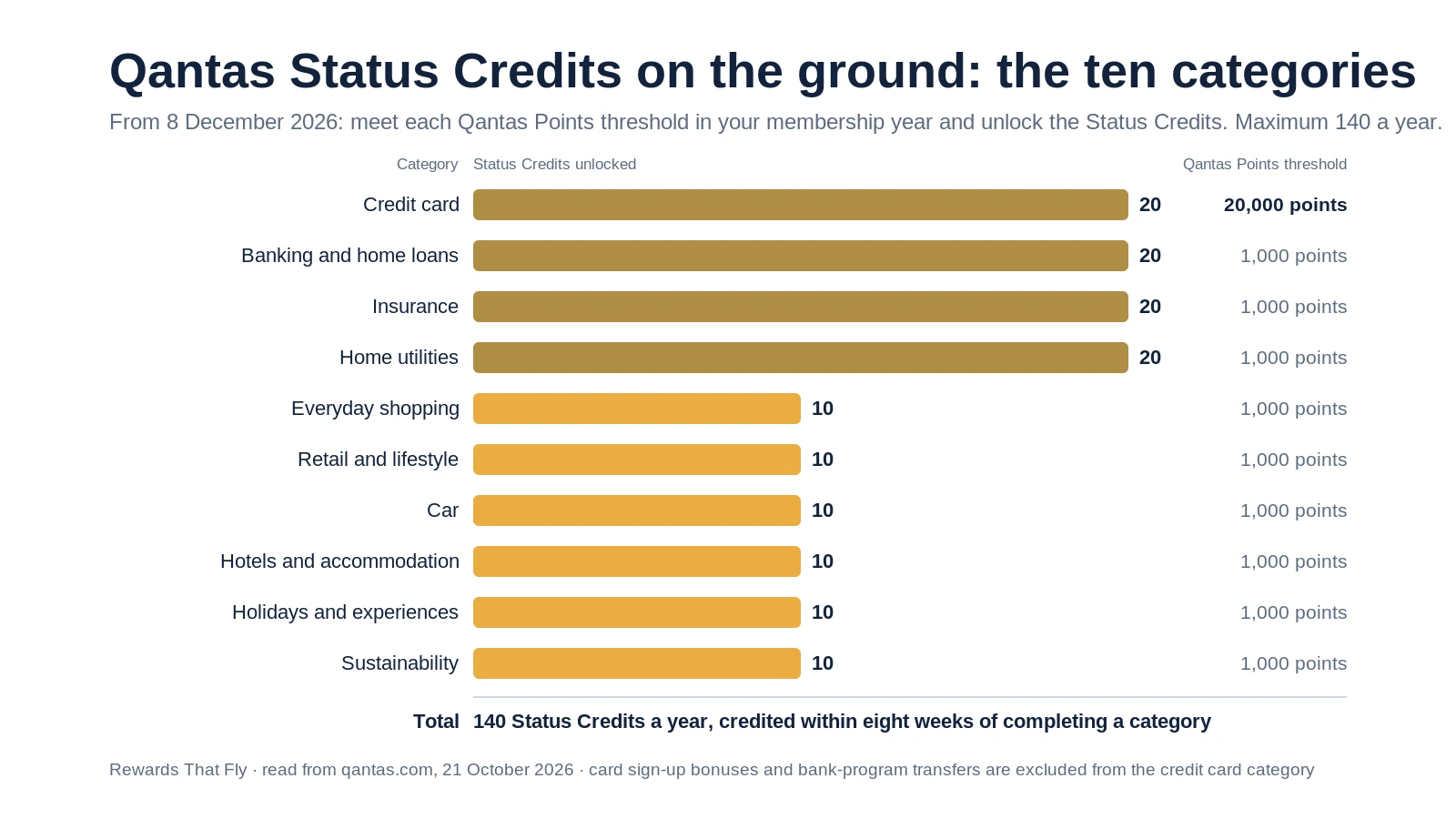
From 8 December 2026, Qantas Frequent Flyer members will be able to earn up to 140 Status Credits per membership year without flying.
The new benefit rewards members for earning Qantas Points through everyday activities, including credit card spending, shopping, banking, insurance, hotels and car hire.
Each of ten categories has a Qantas Points threshold. Meet that threshold during your membership year and Qantas awards either 10 or 20 Status Credits.
For members working towards Gold or Platinum, these credits can help reduce the amount of flying needed to attain or retain status.
Qantas has published the permanent earning thresholds; we read them on 21 October 2026. This guide explains the categories, what counts and how much difference the additional credits could make.
At a glance
- Starts: 8 December 2026.
- Maximum: 140 Status Credits per membership year across ten categories.
- Earning thresholds: 20,000 Qantas Points from eligible credit card spending; 1,000 Qantas Points in each of the other nine categories.
- Status Credits awarded: 20 each for credit cards, banking, insurance and utilities; 10 each for the remaining six categories.
- Existing activity counts: Eligible points earned during the membership year current on 8 December 2026 can count towards the thresholds.
- Crediting: Within eight weeks of completing an eligible category, but not before launch.
- Lifetime Status: Ground-earned Status Credits count towards Lifetime Status.
- Four-flight requirement: Members must still complete four eligible flight sectors each membership year.
The useful starting point is to identify which categories you already use. Earning 30 or 50 Status Credits through existing activity may be more practical than trying to reach the full 140.
The ten ways to earn Status Credits on the ground
Qantas has published the following categories and thresholds for the permanent program beginning on 8 December 2026.
| Category | Qantas Points required | Status Credits | Participating partners and examples |
|---|---|---|---|
| Credit cards | 20,000 | 20 | Eligible Qantas Points earning credit cards |
| Banking and home loans | 1,000 | 20 | Qantas Pay, Qantas Money Home Loans, La Trobe Financial, AMP Bank GO, Qudos Bank, Alex.Bank and participating partners |
| Insurance | 1,000 | 20 | Qantas Car, Health, Home and Travel Insurance, Miga and OnePath |
| Home utilities | 1,000 | 20 | Red Energy |
| Everyday shopping | 1,000 | 10 | Everyday Rewards, HelloFresh and Youfoodz |
| Retail and lifestyle | 1,000 | 10 | Qantas Shopping, Qantas Marketplace, Qantas Wine, David Jones, Kogan, Hoyts and participating retailers |
| Car | 1,000 | 10 | Avis, Budget, Uber, Uber Eats, bp Rewards, Qantas Valet and participating partners |
| Hotels and accommodation | 1,000 | 10 | Qantas Hotels and Airbnb |
| Holidays and experiences | 1,000 | 10 | Qantas Holidays, TripADeal, Qantas Cruises and participating experience providers |
| Sustainability | 1,000 | 10 | Voluntary Carbon Program |
| Maximum | 140 |
Source: Qantas' Status Credits on the ground page, read 21 October 2026. Partner lists are abbreviated and eligible earning conditions apply.
Four categories provide 20 Status Credits each, accounting for 80 of the 140 available.
The remaining six categories provide 10 each.
Most categories require 1,000 eligible Qantas Points, although the spending or activity needed to earn those points varies considerably.
How the earning rules work
Each category can be completed once per membership year
Status Credits are awarded when you meet the eligible Qantas Points threshold in a category.
For example, if you earn 1,000 eligible Qantas Points through Everyday Rewards during your membership year, you qualify for 10 Status Credits.
Further Everyday Rewards activity during that same membership year does not unlock another 10 Status Credits.
The category resets when your next membership year begins.
Points earned before 8 December can count
Qantas has confirmed that eligible activity during the membership year current on 8 December 2026 will count towards the new thresholds.
For example, suppose your membership year runs from 1 March 2026 to 28 February 2027.
Eligible Qantas Points earned through participating partners since March 2026 can count towards the categories when the program launches.
This means you may have already met some of the thresholds before 8 December.
However, no Status Credits will be awarded under the permanent program before launch.
Qantas will also introduce a way to view progress towards the categories through your Frequent Flyer account and app.
Status Credits are credited separately
Qantas says ground-earned Status Credits will be credited within eight weeks of completing an eligible category.
The Qantas Points themselves continue to be earned under the relevant partner's normal rules.
The Status Credits are an additional benefit for reaching the category threshold.
Not every source of Qantas Points qualifies
Some commonly earned points are excluded from the relevant categories.
These include:
- Credit cards: sign-up bonus points and points transferred from a bank's own rewards program.
- Insurance: Qantas Wellbeing App points.
- Hotels: points transferred or converted from hotel loyalty programs outside Qantas Frequent Flyer.
Other exclusions apply across the program, including certain transferred, purchased and bonus points.
Check the Qantas Status Credits on the ground rules before relying on a particular transaction.
What does each category take in practice?
The thresholds are relatively straightforward, but the cost of reaching them varies.
Credit cards: 20,000 Qantas Points
The credit card category requires 20,000 eligible Qantas Points earned through card spending.
Sign-up bonuses and points converted from bank rewards programs do not count.
The spending needed depends on the card's earning rate.
| Eligible Qantas Points per dollar | Spending required for 20,000 points |
|---|---|
| 0.5 | $40,000 |
| 0.75 | ~$26,667 |
| 1.0 | $20,000 |
| 1.25 | $16,000 |
These figures assume all spending earns points at the stated rate, without caps or exclusions.
For members already putting substantial everyday spending through an eligible Qantas card, the 20 Status Credits may be earned without changing their behaviour.
For others, the threshold may be difficult to reach.
The important distinction is that $20,000 of card spending is not the cost of earning 20 Status Credits if those are purchases you would have made anyway.
The relevant cost is any additional fee, spending or change in behaviour required to qualify.
Banking, insurance and utilities: 20 Status Credits each
These three categories also provide 20 Status Credits each, but require only 1,000 eligible Qantas Points.
They include participating banking and home loan products, insurance providers and Red Energy.
These are potentially useful categories for members who already hold eligible products.
However, a 1,000-point threshold does not necessarily make the category easy or inexpensive to complete.
The cost depends on the underlying product.
For example, an insurance policy offering Qantas Points may be competitive with alternatives. If it is, the additional 20 Status Credits are a benefit.
If the policy is substantially more expensive, the Status Credits may not justify the difference.
The same applies to banking products, home loans and utilities.
Everyday shopping: 10 Status Credits
The everyday shopping category includes Everyday Rewards, HelloFresh and Youfoodz.
For members linking Everyday Rewards to Qantas Frequent Flyer, the standard conversion is:
2,000 Everyday Rewards points = 1,000 Qantas Points
That is enough to meet the category threshold, provided the points qualify under the new rules.
This is likely to be one of the more accessible categories for members who already earn Qantas Points through supermarket shopping.
Retail, car hire, hotels and holidays: 10 each
Four further categories provide 10 Status Credits each.
Examples include:
- Qantas Shopping, Qantas Marketplace and Qantas Wine;
- Uber, bp Rewards and participating car hire providers;
- Qantas Hotels and eligible Airbnb bookings; and
- Qantas Holidays, TripADeal and Qantas Cruises.
Each category requires 1,000 eligible Qantas Points.
A hotel booking or purchase during a bonus-points promotion may be enough to reach the threshold, depending on the transaction.
For members already using these partners, the additional Status Credits may require little change.
However, the relevant points must be earned in the correct category. Points earned through one partner cannot simply be combined with unrelated points to complete another category.
Sustainability: 10 Status Credits
The sustainability category requires 1,000 eligible Qantas Points through the Voluntary Carbon Program.
For most members, this will be a deliberate transaction rather than points earned through ordinary household activity.
Whether it is worthwhile depends on the cost and value of the underlying purchase, not simply the additional 10 Status Credits.
How much difference can 140 Status Credits make?
From later in 2027, Qantas will introduce a single annual Status Credit target for attaining and retaining each tier.
The lower retention thresholds will disappear.
The maximum ground-earning benefit compares with those new targets as follows.
| Tier | New annual target | Maximum ground credits | Remaining Status Credits required |
|---|---|---|---|
| Silver | 300 | 140 | 160 |
| Gold | 700 | 140 | 560 |
| Platinum | 1,400 | 140 | 1,260 |
| Platinum One | 3,600 | 140 | 3,460 |
For Platinum One, at least 2,700 Status Credits must still come from Qantas-marketed flights.
All tiers also retain the requirement for four eligible flight sectors.
The table assumes the member earns all 140 ground Status Credits and has no rollover or other additional Status Credits.
Gold members
For Gold, the maximum ground-earning benefit represents 20% of the new 700-Status-Credit target.
That is substantial.
However, the full 140 requires completing every category, including insurance, banking, utilities and sustainability.
A more realistic example may be a member earning:
| Category | Status Credits |
|---|---|
| Credit card | 20 |
| Everyday shopping | 10 |
| Retail and lifestyle | 10 |
| Hotels and accommodation | 10 |
| Total | 50 |
That member would have 650 Status Credits remaining towards the new Gold target, before any rollover or other bonuses.
The benefit is smaller than the headline maximum, but still useful.
Platinum members
For Platinum, 140 Status Credits represent 10% of the new annual target.
Ground earning can help reduce the amount of flying required, but it is unlikely to replace a substantial part of the flying undertaken by someone retaining Platinum.
Status Credit rollover may be more important for members whose travel varies considerably between years.
Platinum One members
For Platinum One, the maximum ground-earning benefit represents about 4% of the overall 3,600-Status-Credit requirement.
However, it cannot replace the separate requirement for 2,700 Status Credits from Qantas-marketed flights.
Ground earning therefore provides a modest contribution towards the overall requirement without materially changing the core flying commitment.
How does this compare with earning Status Credits by flying?
Our Status Run Builder compares Status Credit earning across documented Qantas fares and selected live deals.
In October 2026, the Business fares in our dataset produced a median cost of approximately $12.50 per Status Credit, with some fares as low as $7.50.
Economy fares in the same sample generally produced higher costs per Status Credit.
Those figures are historical observations, not a universal cost of earning Status Credits.
They provide a useful reference when considering whether extra spending on a participating partner is worthwhile.
Example: comparing an insurance policy
Suppose an eligible insurance policy would cost $200 more per year than an otherwise comparable alternative.
If that policy earns enough Qantas Points to unlock 20 Status Credits:
$200 ÷ 20 = $10 per Status Credit
That is broadly comparable with some of the better flying options in our October dataset.
However, the comparison is not complete.
A flight may provide transport or personal enjoyment in addition to Status Credits. An insurance policy provides coverage, with its own benefits, exclusions and conditions.
The relevant question is whether the additional 20 Status Credits justify any difference in the overall value of the products.
If the eligible insurance policy is already your preferred option, the credits may effectively be an additional benefit at no incremental cost.
If it is materially more expensive or less suitable, the Status Credits alone may not justify switching.
Example: earning through existing activity
Suppose you already:
- earn Qantas Points through Everyday Rewards;
- use Qantas Shopping; and
- book accommodation through Qantas Hotels.
If each category reaches its threshold, you would earn:
10 + 10 + 10 = 30 Status Credits
If those are transactions you would have made anyway, there may be little incremental cost.
That is where the program is likely to be most useful.
What about Lifetime Status?
Ground-earned Status Credits will count towards Lifetime Status.
The current lifetime thresholds include:
- Lifetime Silver: 7,000 Status Credits.
- Lifetime Gold: 14,000 Status Credits.
Qantas is also introducing new lifetime milestones during 2027 that provide banked years of Platinum status at specified thresholds.
For illustration, a member earning 100 ground Status Credits each year would accumulate:
100 × 10 years = 1,000 additional Lifetime Status Credits
That would be a meaningful contribution towards Lifetime Gold over time.
It is not a forecast of what any member will earn. The actual result will depend on eligible activity and whether the program rules remain unchanged.
Who is likely to benefit most?
Members already earning Qantas Points across several participating categories are likely to receive the greatest benefit with the least additional effort.
For example, someone using an eligible Qantas Points earning card, Everyday Rewards, Qantas Hotels and a participating insurance product could earn 60 Status Credits after meeting the relevant thresholds.
That may help offset some of the higher annual retention requirements arriving in 2027.
Members whose points earning is concentrated in excluded categories may benefit less.
For example, someone who primarily transfers bank rewards points into Qantas may not qualify for the credit card category through those transfers.
Similarly, members relying on credit card sign-up bonuses cannot count those points towards the 20,000-point credit card threshold.
The program therefore rewards the breadth of eligible Qantas Points earning, rather than simply the total number of points accumulated.
Is the full 140 realistic?
It is possible, but requires activity in all ten categories during the same membership year.
That includes:
- earning 20,000 eligible points through a Qantas Points earning credit card;
- meeting thresholds through participating banking, insurance and utility products;
- earning points across shopping, accommodation, car and holiday categories; and
- completing the sustainability category.
Some members may already use most of these services.
Others would need to change providers or make additional purchases.
For most people, the more useful target is the number of Status Credits available through activity they already undertake, rather than the full 140.
What should you do before 8 December?
Start with your Qantas Frequent Flyer membership-year end date.
That determines which period of existing earning activity can count when the program launches.
Then review your Qantas Points activity for the current membership year and identify which categories you may already have completed.
In particular:
- Check whether your Everyday Rewards account is linked and set to convert to Qantas Points.
- Review eligible points earned from credit card spending, excluding sign-up bonuses and bank rewards transfers.
- Check whether accommodation, car hire or other purchases have earned points through participating partners.
- Identify any banking, insurance or utility products you already use that qualify.
There is no need to change providers or make additional purchases solely because the new program is launching.
Once the feature becomes available on 8 December, check the categories recorded in your Qantas account and any outstanding thresholds.
For the broader status changes, including rollover and the higher retention targets, see our Qantas status changes guide.
If you want to compare the cost of earning additional Status Credits through flying, the Status Run Builder uses documented fares and current earning rates.
The practical value of ground earning is straightforward: Status Credits earned from activity you were already undertaking can reduce the flying needed to reach or retain Qantas status.
Methodology and sources
Verification date
This guide was prepared from Qantas' published material as read on 21 October 2026.
The program is scheduled to commence on 8 December 2026.
The category thresholds, eligible partners, exclusions and crediting rules may change before or after launch.
Categories and earning thresholds
The primary source is Qantas' Status Credits on the ground page.
It sets out:
- ten earning categories;
- the Qantas Points threshold for each category;
- the corresponding Status Credits;
- participating partners;
- exclusions; and
- rules for earning and crediting the Status Credits.
The category table in this guide uses the thresholds published on that page as read on 21 October 2026.
Partner lists have been abbreviated for readability.
Launch and membership-year treatment
Qantas has stated that eligible points earned during the membership year current on 8 December 2026 will count towards the thresholds when the permanent program launches.
Status Credits will not be awarded before launch.
Qantas has also stated that credits will be awarded within eight weeks of meeting a category threshold.
The precise timing of initial credits may depend on the launch arrangements and when Qantas processes eligible activity.
Status tiers and Lifetime Status
Tier targets and broader program changes were checked against Qantas' Frequent Flyer program changes page.
The ground-earning feature launches on 8 December 2026.
The new single attainment and retention targets are scheduled to take effect later in 2027.
Ground-earned Status Credits count towards Lifetime Status, but members must continue meeting the four-flight requirement and any additional tier-specific flying conditions.
Spending examples
The credit card spending examples assume eligible earn rates of 0.5 to 1.25 Qantas Points per dollar, without caps or exclusions.
Actual earning rates depend on the product and transaction.
The Everyday Rewards conversion example uses the standard rate of 2,000 Everyday Rewards points to 1,000 Qantas Points.
No financial product is recommended in this guide.
Cost of earning Status Credits by flying
The flying comparison uses documented fares from the Rewards That Fly Status Run Builder, including October 2026 observations.
The approximate $7.50 minimum and $12.50 median Business Class costs per Status Credit are specific to that dataset and are not representative of every available flight.
The insurance example illustrates the calculation of incremental cost per Status Credit. It is not a valuation or recommendation of an insurance product.
Scope and limitations
This guide explains the published Qantas Status Credits on the ground rules.
It does not assess the suitability of financial products or estimate what any particular member will earn.
Participating partners, earning thresholds, exclusions and program rules can change.
Confirm the applicable conditions with Qantas before changing spending or product decisions.
We review the guide following material program changes. Updates are recorded in the Program Change Log.