Guides · Strategy
Round-the-world from Australia: points, cash or separate tickets?
Compare round-the-world tickets from Australia using Qantas Points, cash fares or separate bookings. Includes 2026 Business Class prices, booking rules and reward availability.
By Rewards That Fly · Updated 16 October 2026 · 15 min read
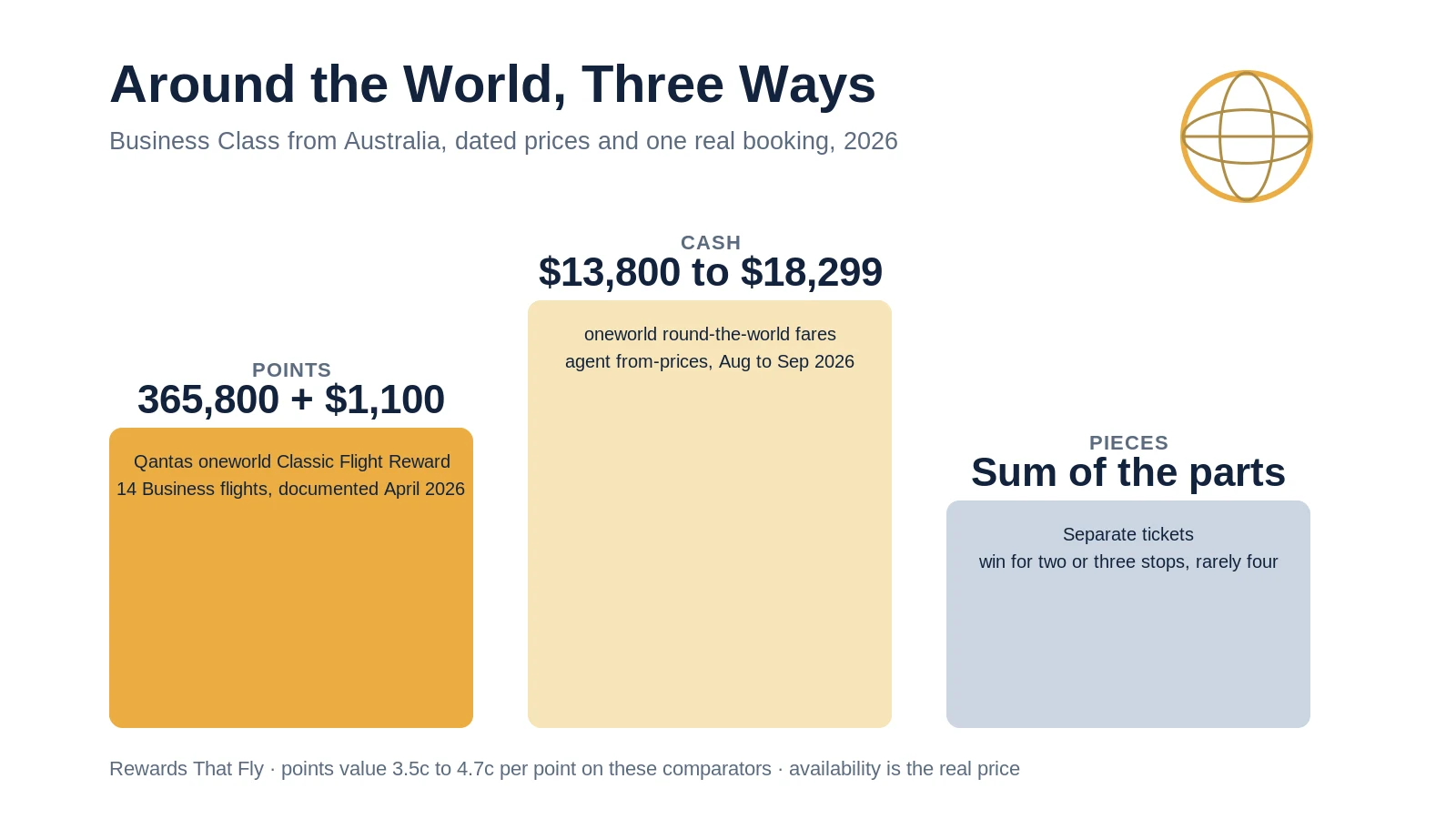
There are three main ways to book a round-the-world trip from Australia: use Qantas Points for a oneworld Classic Flight Reward, buy a cash round-the-world fare, or build the itinerary from separate tickets.
Each has a different advantage.
The Qantas oneworld Classic Flight Reward can provide exceptional value in Business Class, with a maximum price of 365,800 Qantas Points plus taxes and charges for an eligible itinerary of up to 35,000 miles.
A cash round-the-world fare offers greater certainty, with published Business Class fares starting around $13,800 in recent Australian travel-agent listings. It also earns points and Status Credits, subject to the flights and fare classes.
Separate tickets may be cheaper for a simpler trip with only two or three destinations, particularly where sale fares or points are available on individual sectors.
The difficult part is determining which structure works for the itinerary you actually want.
At a glance
- Qantas Points: a oneworld Classic Flight Reward costs up to 365,800 points in Business Class for an eligible itinerary of up to 35,000 miles, 16 sectors and five stopovers.
- Cash: recent Australian agent listings advertised oneworld Business Class round-the-world fares from about $13,800, with higher prices for longer mileage allowances.
- Separate tickets: worth comparing where the trip involves only a few destinations or the fixed round-the-world rules are restrictive.
- Availability: the Qantas points option requires Classic Reward seats on every flight. Long-haul Business availability from Australia can be particularly limited.
- Flexibility: cash round-the-world fares generally offer more flexibility to change travel dates, subject to the applicable fare rules and available seats.
- Value: one documented 2026 oneworld Classic Flight Reward booking cost 365,800 points plus $1,099.62 in charges for 14 Business Class flights.
The main distinction is straightforward: points offer the potential for the lowest economic cost, cash provides greater booking certainty, and separate tickets provide the most freedom over the itinerary.
The three options compared
| Qantas oneworld Classic Flight Reward | Cash round-the-world fare | Separate tickets | |
|---|---|---|---|
| Business Class cost | Up to 365,800 Qantas Points plus taxes and charges | From approximately $13,800 in recent agent listings | Depends on the individual flights |
| Availability | Classic Reward inventory required on every sector | Eligible paid seats must be available in the relevant booking class | Cash or reward availability on each ticket |
| Maximum itinerary | 35,000 miles, 16 sectors and five stopovers | Generally up to 16 sectors and 15 stopovers, subject to the fare product | No overall round-the-world limit |
| Routing | Must satisfy Qantas' oneworld Classic Reward rules | Must generally travel continuously around the world | No overall direction requirement |
| Changes | Points fees apply | Date changes generally permitted without a change fee, subject to fare rules and availability | Each ticket has its own conditions |
| Qantas Status Credits | Generally none | May earn on eligible flights and fare classes | Depends on the flights and fares |
| Main advantage | Potentially exceptional value from points | Greater certainty and a single fare structure | Flexibility and potential savings on simpler trips |
| Main limitation | Finding suitable reward seats | Higher cash outlay | Separate-ticket risk and administration |
These are not always directly comparable products. A 35,000-mile Classic Flight Reward may have a different route, airlines and flexibility from a cash fare with a 26,000-mile allowance.
The comparison is most useful when both structures can accommodate substantially the same trip.
Option 1: buying a cash round-the-world fare
oneworld offers two main round-the-world fare structures.
The oneworld Explorer is priced according to cabin and the number of continents visited.
The Global Explorer is priced according to cabin and total distance flown, with mileage allowances ranging from 26,000 to 39,000 miles.
Both allow a substantial number of destinations on one fare, making them suitable for a genuine multi-continent trip rather than a conventional return holiday.
What the fares cost
Recent Australian travel-agent listings provide the following reference points.
| Source | Business Class price | Basis |
|---|---|---|
| Airfare Geeks | From $13,800 | Advertised round-the-world fare, updated 31 August 2026 |
| FirstClass | $14,799 | Advertised 26,000-mile fare, updated 30 September 2026 |
| FirstClass | $18,299 | Advertised 34,000-mile fare, updated 30 September 2026 |
The listed prices include taxes and surcharges according to the agents, but apply to selected itineraries and travel dates.
They are advertised reference prices, not live quotes for a particular itinerary.
A useful historical comparison comes from Australian Frequent Flyer, which priced a four-continent oneworld Explorer itinerary in April 2025.
The same 14-stop journey cost:
- $17,328 in Business Class when starting in Melbourne; or
- $12,541 in Business Class when starting in Tokyo.
That was a saving of around 28% from changing the departure country.
Those prices are no longer current, but they illustrate why the country where a round-the-world fare begins can materially affect the cost.
Positioning to another country may therefore be worth considering, provided the saving justifies the additional flights, time and separate-ticket risk.
How the routing rules work
A cash oneworld round-the-world fare generally requires you to:
- travel in one continuous direction around the world;
- cross both the Pacific and Atlantic Oceans;
- finish in the country where the journey began;
- complete the itinerary within twelve months; and
- remain within the applicable sector, stopover and mileage or continent limits.
The oneworld Explorer also places limits on the number of flights and stopovers within individual continents.
For example, it generally permits four flights within a continent, or six within North America, and limits stopovers in the continent of origin.
The Middle East and North Africa are treated as part of Europe for oneworld Explorer pricing.
These rules can make a complex itinerary surprisingly economical, but they also limit the order in which you can visit destinations.
Changes and Status Credits
One advantage of the cash fare is the ability to change travel dates after ticketing without a change fee under the standard round-the-world conditions.
That does not guarantee a seat on the replacement flight. Availability in the relevant fare class, any fare differences and the detailed fare rules still matter.
Routing changes and cancellations can also attract fees.
Cash Business Class flights may earn substantial Qantas Points and Status Credits, depending on the operating airline, flight number and booking class.
For someone pursuing or retaining status, that can form a meaningful part of the comparison with a points redemption.
However, the total should be calculated sector by sector. A round-the-world Business fare does not automatically earn Qantas Status Credits at the same rate on every airline.
Our Qantas status runs guide explains the earning differences.
Where to book
Cash round-the-world fares can be arranged through participating travel agents or the oneworld online planner.
For a complicated itinerary, an experienced agent may be particularly useful in identifying valid routings, fare classes and alternative departure points.
Option 2: the Qantas oneworld Classic Flight Reward
For travellers with a substantial Qantas Points balance, the oneworld Classic Flight Reward is one of the program's more attractive premium-cabin redemptions.
It allows multiple oneworld flights to be combined into a single Classic Flight Reward, with the points requirement determined by the total itinerary distance and highest cabin used.
The maximum Business Class price under the current table is:
365,800 Qantas Points plus taxes and charges
That covers an eligible itinerary of up to 35,000 miles, with a maximum of 16 sectors and five stopovers.
It is not necessary to use the full 35,000 miles. Shorter itineraries can fall into lower pricing bands.
For example, the Business Class price for a qualifying itinerary of 14,001–16,800 miles is 286,000 points.
The main booking rules
The important conditions are:
- the itinerary must include at least two oneworld airlines other than Qantas;
- only eligible oneworld member airlines can be included;
- Jetstar-operated flights are excluded;
- a maximum of five stopovers is permitted;
- a maximum of 16 flight sectors applies;
- the distance of any permitted surface sector counts towards the mileage allowance;
- stopovers and transits in individual cities are restricted; and
- the itinerary must be completed within twelve months.
Unlike the cash round-the-world products, the Qantas award does not require a conventional circumnavigation involving both oceans.
It is better understood as a multi-sector oneworld reward with a generous total-distance allowance.
That can make it useful for itineraries that would not satisfy the cash fare's direction requirements.
The highest cabin determines the price
This rule is particularly important.
The oneworld Classic Flight Reward is priced according to the highest cabin included in the itinerary.
If you book an otherwise Business Class itinerary containing one First Class sector, the entire reward can price at the First Class level.
Under the current top-distance band:
| Cabin | Qantas Points |
|---|---|
| Economy | 152,200 |
| Premium Economy | 287,000 |
| Business | 365,800 |
| First | 523,200 |
Check the cabin on every sector before confirming the booking.
A single higher-cabin flight can materially change the points requirement.
One documented 2026 booking
FreePoints documented a oneworld Classic Flight Reward booked in early 2026 and published the experience in April.
The itinerary involved:
- 14 Business Class flights;
- approximately 50,000 kilometres of travel;
- 365,800 Qantas Points; and
- $1,099.62 in taxes, fees and carrier charges.
The traveller held Bronze status and booked approximately two weeks before departure.
The itinerary came together after Fiji Airways released Business Class availability from Sydney to Los Angeles via Nadi.
The traveller subsequently incurred additional points costs for booking changes and an upgrade to the final domestic sector.
It is a useful real-world example because it demonstrates both sides of the product.
The points requirement was exceptionally attractive for the amount of premium-cabin flying.
But securing the itinerary required flexibility, substantial searching and a willingness to travel at relatively short notice.
It should not be interpreted as evidence that a similar itinerary will routinely be available for a particular set of dates.
The two main challenges with the points option
1. Finding reward seats
The most difficult part is usually securing suitable long-haul Business Class flights from Australia.
Each sector must have qualifying Classic Reward availability.
That is very different from buying a cash ticket, where any seat available in the required paid booking class may be usable.
The problem compounds as the number of sectors increases.
Finding one Sydney–London Business Reward is difficult enough. Finding the required flights across several continents, in the right sequence and within the applicable routing rules, is harder.
Partner availability also varies significantly.
Some airlines release inventory well in advance, while others make seats available only close to departure.
For example, Qatar Airways Business and First Class inventory accessible through Qantas Points has generally been released only very close to departure, making it difficult to incorporate into a trip planned months ahead.
Our Classic Reward availability guide covers these patterns in more detail.
2. Managing taxes and carrier charges
The points requirement is only part of the cost.
Each flight can add taxes, airport charges and airline-imposed carrier charges.
The total depends heavily on which airlines and airports are included.
Some oneworld partners impose relatively modest carrier charges, while others can add substantial amounts to premium-cabin rewards.
Departing the United Kingdom on a long-haul Business Class flight can also be expensive because of Air Passenger Duty.
From 1 April 2026, the standard Band C rate is £253.
That can add several hundred Australian dollars to a premium-cabin departure.
Where the itinerary permits, flying into London and departing Europe from another country can reduce the tax burden.
That is not a universal instruction to avoid London departures. The cost of repositioning elsewhere may exceed the tax saving.
The correct comparison is the total cost of the alternative itinerary.
What our reward-seat watch shows
Rewards That Fly monitors selected international routes through Qantas' Flight Reward Finder each night.
Our snapshot from 7 October 2026 recorded the following availability for travel between November 2026 and September 2027.
| Route | Dates showing Business availability | Dates showing Economy availability |
|---|---|---|
| Sydney–London | 2 | 235 |
| Perth–London | 9 | 127 |
| Sydney–Los Angeles | 4 | 275 |
| Melbourne–Los Angeles | 7 | 275 |
| Brisbane–Los Angeles | 4 | 264 |
| Sydney–New York | 4 | 224 |
| Sydney–Dallas Fort Worth | 1 | 248 |
| Sydney–Singapore | 35 | 266 |
| Melbourne–Singapore | 71 | 271 |
| Sydney–Tokyo Haneda | 34 | 214 |
| Brisbane–Tokyo Narita | 24 | 239 |
| Sydney–Auckland | 139 | 317 |
These figures represent dates showing availability in the search, not the number of available seats.
The Flight Reward Finder can include partner-operated flights, so the totals should not be interpreted as Qantas-operated availability alone.
They also do not establish whether an entire multi-sector itinerary can be booked, whether several passengers can travel together or whether the seats will remain available.
Long-haul Business availability is particularly limited
The difference between routes is substantial.
In this snapshot, Sydney–London showed Business availability on only two dates across the monitored period.
Sydney–Los Angeles showed four, while Melbourne–Los Angeles showed seven.
By comparison, Sydney–Singapore showed 35 dates and Melbourne–Singapore 71.
That suggests a practical approach to building a oneworld reward:
Start with the sectors that are hardest to obtain, then construct the rest of the itinerary around them.
For an Australian traveller, that will often mean finding a workable flight across the Pacific or between Australia and Europe before trying to assemble the shorter connections.
Close-in availability can change the picture
A separate snapshot taken on 1 October 2026, which included departures during October, showed materially more trans-Pacific Business availability.
For example:
- Sydney–Los Angeles showed 20 dates, 17 of them in October;
- Brisbane–Los Angeles showed 18 dates, 14 in October; and
- Melbourne–Los Angeles showed 15 dates, 12 in October.
That is consistent with the release of additional premium reward inventory close to departure.
It does not mean seats will reliably appear at a particular number of days before travel.
The practical implication is that a flexible traveller may be able to construct an itinerary that would have been impossible to book several months earlier.
How to build a oneworld Classic Flight Reward
A sensible process is to work from availability rather than drawing a complete itinerary first and expecting every flight to have reward seats.
Start with the difficult long-haul sectors
Identify the flights where suitable Business Classic Rewards are least likely to be available.
These may include:
- Australia to North America;
- Australia to Europe;
- trans-Pacific flights; or
- other long-haul routes with limited partner availability.
Use the Flight Reward Finder or a suitable third-party search tool to identify potential dates.
Build around available partner flights
Once the difficult flights are identified, search the shorter connections needed to complete the trip.
Keep the routing rules, stopover limits and total distance in mind.
A valid itinerary on paper is not necessarily an itinerary that Qantas can price and ticket using the available reward inventory.
Check the final points and charges
Qantas' multi-city booking tool can accommodate qualifying Classic Flight Reward itineraries.
The online tool has a sector limit, so more complex itineraries may require assistance from the Qantas contact centre.
Contact-centre Reward Assistance Fees can apply, although the treatment may differ where the website cannot complete an eligible booking.
Changes and cancellations also attract points fees under the current rules.
Confirm all applicable fees before booking, particularly if you expect to modify the itinerary as additional reward seats appear.
Use the correct product name
When speaking with Qantas, ask about a oneworld Classic Flight Reward.
It is not the same product as a paid oneworld round-the-world fare.
The booking processes, fare rules and availability requirements are different.
What about Star Alliance?
Star Alliance also offers cash round-the-world fares.
Its published structure permits up to 39,000 miles in the highest mileage band, with up to 15 stopovers and 16 sectors, subject to the applicable routing conditions.
FirstClass advertised a Star Alliance Business Class round-the-world fare from approximately $15,999 when checked on 8 October 2026.
That makes it another cash alternative worth pricing where Star Alliance airlines offer a better fit for your destinations.
For points, however, the options have narrowed.
Singapore Airlines KrisFlyer stopped issuing new Star Alliance round-the-world awards in May 2024, while ANA Mileage Club ended new round-the-world award bookings in June 2025.
That removes two previously useful ways for Australian travellers to book a multi-airline Star Alliance round-the-world award using points.
Individual Star Alliance reward flights remain available through participating programs, so a trip assembled from separate points bookings is still possible.
Option 3: building the trip from separate tickets
Not every multi-city holiday needs a round-the-world fare.
If the itinerary involves only two or three main destinations, separate tickets may be more economical or convenient.
For example, a trip involving Sydney, Singapore, London and New York may be worth pricing as individual flights or combinations of return and one-way fares.
The relevant comparison is the complete itinerary, including baggage, connection risk, change flexibility and the cost of any positioning flights.
Cash and points can be combined
Separate tickets also allow you to mix cash fares and reward flights.
For example, the current Qantas Classic Reward Business prices for selected one-way routes are:
| Route | Qantas Points, one way in Business |
|---|---|
| Sydney–Singapore | 82,100 |
| Sydney–Tokyo | 98,400 |
| Sydney–Los Angeles | 130,100 |
| Sydney–London | 166,300 |
Taxes and carrier charges are additional.
You might use points for a particularly expensive long-haul sector and buy cash fares for the shorter connections.
This can be attractive where the individual reward seats are easier to obtain than a complete oneworld Classic Flight Reward itinerary.
Historical cash fare examples
Our Qantas deals collector has recorded the following advertised return Business Class fares:
| Route | Return Business fare | Captured |
|---|---|---|
| Sydney–Singapore | $4,403 | 31 July 2026 |
| Sydney–Tokyo Haneda | $6,289 | 7 October 2026 |
| Sydney–Los Angeles | $8,498 | 11 September 2026 |
These are dated sale observations, not fares currently available for booking.
They also cannot simply be added together to create a round-the-world itinerary. Travel dates, fare conditions and the direction of each flight must align.
The purpose is to provide reference points for comparing the cost of individual flights with a packaged fare.
The separate-ticket risk
Separate tickets create separate contracts with the airlines.
If an earlier flight is delayed and you miss the next booking, the onward airline may not be required to accommodate you.
You may also need to collect and recheck baggage, meet additional transit requirements and allow more time between flights.
For a complex itinerary, those risks become more important.
An apparent saving of $1,000 may be less attractive if it requires several additional hotel nights or creates significant exposure to missed connections.
Our cheap-flight booking guide covers these considerations.
What are 365,800 Qantas Points worth on a round-the-world redemption?
The oneworld Classic Flight Reward can produce a high cents-per-point value, but the result depends on the cash fare used for comparison.
Using the documented redemption of 365,800 points plus approximately $1,100 in charges, the following calculations illustrate the potential value.
| Cash Business fare comparator | Implied value per Qantas Point |
|---|---|
| $13,800 | 3.5 cents |
| $14,799 | 3.7 cents |
| $18,299 | 4.7 cents |
The calculation is:
(Comparable cash fare − reward taxes and charges) ÷ points used
These results are illustrative because the cash fares and documented reward booking do not necessarily cover identical routes, dates, airlines or booking conditions.
A like-for-like cash alternative for the actual itinerary would provide a more meaningful valuation.
Nevertheless, the figures show why the oneworld Classic Flight Reward can be particularly attractive.
Our current Points Valuations benchmark is 1.3 cents per Qantas Point, with strong redemptions generally producing 2.1 cents or more.
At the 1.3c benchmark:
- 365,800 points have an estimated opportunity value of approximately $4,755; and
- adding the documented $1,100 cash component produces an equivalent cost of approximately $5,855.
That is materially below the advertised cash round-the-world Business fares.
The comparison is not complete, however.
A paid Business fare may earn substantial Qantas Points and Status Credits, while the Classic Flight Reward generally does not.
The cash fare may also offer greater flexibility and avoid the difficulty of finding reward inventory.
Those differences matter, particularly for travellers who value Qantas status or need to travel on specific dates.
Which option makes the most sense?
A oneworld Classic Flight Reward is attractive when
You have a substantial Qantas Points balance, flexible dates and a genuine multi-stop itinerary.
It becomes particularly compelling when you can find the difficult long-haul reward sectors and are comfortable building the rest of the trip around them.
For travellers who can move dates or destinations to match reward availability, the potential value can be exceptional.
A cash round-the-world fare is attractive when
You want a substantial multi-continent itinerary but need greater certainty over the flights and travel dates.
It can also suit travellers who will make meaningful use of the Qantas Points and Status Credits earned from paid Business Class travel.
The higher upfront cost buys a different combination of availability, booking simplicity and flexibility.
Separate tickets are attractive when
The trip only involves a few destinations, does not follow a conventional round-the-world structure or can make good use of individual sale fares and reward flights.
They may also suit travellers who want to visit different destinations on separate trips rather than completing one extended journey.
The total cost and connection risks still need to be compared with a packaged fare.
When to reconsider the itinerary
A few situations deserve particular caution.
Fixed school-holiday dates and several Business Class passengers. Finding multiple reward seats on every long-haul sector can be difficult. A cash fare or simpler itinerary may provide greater certainty.
A points itinerary with an unintended First Class sector. The highest-cabin pricing rule can increase the points requirement materially.
A South America-focused itinerary. LATAM is no longer a oneworld member, which can limit the usefulness of the Qantas oneworld Classic Flight Reward for some routes through South America.
A trip with only one or two major stops. The round-the-world products are designed for more extensive itineraries. Compare ordinary multi-city and return fares before paying for a structure you do not need.
A reward itinerary that depends on one particularly scarce flight. Keep searching, but do not assume the remaining seats will stay available indefinitely while you wait for the missing sector.
What to do next
Start by listing the destinations you genuinely want to visit, the approximate dates and how much flexibility you have.
Then price the trip three ways.
For a cash round-the-world fare, compare the oneworld Explorer and Global Explorer structures, including the required continents or mileage allowance. Consider whether an alternative departure country produces a meaningful saving after positioning costs.
For a Qantas oneworld Classic Flight Reward, start with the hardest long-haul sectors. Use the Classic Reward availability guide to understand which airlines release seats early and which tend to offer more close-in availability.
For separate tickets, compare the total cost of individual flights, including any points used, cash charges, baggage and connection risk.
The Route Strategist can help compare the underlying cash, points and alternative-routing options for individual destinations, although a complete round-the-world itinerary still requires separate pricing and routing checks.
The decision is not simply whether 365,800 Qantas Points are worth more than $14,000 in cash.
It is whether the points itinerary you can actually book provides a better combination of cost, destinations, dates and flexibility than the alternatives.
Methodology and sources
This guide was rechecked on 8 October 2026 unless otherwise indicated.
Qantas oneworld Classic Flight Reward
Points prices are from Qantas' Classic Flight Reward tables, effective for bookings from 5 August 2025.
The routing rules, sector limits, contact-centre booking arrangements and change and cancellation fees were reviewed against Qantas' published terms and Australian Frequent Flyer's April 2026 oneworld Classic Flight Reward guide.
The documented 365,800-point booking, including the $1,099.62 cash component, 14 flights and subsequent changes, is from FreePoints' April 2026 trip report. We have not independently reconstructed or repriced that itinerary.
Cash round-the-world fares
The $13,800 Business Class starting price is from Airfare Geeks' listing updated 31 August 2026.
The $14,799 and $18,299 examples are from FirstClass listings updated 30 September 2026.
These are advertised agent prices for selected dates and itineraries, including taxes and surcharges as stated by the providers. They have not been independently repriced by Rewards That Fly.
The historical $17,328 Melbourne-origin and $12,541 Tokyo-origin comparisons are from Australian Frequent Flyer's April 2025 analysis.
Cash fare rules were reviewed using Australian Frequent Flyer's oneworld Explorer guide and the published oneworld fare framework.
Reward-seat availability
Our availability data comes from the Qantas Flight Reward Finder.
The main snapshot was taken at 20:00 AEDT on 7 October 2026 and covers departures from November 2026 to September 2027. Perth–London returned a shorter ten-month window.
The close-in figures come from a separate snapshot taken at 09:40 AEDT on 1 October 2026.
The Sydney–London openings for 3 and 4 November were recorded in our watch's change log on 5 October.
All counts represent dates showing visible availability for one passenger.
They do not establish that multiple passengers can book, that a complete itinerary can be constructed, or that the flights will remain available.
The Finder may include partner-operated services, so aggregate results should not be interpreted as Qantas-operated availability alone.
Carrier charges and taxation
Airline-imposed carrier charges were reviewed using Australian Frequent Flyer's published Qantas carrier-charge information.
The UK Air Passenger Duty example uses the published GOV.UK rate for 1 April 2026 to 31 March 2027.
Separate-ticket comparisons
The Sydney–Singapore, Sydney–Tokyo and Sydney–Los Angeles Business Class prices are dated Qantas sale-fare captures from our twice-daily deals collector.
They are historical observations, not current booking quotes.
Valuation methodology
Cents-per-point calculations use:
(Comparable cash fare − taxes and charges on the reward) ÷ points used
The Qantas Points benchmark of 1.3 cents and strong-redemption threshold of 2.1 cents come from our October 2026 Points Valuations review.
The cash round-the-world fare examples and the documented oneworld Classic Flight Reward are not identical itineraries. Their comparison is illustrative and should not be treated as a realised saving.
We review this guide quarterly and after material changes to reward pricing, routing rules or airline availability.
Updates are recorded in the Program Change Log.
Confirm current fares, points requirements, reward availability, carrier charges and booking conditions before transferring points or paying for travel.