Guides · Points
Qantas Points Planes 2027: routes, dates and redemption value
Qantas Points Planes offer Classic Reward seats on selected flights to Tokyo, Paris and Hobart. See the 2027 dates, points prices and our cash fare comparisons.
By Rewards That Fly · Updated 6 November 2026 · 15 min read
Qantas has announced a series of Points Planes for 2027, offering selected flights where every available seat can be booked as a Classic Flight Reward.
The first release opened on 6 November 2026, covering flights to and from Tokyo, Paris and Hobart in January and February 2027. Bookings close at 11:59pm AEDT on Sunday 8 November, unless the available seats sell out earlier.
The points required are Qantas' normal Classic Reward prices. The difference is availability: instead of releasing a limited number of reward seats, Qantas makes every remaining seat on the selected flights available using points.
We checked the first release on qantas.com, comparing the points and charges with cash fares for the same flights.
The results vary considerably. Tokyo Business Class offers particularly strong potential value, while Melbourne–Hobart Economy sits much closer to our usual Qantas Points benchmark.
At a glance
- Booking window: 6–8 November 2026, closing at 11:59pm AEDT on Sunday.
- Destinations: Tokyo in January, Paris in February and Hobart in January 2027.
- Standard reward pricing: 36,200 Qantas Points one way from Sydney to Tokyo in Economy, 98,400 in Business, and 166,300 from Sydney to Paris in Business.
- Tokyo offers the strongest premium-cabin value. Sydney–Haneda Business returned more than 9c per point against the remaining same-flight Flex fares, or approximately 5–7c against cheaper Business alternatives.
- Paris also offers good Business value. Our comparison returned 6.30c against the remaining Flex fare, or 4.15c against a cheaper nearby-date alternative.
- Hobart is closer to our benchmark. Melbourne–Hobart Economy returned 1.30–1.52c per point depending on the cash fare used.
- Availability is the main benefit. Points Planes make Classic Reward seats available on flights where normal reward inventory can be difficult to find.
Our October 2026 benchmark is 1.3 cents per Qantas Point, with 2.1 cents or more representing a strong redemption.
The Qantas Points Calculator can assess any flight against the same benchmarks.
What is a Qantas Points Plane?
A Points Plane is a specific Qantas-operated flight on which every available seat can be booked as a Classic Flight Reward.
Qantas first introduced the concept in 2019 and has announced plans to operate Points Planes every month during 2027.
The airline has named Los Angeles, Hong Kong and Vancouver among the destinations planned for later releases, with additional routes and dates to be announced.
The points price does not change
Points Planes use Qantas' standard Classic Flight Reward tables.
There is no additional discount to the points required.
For example, Sydney–Tokyo Business costs 98,400 Qantas Points one way, whether booked through a Points Plane or as an ordinary Classic Reward.
Taxes, fees and carrier charges are additional in both cases.
More seats are available
This is the main difference.
On ordinary flights, Qantas may release only a small number of Classic Reward seats in each cabin. On popular dates, there may be no premium reward seats available.
A Points Plane makes every remaining seat available as a Classic Reward.
That does not mean the aircraft is reserved exclusively for points bookings. Seats already sold for cash are not included, and the available reward inventory declines as bookings are made.
The flights operate on fixed dates
Each Points Plane is a particular flight on a particular date.
The first Tokyo and Hobart releases have outbound and return flights approximately one week apart. Paris has a longer interval between the two directions.
If those dates do not suit your plans, you would need to find another Classic Reward or purchase a cash fare.
The first Points Planes: routes and dates
The first release covers selected services to Tokyo, Paris and Hobart.
Flight dates
| Destination | Outbound Points Planes | Return Points Planes |
|---|---|---|
| Tokyo | Sydney–Haneda, Melbourne–Narita and Brisbane–Narita on 5 January 2027 | Tokyo–Sydney, Tokyo–Melbourne and Tokyo–Brisbane on 12 January 2027 |
| Paris | Sydney–Paris via Singapore on 22 February 2027 | Paris–Sydney via Perth on 18 March 2027 |
| Hobart | Selected flights from Sydney, Melbourne and Brisbane on 12 January 2027 | Selected flights to Sydney, Melbourne and Brisbane on 19 January 2027 |
The Tokyo release includes multiple flights on some routes. For example, QF25 and QF59 both operate Sydney–Haneda on 5 January.
The Hobart release similarly includes multiple services from Sydney and Melbourne.
Points required
All prices are one way per passenger.
| Route | Economy | Premium Economy | Business |
|---|---|---|---|
| Sydney or Melbourne–Tokyo | 36,200 | Not offered | 98,400 |
| Brisbane–Tokyo | 29,000 | Not offered | 82,100 |
| Sydney–Paris | 63,500 | 124,700 | 166,300 |
| Sydney or Brisbane–Hobart | 13,800 | Not offered | 29,000 |
| Melbourne–Hobart | 9,200 | Not offered | 19,300 |
Standard Qantas Classic Flight Reward prices. Taxes, fees and carrier charges are additional.
The cash component varies by route and cabin.
In our 6 November booking checks, Sydney–Haneda required:
- Economy: 36,200 points + $184.
- Business: 98,400 points + $385.
Sydney–Paris required:
- Economy: 63,500 points + $318.
- Premium Economy: 124,700 points + $435.
- Business: 166,300 points + $841.
These charges are worth including in the comparison before deciding whether to use points.
What our first-day searches found
We searched the outbound Points Planes on qantas.com during the morning of 6 November 2026, shortly after bookings opened.
For each flight, we compared the Classic Reward with the cheapest cash fare still available on that same flight and in the same cabin.
The calculation is:
Value per point = (cash fare − reward taxes and charges) ÷ points used × 100
The result shows how much cash the points replace, expressed in cents per point.
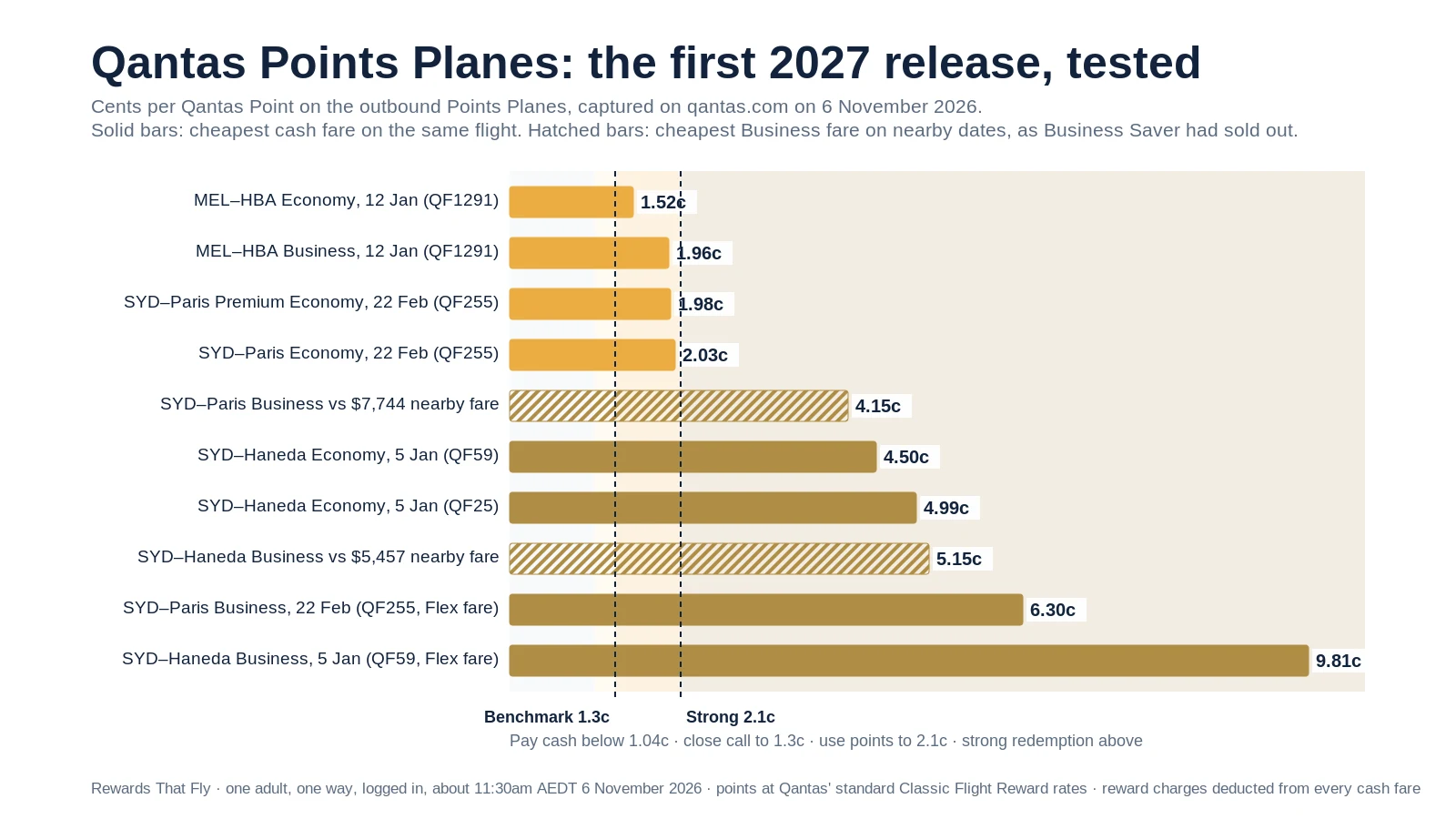
Points Planes: cash versus points
| Flight | Cabin | Cash fare | Classic Reward | Value per point |
|---|---|---|---|---|
| Sydney–Haneda, QF59 | Economy | $1,813 | 36,200 + $184 | 4.50c |
| Sydney–Haneda, QF25 | Economy | $1,989 | 36,200 + $184 | 4.99c |
| Sydney–Haneda, QF59 | Business | $10,038 | 98,400 + $385 | 9.81c |
| Sydney–Haneda, QF25 | Business | $11,535 | 98,400 + $385 | 11.33c |
| Sydney–Paris, QF255 | Economy | $1,605 | 63,500 + $318 | 2.03c |
| Sydney–Paris, QF255 | Premium Economy | $2,900 | 124,700 + $435 | 1.98c |
| Sydney–Paris, QF255 | Business | $11,312 | 166,300 + $841 | 6.30c |
| Melbourne–Hobart, QF1291 | Economy | $205 | 9,200 + $65 | 1.52c |
| Melbourne–Hobart, QF1291 | Business | $469 | 19,300 + $90 | 1.96c |
Captured on 6 November 2026 for one adult travelling one way. Cash fares are the cheapest remaining fares on the same flights at the time of capture.
The Business Class results for Tokyo and Paris need an important qualification.
Business Saver fares were already sold out on those flights. The remaining cash fares were more expensive, fully flexible tickets.
Those fares provide a valid comparison with what could still be purchased on the same flight, but they may overstate the practical value for someone who would otherwise book a cheaper Business fare on another date or route.
Tokyo: the strongest opportunity in the first release
Tokyo offers some of the most attractive redemption values in the first Points Plane release.
On 5 January, Sydney–Haneda Economy required 36,200 points plus $184.
The equivalent cash fares were:
- $1,813 on QF59, returning 4.50c per point.
- $1,989 on QF25, returning 4.99c per point.
Both results are well above our strong-redemption benchmark.
The timing helps explain the value. Early January falls during the Australian school holidays and Japan's winter travel season, when cash fares can be relatively expensive.
Business Class: strong value, even after adjusting the comparison
The same-day Business comparisons initially produced exceptionally high values.
QF59 required 98,400 points plus $385 against a $10,038 cash fare, returning 9.81c per point.
QF25 returned 11.33c, against a remaining cash fare of $11,535.
However, both cash fares were fully flexible fares remaining after Business Saver availability had sold out.
We therefore checked cheaper Business alternatives around the same dates.
The lowest Business fare shown during that week was $5,457 on 7 January.
Using that as the comparator:
($5,457 − $385) ÷ 98,400 × 100 = 5.15c per point
The lowest Business fare available on 5 January across the routings shown was $7,264, producing an illustrative value of 6.99c per point.
These are not identical-flight comparisons, but they provide more realistic alternatives for a traveller with some flexibility.
The conclusion is still favourable.
Tokyo Business is a particularly strong use of Qantas Points in this release, provided you want to travel on the dates offered.
What about Economy on other dates?
The cheapest Sydney–Haneda Economy fare in the surrounding period fell to $1,513 from 11 January.
Against that fare, the 36,200-point reward would return approximately 3.67c per point after the $184 cash component.
That remains a strong redemption.
However, it also demonstrates why the value depends on the dates you are comparing.
A traveller who can move the trip to a cheaper period may not receive the same benefit from using points on the Points Plane.
Paris: particularly attractive in Business
The Sydney–Paris Points Plane departs on 22 February 2027, returning on 18 March.
The outward flight operates via Singapore.
Our search produced the following values:
| Cabin | Value per point |
|---|---|
| Economy | 2.03c |
| Premium Economy | 1.98c |
| Business | 6.30c |
The Economy and Premium Economy results are reasonable uses of points, although neither is particularly exceptional relative to some of the stronger redemptions we have measured.
Business is more interesting.
The reward required 166,300 points plus $841, against a remaining cash fare of $11,312.
That returned 6.30c per point.
As with Tokyo, the remaining cash fare was a flexible ticket.
The cheapest Business fare shown on nearby dates was $7,744, which gives an adjusted comparison of:
($7,744 − $841) ÷ 166,300 × 100 = 4.15c per point
That remains a strong result.
Economy and Premium Economy
For Economy, the same-flight cash fare was $1,605.
Cheaper itineraries around the same dates were available from approximately $1,467.
Using the lower reference would reduce the redemption value from 2.03c to approximately 1.81c per point.
Premium Economy returned 1.98c against the captured $2,900 fare.
Both are above our central Qantas benchmark, but the higher points requirement means it is worth comparing them with the cash fares you would realistically purchase.
A good cents-per-point result is not, by itself, a reason to use more than 100,000 points on a flight.
The reward should also suit your travel plans and the alternative uses of your balance.
Hobart: reasonable value, but closer to the benchmark
The Melbourne–Hobart Points Plane provides a different comparison.
On QF1291, Economy required:
9,200 points + $65
The cash fare was $205, producing:
1.52c per point
However, another Melbourne–Hobart Points Plane on the same day, QF1297, had an Economy fare of $185.
Against that alternative, the value falls to:
($185 − $65) ÷ 9,200 × 100 = 1.30c per point
That is approximately our central Qantas benchmark.
Business returned 1.96c per point, using 19,300 points plus $90 against a $469 cash fare.
Should you use points for Hobart?
There is nothing inherently wrong with using points for these flights.
If you already want to travel to Hobart on those dates and have a substantial points balance, a redemption around the benchmark can be perfectly reasonable.
However, the cash fares are relatively modest.
Someone saving towards a more expensive international redemption may prefer to pay cash and retain their points.
For Hobart, the main benefit of the Points Plane is access to a suitable reward seat, rather than an unusually high redemption value.
Why are the redemption values so different?
The Points Plane pricing itself is not the reason.
All the flights use standard Classic Reward points prices.
The difference comes primarily from the cash fares being replaced.
A fixed-price reward becomes more valuable when the comparable cash fare rises.
That is why Tokyo Business can return more than 5c per point against a realistic alternative, while Melbourne–Hobart Economy returns around 1.3c.
It is also why a redemption can look exceptional against one cash fare but more ordinary against another.
Cash fares on the Points Plane dates can be expensive
The Tokyo Points Planes operate during the January school holidays.
The cash fares available on those dates were materially higher than some of the Qantas sale fares we have recorded for other periods.
For example, our 6 November deals collector recorded a Sydney–Haneda Economy sale fare of $1,623 return for selected travel dates.
That is less than the $1,813 one-way Economy fare still available on QF59 for 5 January.
The difference reflects the dates and fare availability, not simply the value of the reward.
The appropriate comparison depends on whether you need to travel on 5 January or could reasonably choose another period.
A high cents-per-point value is not always a cash saving
Suppose you redeem 98,400 points for Tokyo Business instead of purchasing a $10,038 Flex fare.
The calculated value is 9.81c per point.
However, if you would otherwise have purchased a $1,500 Economy fare, you have not actually saved $9,653.
You have used points to obtain a more expensive cabin than you would otherwise have purchased.
That can still be an excellent use of points, particularly if Business Class is something you value but would not normally buy.
The distinction is between the retail value of the flight obtained and the money you would otherwise have spent.
Our Points Valuations methodology caps unusually expensive cash comparators for the same reason.
Why Points Planes matter for reward availability
The other important benefit is the availability itself.
Our nightly Qantas Flight Reward Finder watch checked Sydney–Haneda, Melbourne–Narita and Brisbane–Narita at 8:53am AEDT on 6 November, shortly before the Points Plane bookings opened.
At that point, our watch showed no Classic Reward availability on 5 January 2027 across the monitored Japan routes.
By late morning, the Points Plane searches showed Classic Reward seats in the cabins we checked.
That is a material change.
The normal Qantas reward-release pattern can make premium seats particularly difficult to find during peak travel periods.
A Points Plane provides access to seats on a known date, without relying on an uncertain future release.
The Flight Reward Finder did not show the seats
We re-ran the same watch at 11:21am AEDT, nearly two and a half hours after bookings opened.
The Flight Reward Finder still showed no Classic Reward availability on 5 January on any of the three Japan routes, even though the qantas.com booking search was showing the Points Plane seats at the same time.
If you are looking for Points Plane seats, search the specific flight on qantas.com with the Rewards view selected, as Qantas' booking instructions describe, rather than relying on the Finder.
Availability is still limited
Every remaining seat may initially be available, but the number is finite.
By approximately 11:30am on 6 November, QF25 Sydney–Haneda Business was already marked "Seats nearly gone".
That does not establish exactly how many seats remained, but it shows that popular cabins were being booked during the opening hours.
The offer also has a booking deadline.
If the seats sell out before Sunday evening, the advertised closing time does not guarantee further availability.
Our Classic Reward availability guide explains how normal reward inventory is released and how to monitor flights outside Points Plane promotions.
How to decide whether to book
We would use four checks before committing a large points balance.
1. Do the dates actually suit?
The first question is whether you want to travel on the Points Plane dates.
For this release, the main options are:
- Tokyo: 5–12 January 2027.
- Paris: 22 February–18 March 2027.
- Hobart: 12–19 January 2027.
You do not need to use the corresponding return Points Plane.
However, if you plan to travel on different dates, confirm the availability and cost of your return journey before booking the outbound reward.
A strong one-way redemption is less useful if the return is unavailable or prohibitively expensive.
2. Compare with a cash fare you would realistically buy
Use the cheapest suitable cash fare for the same flight and cabin where possible.
If that fare is unusually expensive, check nearby dates or alternative routings.
For example, the Tokyo Business Points Planes returned more than 9c per point against the remaining same-flight Flex fares, but around 5–7c against cheaper alternatives.
Both comparisons are useful.
They simply answer slightly different questions.
The Qantas Points Calculator can calculate the value using whichever cash fare is relevant to your decision.
3. Include the cash charges
Taxes, fees and carrier charges remain payable.
In our checks:
- Tokyo Business required $385 in cash.
- Paris Business required $841.
- Melbourne–Hobart Economy required $65.
These amounts reduce the cash value replaced by the points.
They also represent an actual cash outlay, even if the redemption provides excellent cents-per-point value.
4. Check the booking conditions
Points Plane bookings follow the normal Classic Flight Reward rules.
That includes the applicable fees for changes and cancellations.
The Melbourne–Hobart booking screen showed:
- 5,000 Qantas Points for a change; and
- 6,000 Qantas Points for cancellation.
These are per-person charges under the applicable conditions.
A cash fare may have different change and cancellation terms, so include those in the comparison if your plans are uncertain.
Other things to know
You generally do not earn Qantas Points or Status Credits
Points Plane seats are Classic Flight Rewards.
They generally do not earn Qantas Points or Status Credits.
Points Club and Points Club Plus members may be eligible for Status Credits on qualifying Classic Rewards while their relevant benefits remain active.
If earning or retaining status is an important part of the trip, compare the reward with a paid fare.
Connections require separate bookings or rewards
If you do not live in Sydney, Melbourne or Brisbane, you may need a positioning flight to reach the Points Plane departure city.
Qantas has indicated that connecting flights are treated separately from the Points Plane reward.
Include the additional points or cash required, along with any accommodation or connection costs.
One-way bookings provide flexibility
Classic Flight Rewards are priced one way.
That allows you to use points for the outbound Points Plane and choose a different return option if it is more suitable.
For example, you could use points to fly to Tokyo on 5 January and return on a different date using cash or another Classic Reward.
The important step is to confirm the total itinerary before committing to the first flight.
Buying points is a separate calculation
Qantas also promotes Top-up Points and Family Transfers alongside Points Plane offers.
We have not assessed the cost of buying additional points for this release.
If you are considering purchasing points, compare the total cost of acquiring them with the cash fare and other realistic uses of your balance.
Do not assume that a high redemption value automatically makes buying points worthwhile.
What other Points Planes are coming in 2027?
Qantas has announced plans to operate Points Planes every month during 2027.
New routes and travel dates will be released progressively.
The airline has named Los Angeles, Hong Kong and Vancouver among the destinations planned for later releases.
Some international services are expected to use Airbus A380 and Boeing 787 aircraft, offering premium cabins including Business and First where fitted.
The exact dates, flight numbers and booking conditions for future releases have not yet been announced.
How to prepare for the next release
If Points Planes interest you, the useful preparation is straightforward.
Know:
- which destinations you would realistically travel to;
- how flexible your dates are;
- the standard Classic Reward points required for your preferred cabin; and
- what a competitive cash fare looks like on that route.
Qantas' member emails and Points Planes page are the main sources for new announcements.
A large points balance can be useful when a release opens, but there is little benefit in holding points for a destination or cabin you would not otherwise choose.
We will update this guide as further 2027 releases are announced.
Frequently asked questions
What is a Qantas Points Plane?
A Qantas Points Plane is a selected flight where every available seat can be booked as a Classic Flight Reward.
The points required are the standard Classic Reward prices for the route and cabin.
Qantas has announced monthly Points Plane releases for 2027.
Do Points Planes cost fewer Qantas Points?
No.
Points Planes use the normal Qantas Classic Flight Reward rates.
The benefit is increased reward-seat availability rather than discounted points prices.
Taxes, fees and carrier charges are still payable.
When do bookings for the first 2027 Points Planes close?
The first release opened at 9am AEDT on Friday 6 November 2026.
Bookings close at 11:59pm AEDT on Sunday 8 November 2026, unless the available seats sell out earlier.
The release covers selected flights to Tokyo, Paris and Hobart.
Do Points Plane flights earn Qantas Points or Status Credits?
Generally, no.
Points Plane bookings are Classic Flight Rewards, which do not ordinarily earn Qantas Points or Status Credits.
Eligible Points Club and Points Club Plus members may receive Status Credits under their existing benefits.
Which of the first Points Planes offers the best value?
Our 6 November comparisons found particularly strong value on Sydney–Tokyo Business and Economy, and Sydney–Paris Business.
Tokyo Business returned approximately 5.15–6.99c per point against cheaper Business alternatives, or more than 9c against the remaining same-flight Flex fares.
Sydney–Paris Business returned approximately 4.15c against a cheaper nearby-date fare.
Melbourne–Hobart Economy was closer to our usual benchmark at 1.30–1.52c.
The best option depends on the flight, cabin and dates you would actually choose.
Can I book a Points Plane one way?
Yes.
Classic Flight Rewards are priced one way, so you can book a Points Plane in one direction and arrange a different return flight.
Check the availability and total cost of both directions before committing.
What if I do not live in Sydney, Melbourne or Brisbane?
You can book a separate connecting flight to the Points Plane departure city.
That connection requires its own cash fare or reward booking, with the applicable points, charges and availability.
Allow sufficient connection time, particularly if travelling on separate tickets.
Will there be more Points Planes in 2027?
Yes.
Qantas has announced plans for monthly Points Planes throughout 2027.
Los Angeles, Hong Kong and Vancouver are among the destinations named for future releases, with further details to be announced.
What to do next
If Tokyo, Paris or Hobart fits your travel plans, check the current availability through Qantas before the 8 November booking deadline.
Compare the points and cash charges with the fare you would realistically purchase.
The Qantas Points Calculator can assess the redemption against our current benchmark.
For more context on where Qantas Points provide good value, see our 20-route comparison.
If the Points Plane dates do not work, our Classic Reward availability guide explains how to find and monitor ordinary reward seats.
For the wider program, see our Qantas Frequent Flyer guide and Points Valuations.
The main benefit of a Points Plane is not a lower points price. It is the ability to book a Classic Reward on a flight where suitable reward seats might otherwise be unavailable.
Whether that makes it a good use of your points depends on the cash alternative, the dates and how much you value the trip.
Methodology and sources
Verification date
This guide was prepared using Qantas announcements, booking information and first-hand fare observations collected on 6 November 2026.
The first Points Plane release was available for booking from 9am AEDT on 6 November, with a scheduled closing time of 11:59pm AEDT on 8 November 2026.
Offer terms, fares and reward-seat availability can change during the booking window.
Qantas Points Plane terms
The route, flight and points information is based on Qantas' Points Planes page and member communication issued on 6 November 2026.
Qantas' published points and charges were stated as accurate at 3 November 2026.
The broader 2027 program announcement, including the monthly release schedule and future destinations, was reported in Qantas' media coverage on 6 November.
First-hand fare comparisons
Rewards That Fly searched the outbound Points Planes on qantas.com between approximately 11:00am and 11:45am AEDT on 6 November 2026.
Searches were conducted while logged in, for one adult travelling one way.
For each flight and cabin, we recorded:
- the Classic Reward points required;
- taxes, fees and carrier charges;
- the cheapest cash fare still available on the same flight; and
- the applicable cash fare category.
The calculation was:
(Cash fare − reward taxes and charges) ÷ points used × 100
All amounts are in Australian dollars.
Captured cash fares
The same-flight cash fares used were:
| Flight | Cabin | Cash fare |
|---|---|---|
| QF59 Sydney–Haneda | Economy Saver | $1,813 |
| QF25 Sydney–Haneda | Economy Saver | $1,989 |
| QF59 Sydney–Haneda | Business Flex | $10,038 |
| QF25 Sydney–Haneda | Business Flex | $11,535 |
| QF255 Sydney–Paris | Economy Saver | $1,605 |
| QF255 Sydney–Paris | Premium Economy Sale | $2,900 |
| QF255 Sydney–Paris | Business Flex | $11,312 |
| QF1291 Melbourne–Hobart | Economy Red e-Deal | $205 |
| QF1291 Melbourne–Hobart | Business | $469 |
Business Saver fares were no longer available on the Tokyo and Paris flights checked.
The remaining Flex fares were used for the same-flight calculations, but are not necessarily the fares a leisure traveller would otherwise purchase.
Alternative cash comparisons
To provide a broader reference, we also checked cheaper fares on nearby dates and alternative flights.
These included:
- Sydney–Haneda Business: $5,457 on 7 January 2027.
- Sydney–Haneda Business: $7,264 on 5 January across the routings shown.
- Sydney–Haneda Economy: $1,513 from 11 January.
- Sydney–Paris Business: $7,744 on 23 and 24 February.
- Sydney–Paris Economy: $1,467 on other routings during the same week.
- Melbourne–Hobart Economy: $185 on QF1297 on 12 January.
These alternatives may involve different flight times, routings, fare conditions or travel dates.
Their calculated cents-per-point values are illustrative rather than same-flight redemption outcomes.
Reward availability
Our pre-sale availability observations come from the Qantas Flight Reward Finder watch at 8:53am AEDT on 6 November 2026.
The watch covered Sydney–Haneda, Melbourne–Narita and Brisbane–Narita.
It recorded no Classic Reward availability on 5 January 2027 across the monitored routes before the Points Plane release.
A second run of the same watch at 11:21am AEDT on 6 November, after bookings had opened, still recorded no Classic Reward availability on 5 January 2027 on the three routes, while our qantas.com booking searches between 11:00am and 11:45am showed the Points Plane rewards.
The Finder may include partner-operated flights, and its availability observations are not a guarantee that seats can be booked when searched later.
The "Seats nearly gone" label on QF25 Business was recorded from qantas.com during the morning of 6 November.
Points valuations
The Rewards That Fly Qantas benchmark is 1.3c per point, with 2.1c or more representing a strong redemption.
The benchmark is based on the median of our fixed redemption basket, while the strong-redemption level reflects the 75th percentile.
The complete methodology and supporting comparisons are published on Points Valuations.
Limitations
Cents-per-point calculations measure the value of the cash fare replaced by points.
They do not necessarily represent what the traveller would otherwise have spent.
Cash fares may also earn Qantas Points and Status Credits, while Classic Flight Rewards generally do not.
The comparisons were captured during a live, time-limited booking promotion. Prices, reward availability and cabin availability can change at any time.
Confirm the current points requirement, taxes, charges and booking conditions directly with Qantas before booking.
We update this guide when new Points Planes are announced and record material changes in the Program Change Log.