Guides · Points
Best uses of Qantas Points: 20 routes compared
Where are Qantas Points worth the most? We compare 20 Classic Reward routes, including cash fares, redemption values and seat availability.
By Rewards That Fly · Updated 4 November 2026 · 13 min read
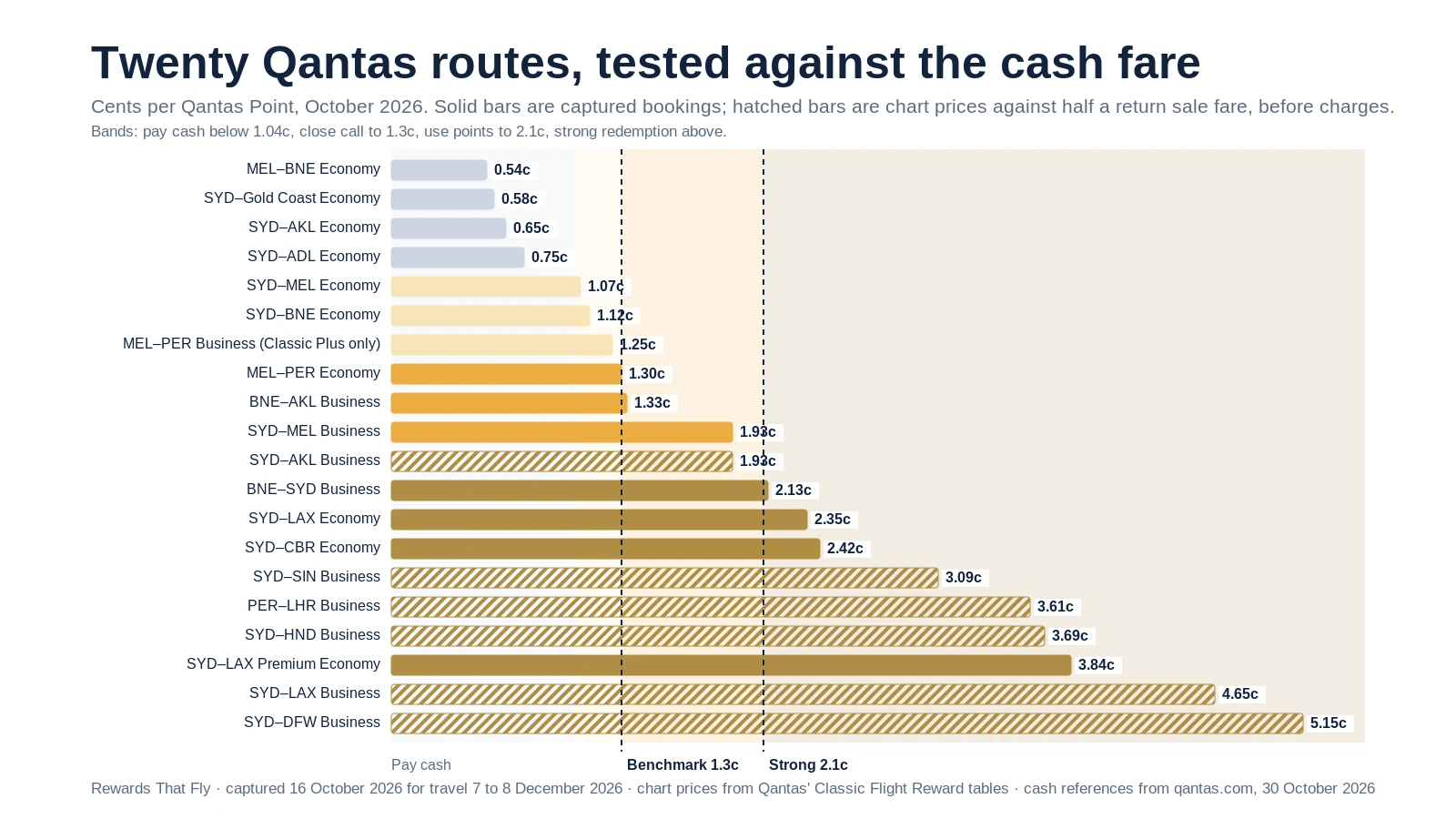
The best use of Qantas Points depends on two things: the value of the cash fare you are replacing and whether a suitable Classic Reward seat is available.
Business Class rewards often produce the highest cents-per-point values, particularly on long-haul flights. But they are not the only good options. Some domestic Economy rewards can also offer strong value when cash fares are expensive.
We compared 20 Qantas Classic Reward routes across domestic Economy, Business Class, trans-Tasman and long-haul travel.
Thirteen comparisons use reward prices and cash fares captured from the same flights in October 2026. The remaining seven cover Business Class: six examine potential redemption values using Qantas' published reward prices, advertised cash fares and our own reward-availability data, and the seventh, Melbourne–Perth, had no Classic Reward seat available at all.
The results range from 0.54 cents per point on Melbourne–Brisbane Economy to a potential 5.15 cents per point before charges on Sydney–Dallas Business.
The difference is substantial, but the highest theoretical value is not necessarily the most useful redemption.
At a glance
- Domestic Business can offer good value. Our Sydney–Melbourne and Brisbane–Sydney examples returned 1.93c and 2.13c per point.
- Domestic Economy varies considerably. Sydney–Canberra returned 2.42c during a reward sale, while Melbourne–Brisbane returned only 0.54c.
- Long-haul premium cabins have the highest potential values. Sydney–Los Angeles Premium Economy returned 3.84c in our live comparison.
- Cheap Jetstar fares often favour cash. Sydney–Gold Coast Economy returned just 0.58c per point against a $75 fare.
- Availability is the main limitation. Our November watch showed Business reward availability on 106 of 285 recorded dates to Singapore, but only 11 of 293 to Los Angeles.
- Always include taxes and carrier charges. These can materially reduce the value of a reward, particularly on shorter international flights.
Our October 2026 benchmark is 1.3 cents per Qantas Point, with 2.1 cents or more representing a strong redemption.
The Qantas Points Calculator uses the same benchmarks to assess any flight you are considering.
How we compared the routes
For each redemption, we calculate the cash fare replaced by the points:
Value per point = (cash fare − reward taxes and charges) ÷ points used × 100
The result is expressed in cents per point.
For example, a Business Class flight costing $459 in cash or 19,300 Qantas Points plus $86 in charges provides:
($459 − $86) ÷ 19,300 × 100 = 1.93 cents per point
That is above our current benchmark, making it an attractive redemption to consider.
We use four classifications:
| Result | Value | Interpretation |
|---|---|---|
| Strong redemption | 2.1c or more | Strong value relative to our measured redemptions |
| Use points | 1.3c to 2.1c | Above our benchmark |
| Close call | 80% of the benchmark up to the benchmark | A reasonable result where other considerations matter |
| Pay cash | Below 80% of the benchmark | Cash may be preferable if you have better uses for the points |
These are reference points, not instructions.
A redemption below the benchmark can still make sense if it provides travel you want and you have limited alternative uses for your points.
Equally, a redemption worth 4c per point is only useful if the seat exists on dates you can travel.
Domestic Economy: some good uses, but cash often wins
Domestic Economy produced some of the widest differences in our October comparisons.
| Route | Classic Reward | Cash fare | Value per point |
|---|---|---|---|
| Sydney–Canberra | 7,300 points + $92 | $269 | 2.42c |
| Melbourne–Perth | 16,600 points + $62 | $278 | 1.30c |
| Sydney–Brisbane | 5,700 points + $43 | $107 | 1.12c |
| Sydney–Melbourne | 5,700 points + $38 | $99 | 1.07c |
| Sydney–Adelaide | 11,000 points + $42 | $125 | 0.75c |
| Sydney–Gold Coast | 5,700 points + $42 | $75 | 0.58c |
| Melbourne–Brisbane | 11,000 points + $46 | $105 | 0.54c |
Rewards and equivalent cash fares captured on 16 October 2026 for travel on 8 December 2026. Jetstar examples use Classic Rewards on Jetstar-operated flights.
Sydney–Canberra: strong value on a short flight
Sydney–Canberra was the strongest domestic Economy result in our sample.
The Classic Reward required 7,300 points plus $92, compared with a $269 Qantas Red e-Deal fare.
That produced 2.42 cents per point.
However, the reward was captured during a promotional points discount that ended on 16 October.
At the standard 9,200-point price, the same comparison would return approximately 1.92c per point.
That remains above our benchmark, although it is below the promotional result.
The main reason the redemption works is the relatively high cash fare on a short route with no low-cost competition.
Melbourne–Perth: reasonable value
Melbourne–Perth Economy returned 1.30c per point, using a Jetstar Classic Reward.
The reward required 16,600 points plus $62 against a $278 cash fare.
That is close to our benchmark and may be a sensible use of points, particularly if you prefer to preserve cash for the trip.
However, the result would be less attractive during a substantial Jetstar sale.
Short routes with cheap Jetstar fares
Sydney–Gold Coast and Melbourne–Brisbane were the weakest redemptions in the comparison.
For Sydney–Gold Coast:
- Cash fare: $75.
- Classic Reward: 5,700 points + $42.
- Cash replaced: $33.
- Value: 0.58c per point.
The charges account for more than half the cash fare.
Melbourne–Brisbane returned even less, at 0.54c per point.
For these flights, paying cash would generally be preferable if you expect to use the points for another redemption.
The lesson is not that domestic Economy is poor value. It is that cheap cash fares can make otherwise reasonable fixed-price rewards unattractive.
Domestic Business: a consistent option worth checking
Domestic Business Class produced better results in the flights we could book and price.
| Route | Classic Reward | Cash fare | Value per point |
|---|---|---|---|
| Brisbane–Sydney | 19,300 points + $87 | $499 | 2.13c |
| Sydney–Melbourne | 19,300 points + $86 | $459 | 1.93c |
| Melbourne–Perth | No Business Classic Reward found | Classic Plus only | Approximately 1.25c through Classic Plus |
Captured 16 October 2026 for travel on 8 December 2026.
Sydney–Melbourne and Brisbane–Sydney
Both routes offered Business Classic Rewards at 19,300 points one way.
Against the available Business Sale fares:
- Sydney–Melbourne returned 1.93c per point.
- Brisbane–Sydney returned 2.13c per point.
These are attractive outcomes relative to our central benchmark.
The Sydney–Melbourne result also demonstrates how the cash fare changes the calculation.
The cheapest Business fare on the date was $459. Most other flights were priced at $499.
At $499, the same 19,300-point reward with $86 in charges would return approximately 2.14c per point.
The points price is unchanged, but the value increases with the cash fare.
Melbourne–Perth: the reward was not available
Our search found no Business Classic Reward on Qantas' direct Melbourne–Perth flights for 8 December.
Instead, Classic Plus was available from 117,600 points plus $101, with other flights requiring substantially more points.
That is an important distinction.
A flight being available to book with points does not mean a fixed-price Classic Reward seat is available.
Our sampled premium-cabin Classic Plus rate is approximately 1.25c per point, generally below the stronger fixed-price Business redemptions.
Classic Plus may still be useful if you want to take a particular flight and prefer to use points, but it should be compared with the equivalent cash fare.
Trans-Tasman: taxes and charges matter
Qantas Points can also be used for flights between Australia and New Zealand.
However, the cash component can materially reduce the value.
| Route | Reward | Cash reference | Value per point |
|---|---|---|---|
| Brisbane–Auckland Business | 43,600 points + $169 | $749, same flight | 1.33c |
| Sydney–Auckland Business | 43,600 points plus charges | $840, derived from half a return Business fare | 1.93c before charges |
| Sydney–Auckland Economy | 16,600 points + $176 | $284, same flight | 0.65c |
Brisbane Business and Sydney Economy were captured on 16 October 2026. Sydney Business is a chart-based comparison using an advertised cash reference, not a confirmed same-flight redemption.
Why Economy can be poor value
Our Sydney–Auckland Jetstar Economy example required:
16,600 points + $176
The same flight cost $284 in cash.
That means the points replaced only $108.
The resulting value was 0.65c per point, well below our benchmark.
Business is better, but not automatically strong
Brisbane–Auckland Business returned 1.33c per point.
That was close to our benchmark, but substantially below the strongest domestic and long-haul premium-cabin examples.
Sydney–Auckland Business has greater potential based on the advertised cash fare, but the illustrative 1.93c figure is before taxes and carrier charges.
The actual redemption value would be lower.
For trans-Tasman flights, checking the cash charges is particularly important before using a large points balance.
Long-haul flights: the highest potential values
Long-haul premium cabins produced the highest potential cents-per-point values in our comparison.
However, the figures below have two different evidence bases.
The Economy and Premium Economy examples are live reward captures, with the same-flight cash fares and charges recorded.
The Business Class examples use Qantas' published Classic Reward prices and advertised cash-fare references. Taxes and carrier charges were not captured, so those values are illustrative and shown before charges.
Long-haul Economy and Premium Economy
| Route and cabin | Classic Reward | Cash fare | Value per point |
|---|---|---|---|
| Sydney–Los Angeles Premium Economy | 97,600 points + $355 | $4,107 | 3.84c |
| Sydney–Los Angeles Economy | 48,200 points + $289 | $1,424 | 2.35c |
Captured 16 October 2026 for travel in December 2026. The Economy itinerary connected via Melbourne.
Both returned strong value relative to our benchmark.
Sydney–Los Angeles Premium Economy
The Premium Economy reward returned 3.84 cents per point.
The cash fare was $4,107, while the reward required 97,600 points plus $355.
The points replaced $3,752 of the cash fare.
That is one of the strongest confirmed redemptions in our October sample.
However, the calculation measures the value of the Premium Economy fare replaced.
If you would otherwise travel in Economy, your personal saving may be much smaller than the $3,752 retail comparison.
Sydney–Los Angeles Economy
The Economy reward returned 2.35 cents per point against a $1,424 cash fare.
This is particularly interesting because the same 48,200-point reward returned only about 1.05c in an earlier comparison for September travel.
The increase came from the higher December cash fare rather than a lower points price.
Fixed-price rewards can therefore become more valuable during expensive travel periods.
That is one reason to check reward availability for school holidays, Christmas and other peak dates, although reward seats may also be harder to find.
Long-haul Business: strong potential, limited availability
The following comparisons show the potential value of Business Classic Rewards using published points prices and Qantas' advertised Business fares.
| Route | Business Classic Reward | Cash reference | Value before reward charges |
|---|---|---|---|
| Sydney–Dallas Fort Worth | 151,800 points | $7,814 | 5.15c |
| Sydney–Los Angeles | 130,100 points | $6,050 | 4.65c |
| Sydney–Tokyo Haneda | 98,400 points | $3,628 | 3.69c |
| Perth–London | 151,800 points | $5,476 | 3.61c |
| Sydney–Singapore | 82,100 points | $2,533 | 3.09c |
Cash references are based on half the advertised return Business Saver fares captured on 30 October 2026. The figures are before reward taxes and carrier charges and do not establish that a Classic Reward seat was available.
These comparisons show why long-haul Business Class is often considered an attractive use of Qantas Points.
However, they should not be interpreted as realised redemption values.
There are two important limitations.
First, the final cents-per-point value will be lower once reward taxes and carrier charges are deducted.
Second, the reward must actually be available.
For Sydney–Dallas, our 1 November reward watch showed no Business Classic Reward availability across the 273 dates recorded.
A theoretical 5.15c redemption is not useful if no seat can be booked.
That is why availability deserves as much attention as the points price.
How often are the best Reward Seats available?
Our nightly Qantas Flight Reward Finder watch records availability on selected international routes.
The snapshot from 1 November 2026 provides a useful indication of how different routes compare.
| Route | Dates showing Business availability | Dates monitored |
|---|---|---|
| Sydney–Auckland | 148 | 318 |
| Sydney–Singapore | 106 | 285 |
| Sydney–Tokyo Haneda | 37 | 261 |
| Perth–London | 13 | 164 |
| Sydney–Los Angeles | 11 | 293 |
| Sydney–London | 3 | 265 |
| Sydney–Dallas Fort Worth | 0 | 273 |
These are dates where at least one Business Classic Reward appeared in the Finder data.
They are not seat counts or probabilities of securing a booking.
The Finder may include partner-operated flights, and its results can be several hours or weeks old depending on the month being monitored.
Availability must be confirmed through Qantas before booking.
Singapore and Auckland are more accessible
Sydney–Singapore and Sydney–Auckland showed considerably more Business availability than the long-haul routes to Europe and North America.
That does not guarantee a seat on your preferred dates.
However, it makes them more practical routes to search when planning a redemption several months ahead.
Los Angeles and London require more flexibility
The picture is different for Los Angeles and London.
Sydney–Los Angeles showed Business availability on only 11 of 293 monitored dates in the 1 November snapshot.
Sydney–London showed just three dates.
For these routes, flexibility in travel dates, connections and airlines can make a substantial difference.
Our Classic Reward availability guide explains the release patterns and how to search more effectively.
Why one availability snapshot does not tell the whole story
Reward availability changes continually.
Our nightly watch records not only the dates with seats visible at a particular time, but also new openings since the previous check.
Between 21 August and 1 November 2026, the watch recorded Business availability appearing on the following numbers of distinct travel dates:
| Route | Dates with recorded Business openings |
|---|---|
| Sydney–Singapore | 232 |
| Sydney–Tokyo Haneda | 202 |
| Sydney–Los Angeles | 194 |
| Sydney–Auckland | 173 |
| Sydney–New York | 78 |
| Perth–London | 75 |
| Sydney–Dallas Fort Worth | 25 |
| Sydney–London | 24 |
These figures describe distinct travel dates on which new availability was observed during the monitoring period.
They do not mean that all those seats were simultaneously available, or that the same number of seats could be booked today.
For example, Sydney–Los Angeles Business availability appeared across 105 dates during a single release recorded on 12 September 2026.
That helps explain why one snapshot may show very little availability even though substantial inventory has appeared during the preceding months.
For difficult long-haul routes, the practical approach is to monitor the route and be ready to book when suitable availability appears.
Where we found no Classic Reward seats
Not every route in our October valuation work had an available fixed-price Classic Reward.
The following searches produced no suitable Classic seat in the periods checked.
| Route and cabin | What our search found |
|---|---|
| Sydney–Singapore Economy | No Qantas-operated Economy Classic seat found for 1–15 December 2026 |
| Sydney–Singapore First | No First Classic seat found during the late-September to mid-October search period |
| Sydney–Denpasar Economy | Classic Plus only for the date checked |
| Sydney–Cairns Economy and Business | No suitable Classic seats found during the September school-holiday dates checked |
| Melbourne–London Business | No Business Classic seat found in the dates searched |
| Sydney–Hong Kong Business | No Cathay Pacific partner Business reward found in the checked window; Qantas Classic Plus available |
These are dated search results, not statements that the routes never have Classic Reward availability.
Classic Plus is still an option
Where fixed-price Classic Rewards are unavailable, Qantas may offer Classic Plus.
Classic Plus generally provides broader availability, but the points requirement moves with the underlying cash fare.
Our recent checks returned approximately:
- 0.9c per point in Economy; and
- 1.25c per point in premium cabins.
These results are below the stronger fixed-price Classic Rewards in our sample.
However, Classic Plus can still make sense when you want a particular flight, have points available and prefer not to pay the full cash fare.
The Qantas Points Calculator can assess the specific Classic Plus quote against our benchmark.
Is Perth a better departure point for London?
Perth is worth considering for long-haul Qantas rewards because it can fall into a lower distance band than east-coast departures.
Under the current Qantas Classic Reward tables:
- Perth–London Business: 151,800 points one way, based on the Zone 9 distance calculation.
- Sydney–London Business: 166,300 points one way.
That is a potential saving of 14,500 Qantas Points one way.
However, the Perth figure is based on our application of Qantas' published distance chart, rather than a completed booking. Confirm the final reward price through Qantas.
The saving also needs to be assessed against:
- the cost of positioning to Perth;
- any additional accommodation;
- the time required; and
- the availability of a suitable Business Classic Reward.
Our November watch showed Perth–London Business availability on 13 of 164 recorded dates, compared with three of 265 for Sydney–London.
Perth may therefore be worth including in a broader search, but the lower points price is not sufficient on its own to make positioning worthwhile.
How to find the best use of your Qantas Points
The tables above provide reference points, but the right decision depends on the flight you actually want to take.
We would use three steps.
1. Start with the cash fare
Check the cash price for the same flight and cabin.
A fixed-price reward becomes more valuable when the cash fare is high.
For example, the same 19,300-point domestic Business reward can return materially different values depending on whether the cash fare is $459, $499 or substantially higher.
Do not use an unusually expensive fare simply to make the points appear more valuable.
2. Calculate the redemption value
Subtract the reward's taxes and charges from the cash fare, then divide by the points required.
Compare the result with our published benchmark.
The Qantas Points Calculator does this automatically and includes a Classic Plus comparison.
3. Check whether the reward is actually available
For a domestic flight, use the Qantas booking calendar.
For international travel, the Flight Reward Finder provides a broader view of available dates and destinations.
If you are searching for a particularly scarce Business Class seat, monitoring availability over time is often more useful than searching once.
Our Classic Reward availability guide explains how to approach that process.
Frequently asked questions
What is the best use of Qantas Points in 2026?
In our October 2026 comparisons, selected long-haul Business and Premium Economy Classic Rewards offered the highest potential values.
Sydney–Los Angeles Premium Economy returned 3.84 cents per point in a confirmed comparison, while long-haul Business examples showed potential values above 3c before taxes and charges.
Domestic Business also offered good value, with Sydney–Melbourne and Brisbane–Sydney returning 1.93c and 2.13c.
The best redemption depends on finding a suitable seat and whether the flight is one you actually want to take.
How much should I aim to get per Qantas Point?
Our October 2026 benchmark is 1.3c per point, with 2.1c or more representing a strong redemption.
These figures come from our basket of live redemption comparisons, re-verified on 16 October 2026.
They provide a useful reference, but a redemption below the benchmark can still make sense if you have limited alternative uses for your points.
Are Qantas Points worth using for domestic Economy?
Sometimes.
Sydney–Canberra returned 2.42c per point during a points promotion, while Melbourne–Perth returned 1.30c.
By comparison, Sydney–Gold Coast returned only 0.58c and Melbourne–Brisbane 0.54c against cheap Jetstar fares.
The deciding factor is usually the cash fare and reward charges.
Why are Qantas Points sometimes poor value to New Zealand?
Taxes and carrier charges can account for a substantial part of the cash fare.
Our Sydney–Auckland Jetstar Economy example required 16,600 points plus $176 in charges, compared with a $284 cash fare.
The points replaced only $108, producing 0.65c per point.
Business rewards can provide better value because the cash fares are higher, although charges still need to be included.
Are Business Class rewards always the best use of Qantas Points?
No.
Business Class can produce high cents-per-point values because comparable cash fares are expensive.
However, availability can be limited, and the retail value of a Business fare is not necessarily the amount you would personally spend.
An Economy reward on a route you regularly fly may provide more useful value than a theoretically exceptional Business redemption you are unlikely to book.
Is Qantas Classic Plus worth using?
It can be.
Classic Plus generally returns a lower cents-per-point value than the stronger fixed-price Classic Rewards, but it may be available when Classic Rewards are not.
If the flight and dates matter more than maximising redemption value, Classic Plus can be a reasonable option.
Compare the actual points price, cash charges and equivalent cash fare before booking.
How do I check a Qantas redemption that is not in this guide?
Use the Qantas Points Calculator.
Enter:
- the cash fare;
- the points required; and
- the reward's taxes and charges.
The calculator shows the value per point and compares it with our current Qantas benchmark.
What to do next
If you have a destination in mind, start by checking the cash fare and available Classic Rewards.
Use the Qantas Points Calculator to compare the options.
If a suitable reward provides good value, confirm the final points, charges and booking conditions before using your balance.
If the redemption is relatively poor value, check whether a competitive cash fare is available through our Australian flight deals board.
For international Business and First Class rewards, the main challenge may be finding the seat rather than achieving a high cents-per-point result. Our Classic Reward availability guide explains how to search and monitor those routes.
For the wider program, see our Qantas Frequent Flyer guide.
And if you want to understand what your whole points balance is worth, rather than a particular flight, see Points Valuations.
The strongest use of Qantas Points is not necessarily the highest theoretical cents-per-point result. It is a redemption that provides good value for travel you actually want to take.
Methodology and sources
Verification dates
This guide uses redemption comparisons and availability observations collected between August and November 2026.
The principal cash and reward comparisons were captured on 16 October 2026.
Additional Qantas sale-fare references were captured on 30 October 2026, while the reward-availability snapshot was taken on 1 November 2026.
All values are dated observations, not live booking quotes.
Confirmed redemption comparisons
Thirteen routes use the bookable redemption examples from our October 2026 valuations basket.
These were captured through qantas.com and jetstar.com for travel on 8 December 2026, except the Sydney–Los Angeles Economy itinerary, which was for 7 December.
Each example records:
- the points required;
- the taxes and carrier charges payable;
- the cheapest available standard cash fare for the same flight and cabin; and
- the resulting cents-per-point value.
The calculation is:
(Cash fare − reward taxes and charges) ÷ points used × 100
The full valuation basket is published on Points Valuations.
Chart-based Business comparisons
Six comparisons use Qantas' published Classic Flight Reward prices rather than a confirmed reward booking; the Melbourne–Perth Business row records a search that found no Classic Reward seat.
Points prices are based on the relevant distance bands in the Qantas Classic Flight Reward tables.
Cash references are derived from half the advertised return Business Saver fares recorded by our Qantas deals collector on 30 October 2026.
These figures are illustrative rather than directly comparable one-way cash quotes.
Taxes and carrier charges were not captured for these rows, so the stated cents-per-point values are before reward charges.
The final value would be lower once those amounts are deducted.
The Perth–London Zone 9 classification is based on our application of the published distance chart and has not been confirmed through a completed booking.
Reward availability
Availability observations come from our nightly Qantas Flight Reward Finder monitoring.
The main snapshot was taken on 1 November 2026.
The figures count dates where at least one Business Classic Reward appeared in the monitored data.
They do not represent:
- the total number of seats available;
- guaranteed availability for any number of passengers;
- a complete live search of every possible itinerary; or
- a probability of booking a particular flight.
The Finder can include partner-operated services.
The number of monitored dates differs between routes, and some monthly observations may be older than others because the watch refreshes months in rotation.
The opening-history counts cover distinct travel dates on which new availability appeared between 21 August and 1 November 2026.
These are observations over time, not seats simultaneously available.
Benchmarks
Our current Qantas valuations are:
- Benchmark: 1.3c per point.
- Strong redemption: 2.1c per point.
The benchmark is based on the median of our fixed redemption basket, while the strong-redemption level reflects the 75th percentile.
The close-call band begins at 80% of the benchmark.
Classic Plus comparison values use our sampled estimates rather than conversion rates published by Qantas.
Scope and limitations
The comparisons measure the value of cash fares replaced by points.
They do not necessarily represent the amount a traveller would otherwise spend on the same cabin.
Cash fares may also earn Qantas Points and Status Credits, while reward bookings have different change and cancellation conditions.
Reward availability, points pricing, taxes and fares change regularly.
Confirm the final details with Qantas before transferring points or booking.
We review the underlying valuations monthly and update the guide following material changes.