Guides · Points
Australia's card surcharge ban: what it means for Qantas and Velocity Points
Australia's card surcharge ban began on 1 October 2026, alongside lower interchange fees. See what changed for credit card rewards, ATO payments and Qantas and Velocity Points.
By Rewards That Fly · Updated 16 October 2026 · 10 min read
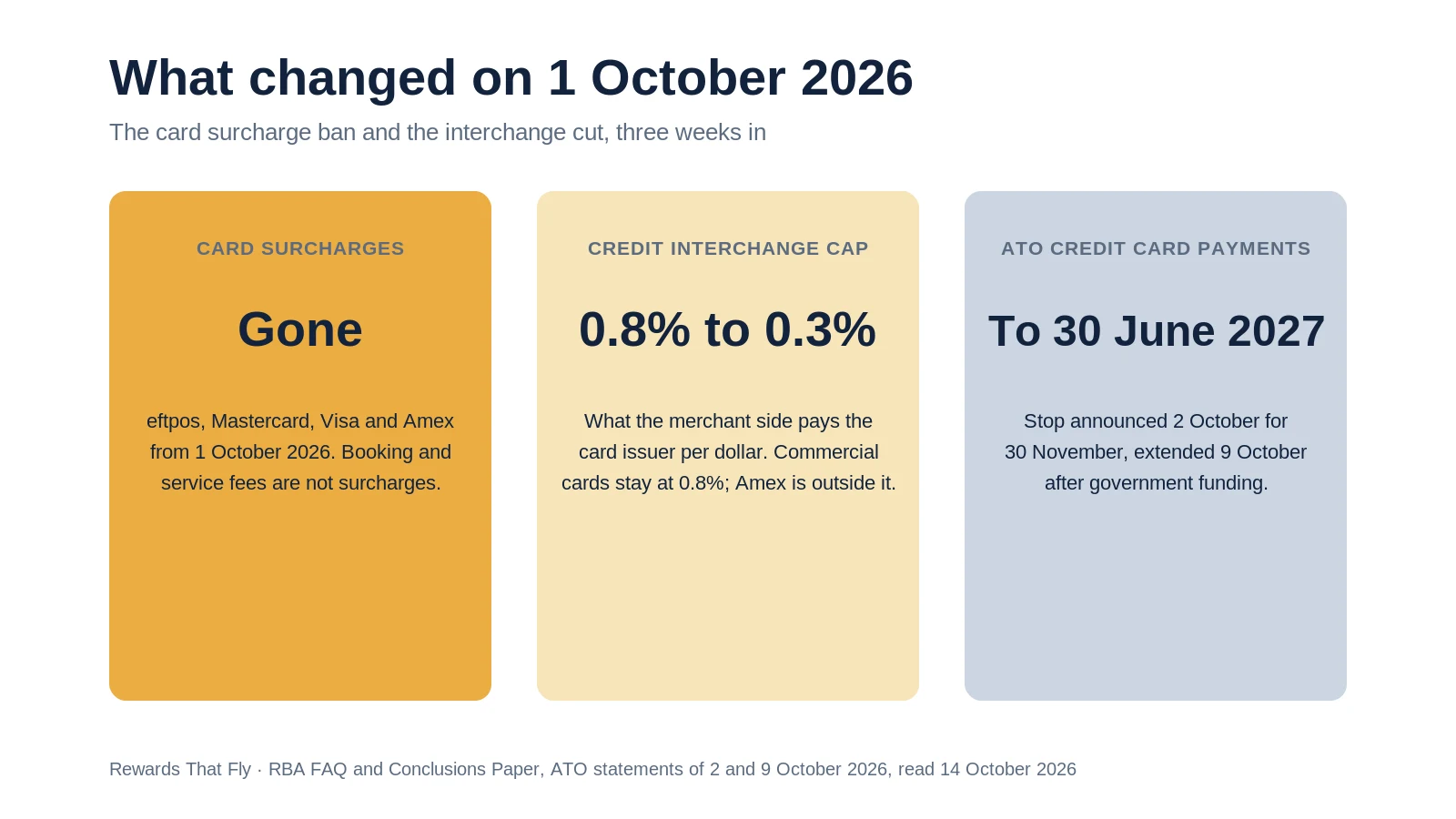
Australia's ban on card payment surcharges took effect on 1 October 2026, alongside changes to the fees banks receive when customers pay by card.
For consumers, the immediate benefit is straightforward: businesses can no longer add surcharges for payments using the affected card networks.
For people earning Qantas or Velocity Points, the consequences are more complicated.
The Reserve Bank has also reduced the maximum interchange fee on consumer credit card transactions from 0.8% to 0.3%. That reduces an important source of revenue for card issuers, several of which have announced changes to rewards programs, earning rates and fees.
The changes also affect some large payments that previously offered opportunities to earn substantial points, including tax payments.
At a glance
- Card surcharges ended on 1 October 2026 for eftpos, Mastercard and Visa. American Express also removed surcharging through its own arrangements.
- Consumer credit card interchange fees fell from a maximum of 0.8% to 0.3%. This reduces revenue available to support card rewards.
- Several banks have reduced ongoing points earning, introduced caps or increased card and rewards-program fees.
- Sign-up bonuses remain available, although some offers have become less generous and exclusion periods have lengthened.
- The ATO will continue accepting credit cards until 30 June 2027, following an extension announced on 9 October.
- Paying fees solely to earn points needs careful calculation. A 1.5% payment fee can exceed the value of points earned at our benchmark.
- It may be worth comparing rewards cards. Some American Express products have retained their existing earn rates while several Visa and Mastercard issuers have reduced rewards.
The main implication is that earning points through everyday card spending has become less attractive on some products, even though paying by card is now cheaper where surcharges previously applied.
What changed on 1 October 2026?
The Reserve Bank announced its final payment regulation reforms on 31 March 2026, with the changes taking effect on 1 October.
Two changes matter most.
Card surcharges have been removed
Businesses can no longer impose payment surcharges on transactions using the designated eftpos, Mastercard and Visa networks.
The ban covers credit, debit and prepaid cards.
American Express is not regulated under the same RBA framework, but also removed surcharging through its own arrangements from 1 October.
This means a retailer that previously added a 1% or 1.5% surcharge for paying by card can no longer impose that surcharge on an affected transaction.
However, three distinctions remain important:
- Businesses are not required to accept credit cards.
- Genuine booking or service fees may still apply where they are not prohibited card surcharges.
- Businesses can continue offering discounts for alternative payment methods.
The surcharge ban therefore does not mean every payment involving a credit card must be free of additional fees.
Interchange fees have been reduced
Interchange is the fee paid between banks when a customer uses a card.
It is an important source of revenue for card issuers and helps fund rewards programs, among other costs.
The reforms reduce the relevant caps as follows:
| Transaction type | Previous cap | New cap |
|---|---|---|
| Consumer credit cards | 0.80% | 0.30% |
| Commercial credit cards | 0.80% | 0.80% |
| Debit cards, fixed-fee cap | 10 cents | 8 cents |
| Debit cards, percentage-based cap | 0.20% | 0.16% |
The consumer credit card reduction is particularly significant for rewards programs.
The RBA estimated that the reforms would reduce annual interchange revenue by more than $910 million.
That does not translate directly into an equivalent reduction in points or cardholder benefits. Banks have several sources of revenue and different commercial arrangements.
However, it helps explain why issuers are reviewing the economics of their rewards products.
What have Australian credit card issuers changed?
Several major issuers have announced changes taking effect between September 2026 and early 2027.
The changes vary by issuer and product, but the main areas are points earning, annual fees, program fees, insurance benefits and sign-up bonus conditions.
| Issuer | Main announced changes | Timing |
|---|---|---|
| ANZ | Reduced Qantas sign-up bonuses, introduced rewards-earning caps and announced changes to insurance benefits | October 2026 to March 2027 |
| NAB | Reduced ongoing Qantas Points earning on selected cards, changed fees and increased the Qantas Rewards bonus exclusion period to 36 months | October 2026 |
| Westpac and Amplify brands | Increased some rewards-program fees, reduced selected transfer rates and changed card fees and conditions | September 2026 |
| CommBank | Changes to rewards earning and redemption, fee waivers and selected insurance benefits | September 2026 to January 2027 |
| Bankwest | Reduced Qantas Points earning on selected cards and introduced a 36-month exclusion period for Qantas Mastercard bonuses | October 2026 |
| Virgin Money | Reduced earning rates and increased annual fees on selected rewards cards | October 2026 |
| Qantas Money | Changed the structure of its Platinum sign-up bonus, including an additional eligibility condition | September 2026 |
| American Express | No comparable broad reduction in points earning identified in the announcements reviewed; separate lounge-benefit changes have occurred | Various dates in 2026 |
Summary of announced changes reviewed on 14 October 2026. Individual products have different rates and effective dates. See the issuer terms and sources below for the detailed conditions.
Three developments are particularly relevant for frequent flyer members.
1. Ongoing points earning has been reduced
Several Visa and Mastercard rewards products now earn fewer points per dollar or apply lower earning rates above a monthly spending threshold.
For example, NAB's Qantas Rewards Signature card reduced its earning rate from the previous one-point-per-dollar structure, while Bankwest and Virgin Money also announced lower earning rates on selected products.
ANZ has introduced spending caps that limit the amount of expenditure eligible for rewards earning during a statement period.
The impact depends on the card and how much is spent.
For a cardholder who previously earned one point per dollar and now earns 0.75 points, $50,000 of eligible annual spending produces:
| Before | After | |
|---|---|---|
| Eligible spending | $50,000 | $50,000 |
| Points per dollar | 1.00 | 0.75 |
| Points earned | 50,000 | 37,500 |
That is 12,500 fewer points, or a 25% reduction, on the same spending.
At our current benchmark of 1.3 cents per Qantas Point, those 12,500 points have an estimated redemption value of approximately $163 (about $188 at the 1.5 cents Velocity benchmark).
This is an illustration of the effect of a lower earn rate, not a calculation for a particular card.
2. Some card and rewards-program fees have increased
Lower earning rates are not the only change.
Several issuers have also increased annual fees, introduced separate rewards-program charges or amended benefits such as travel insurance.
Westpac's changes include higher fees for some rewards programs and less favourable transfer rates from Altitude Rewards to selected airline partners.
These can affect the value of rewards even where the headline points-earning rate has not changed.
A card that earns the same number of points but costs more each year may deliver less net benefit.
3. Some sign-up bonus exclusions have lengthened
The changes are not confined to ongoing earning.
NAB Qantas Rewards, Bankwest Qantas Mastercard and MyCard Premier Qantas now have 36-month exclusions under their current sign-up bonus offers.
Many other major bank rewards products use 24-month periods.
The restrictions determine whether a current or former cardholder can receive a new sign-up bonus.
They do not necessarily prevent someone from applying for the card itself.
Our Australian credit card bonus eligibility guide sets out the current rules, including which products count as the same card family.
What about American Express?
American Express is in a different position because its card payment arrangements do not fall under the same interchange caps as Visa and Mastercard.
As at our 14 October review, we had not identified a comparable broad reduction in American Express Membership Rewards earning or transfer rates directly associated with the October reforms.
That may make certain American Express products more attractive relative to Visa and Mastercard rewards cards whose earning rates have fallen or fees have increased.
However, American Express has already made separate changes to selected lounge benefits during 2026, and future changes to earning rates or program benefits remain possible.
Merchant acceptance also varies, while annual fees and the value of included benefits can differ substantially between products.
American Express is therefore one option worth comparing, rather than an automatic replacement for an existing rewards card.
What happened to ATO credit card payments?
The ATO's response to the surcharge ban is particularly relevant to people who use credit cards for large payments.
On 2 October 2026, the ATO announced that it would stop accepting credit cards after 30 November 2026.
The ATO cited merchant fees approaching $200 million annually and the difficulty of absorbing those costs where tax liabilities are set by legislation.
It subsequently changed the timetable.
On 9 October 2026, the ATO announced that credit card acceptance would continue until 30 June 2027, following transitional government funding.
What happens after June 2027?
Under the currently announced arrangements, taxpayers wishing to pay by credit card after 30 June 2027 may need to use a third-party payment provider.
Those providers can charge service fees.
That creates a different calculation from paying the ATO directly.
The relevant questions are:
- What fee does the payment provider charge?
- Does the credit card award points on that payment?
- What is the effective earning rate?
- What are those points realistically worth?
The fact that a payment earns points does not necessarily mean the fee is worthwhile.
When is paying a fee to earn points worthwhile?
A useful way to assess a payment fee is to calculate the cost per point earned.
For example, suppose you make a $10,000 payment through a provider charging 1.5%.
The payment fee is:
$10,000 × 1.5% = $150
If the card earns one Qantas Point per dollar, you receive 10,000 points.
The effective cost is:
$150 ÷ 10,000 = 1.5 cents per point
Our current Points Valuations benchmark is 1.3 cents per Qantas Point.
At that benchmark, the points have an estimated value of $130, compared with the $150 fee.
That is not an attractive exchange on a purely financial basis.
However, selected flight redemptions can deliver more than 2.1 cents per Qantas Point.
If the points are used for a suitable higher-value redemption, the calculation may be different.
The important distinction is between the value you expect to receive and the highest theoretical value available somewhere in the program.
A strong redemption is only relevant if you can actually book and use it.
A simple comparison
Assuming one point per dollar of eligible spending:
| Payment fee | Cost per point |
|---|---|
| 0.5% | 0.5c |
| 1.0% | 1.0c |
| 1.5% | 1.5c |
| 2.0% | 2.0c |
These figures exclude any other fees and assume the entire payment earns points at the stated rate.
If the card earns only 0.5 points per dollar, the effective cost per point doubles.
Before paying a fee solely to earn points, check the actual earning eligibility and rate for that transaction. Government payments and payments through intermediaries may be excluded or earn at a reduced rate.
What about schools and other large bills?
Some businesses and organisations have responded to the surcharge ban by reconsidering whether to accept credit cards.
Contemporary reporting suggests that certain private schools have removed credit card payment options for school fees rather than absorb the merchant costs.
Similar concerns have been raised in the childcare sector.
We have not independently verified the payment policies of the individual schools cited in that reporting, so these should be treated as reported examples rather than evidence of an industry-wide change.
The broader point is that removing surcharges does not require a merchant to keep accepting credit cards.
For large recurring expenses, payment acceptance and any associated service fees are now worth checking before assuming that an established points-earning arrangement will continue.
What does the surcharge ban mean for everyday spending?
There are two effects working in opposite directions.
Card payments are cheaper where surcharges previously applied.
A $100 purchase that previously attracted a 1.5% surcharge now saves the customer $1.50 if the underlying price is unchanged and no other fee applies.
Some rewards cards now earn fewer points or cost more to hold.
That reduces the value of points earned from the same spending.
The overall result depends on the individual card and spending pattern.
For example, someone who previously paid frequent surcharges may benefit substantially from their removal, even if their card earns fewer points.
Someone whose spending rarely attracted surcharges but whose card has a materially lower earning rate may see little direct benefit from the ban.
Businesses may also adjust their underlying prices over time in response to payment costs, so the saving cannot necessarily be assumed to persist in full.
What should Qantas and Velocity members check?
The changes are a reason to review how you earn points, particularly if your existing card has become less generous.
Your current earning rate
Check the latest earning rate and spending caps on the card you already use.
Several issuers changed their terms from 30 September or 1 October 2026, while some additional changes take effect later.
The rate applying today may differ from the one that applied when the card was opened.
Whether another card offers better value
If your card's earning rate has fallen or its fees have increased, it may be worth comparing it with other available products.
Some American Express cards have retained their existing earning rates, while several Visa and Mastercard issuers have reduced rewards or increased fees. That may make American Express or another rewards card more attractive for some members.
However, a higher earning rate does not necessarily mean better overall value.
The comparison should consider:
- annual fees and any separate rewards-program charges;
- points earned on your actual spending;
- merchant acceptance and any remaining payment costs;
- transfer rates and the programs you use; and
- insurance, lounge access and other benefits you would genuinely use.
The objective is to assess the total value of the card, rather than simply finding the highest advertised points-earning rate.
The cost of earning points
Annual fees, rewards-program fees and transaction charges all affect the net value of points earned.
For large payments, calculate the effective cost per point rather than relying on the headline earning rate.
Our Points Valuations provides a benchmark for the likely redemption value.
Other ways of earning points
Credit card spending is only one way to earn Qantas and Velocity Points.
Flying, shopping partners, loyalty-program promotions and transfers from participating rewards programs remain relevant.
Our Qantas Frequent Flyer guide and Velocity Frequent Flyer guide cover the main earning options.
The points transfer bonuses guide also tracks promotions that can increase the airline points received from participating rewards programs.
What to do next
If your rewards card has changed, start by comparing the new terms with what applied previously.
Calculate the points you expect to earn from your normal spending over a year, account for any caps or higher fees, and consider the value of benefits you actually use.
It may be worthwhile comparing alternative rewards cards, including American Express, particularly where your current earning rate has fallen materially. The comparison should be based on total costs and benefits rather than points earning alone.
For large payments, check whether the transaction earns points and calculate the cost per point after any service fees.
Finally, consider whether other earning methods, including airline partners or transfer promotions, provide a better way to accumulate points for the flights you want.
The surcharge ban has made some card payments cheaper, but changes to rewards earning mean it is worth reassessing how you accumulate Qantas and Velocity Points.
Methodology and sources
Verification date
This guide was reviewed on 14 October 2026.
The article summarises regulatory changes, published issuer announcements and reported responses to the surcharge ban.
Individual credit card terms may differ from the general descriptions above.
Reserve Bank reforms
The regulatory changes are based on the Reserve Bank of Australia's March 2026 conclusions paper and surcharge FAQs.
The RBA's reforms removed surcharging on the designated eftpos, Mastercard and Visa networks from 1 October 2026.
The consumer credit interchange cap was reduced from 0.8% to 0.3%, with separate changes to debit interchange caps.
The estimated reduction in interchange revenue was also reported by Point Hacks.
American Express implemented separate changes to surcharging outside the RBA's designated network framework.
ATO payments
The ATO initially announced changes to credit card acceptance in its 2 October 2026 statement.
It subsequently announced an extension to 30 June 2027 in its 9 October 2026 update.
The treatment of payments after that date may change. Taxpayers should confirm the current options and any fees with the ATO or relevant payment provider.
Credit card issuer changes
The issuer comparison draws on:
- Point Hacks' October 2026 credit card changes tracker;
- Canstar's issuer-by-issuer review;
- Australian Frequent Flyer's discussion of NAB's October changes; and
- our credit card bonus eligibility guide, which incorporates issuer terms reviewed on 14 October 2026.
The issuer table summarises material changes and is not intended to reproduce the complete terms of every card.
Some changes were announced before 1 October or take effect after that date. Their timing does not establish that the interchange reforms were the sole cause.
Schools and childcare
The discussion of school and childcare payment arrangements is based on contemporary reporting, including Spectator Australia's 9 October 2026 column.
We have not independently verified the payment policies of the individual organisations mentioned.
Points valuations
The value examples use our August 2026 Points Valuations benchmark:
- Qantas Points: 1.3 cents per point.
- Velocity Points: 1.5 cents per point.
- Strong Qantas flight redemptions: 2.1 cents per point or more.
The cost-per-point examples assume eligible spending earns at the stated rate and exclude any fees not expressly included in the calculation.
Scope and limitations
This guide provides general information about published regulatory changes and rewards-program conditions.
It does not recommend any particular credit card or assess the suitability of a financial product.
Fees, points earning, transfer rates, payment acceptance and card conditions can change.
Check current issuer and payment-provider terms before relying on any figure.
We review this guide following material changes. Updates are recorded in the Program Change Log.