Guides · Points
Points or cash? When to use Qantas or Velocity Points
Should you use points or pay cash for a flight? Compare Qantas and Velocity redemptions using our points benchmarks, real examples and calculators.
By Rewards That Fly · Updated 21 October 2026 · 10 min read
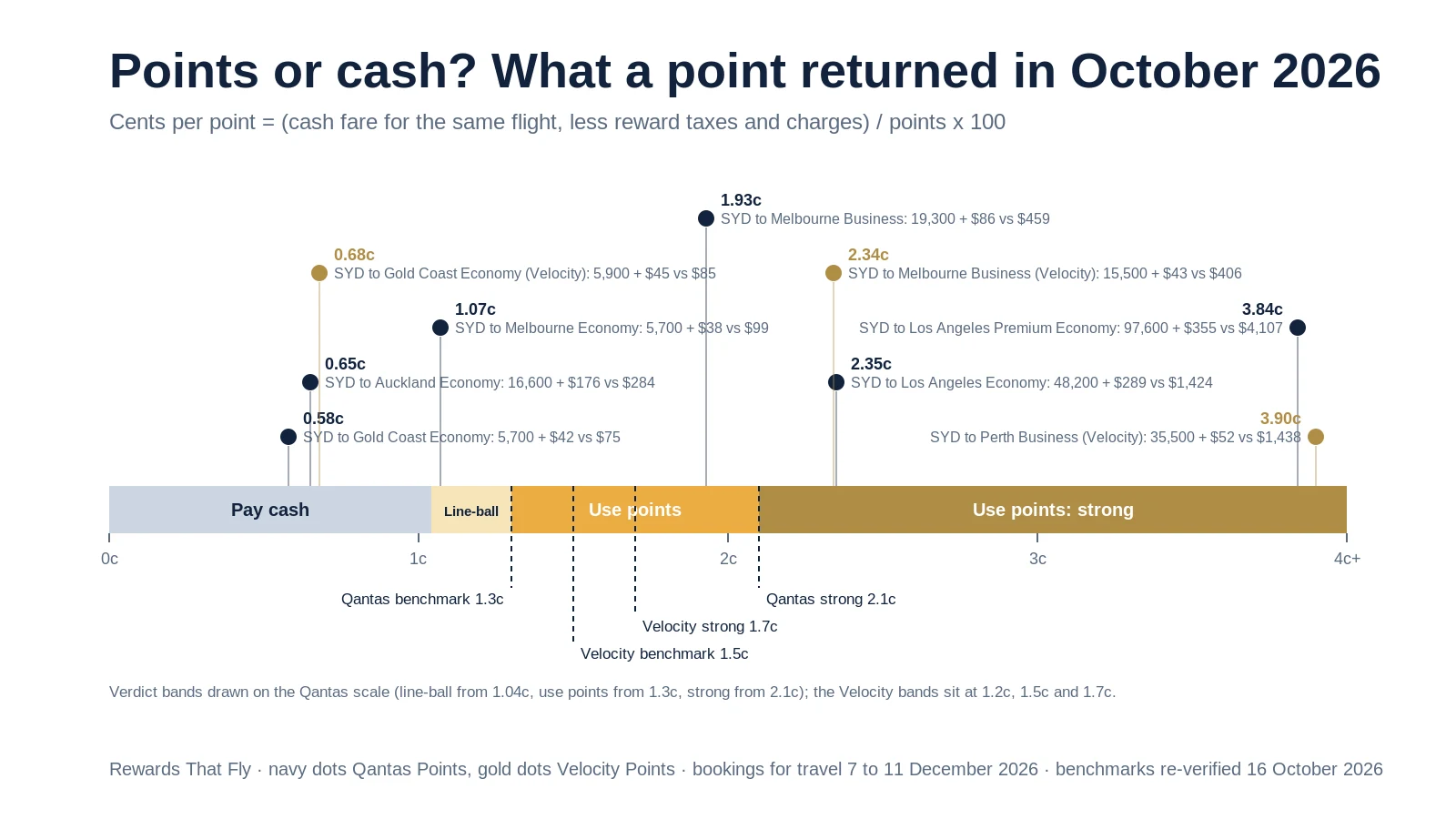
Should you use Qantas or Velocity Points to book a flight, or would you be better off paying cash?
The answer depends on the cash fare, the points required and the taxes and charges payable on the reward.
The same points balance can provide excellent value on one flight and relatively poor value on another. A cheap Economy sale fare may be better purchased with cash, while a Business Class Reward Seat can replace a much more expensive ticket.
The simplest way to compare them is to calculate the cents-per-point value of the redemption and assess it against a reasonable benchmark.
Our Qantas Points Calculator and Velocity Points Calculator do this for any flight. This guide explains how to interpret the result and when other considerations may change the decision.
At a glance
- Calculate the value: subtract the reward's taxes and charges from the comparable cash fare, then divide by the points required.
- Qantas Points: our October 2026 benchmark is 1.3c per point, with strong redemptions reaching 2.1c or more.
- Velocity Points: our benchmark is 1.5c per point, with strong redemptions reaching 1.7c or more.
- Points often offer better value on selected Business Class and Premium Economy rewards, or when cash fares are particularly expensive.
- Cash often makes more sense during strong Economy sales or where a reward requires substantial taxes and charges.
- Availability matters. A high-value redemption is only useful if the Reward Seat is available on a flight you want to take.
These are benchmarks, not rules. A redemption below the benchmark can still make sense if you have limited alternative uses for your points. Equally, a high cents-per-point result does not automatically make a flight worth booking.
How to calculate the value of a points redemption
The calculation is straightforward:
Value per point = (cash fare − reward taxes and charges) ÷ points used
Multiply the result by 100 to express it in cents.
For example, suppose a Qantas Business Class flight costs:
- $459 when purchased with cash; or
- 19,300 Qantas Points + $86 as a Classic Reward.
The points replace $373 of the cash fare.
The calculation is:
($459 − $86) ÷ 19,300 × 100 = 1.93 cents per point
This was an actual Sydney–Melbourne Business Class comparison we captured on 16 October 2026 for travel on 8 December.
At 1.93 cents per point, the redemption is above our current Qantas benchmark, although below the strong-redemption threshold.
That makes it worth considering.
Use a comparable cash fare
The cash fare should be for the same flight and cabin, or as close a comparison as possible.
Do not compare an Economy reward with a Business Class cash fare, or use an unusually expensive flexible ticket if a cheaper fare on the same flight is available.
It is also important to distinguish between the retail value of a flight and what you would personally pay for it.
A Business Class reward might replace a $5,000 fare, producing an excellent cents-per-point result. But if you would otherwise travel in Economy for $1,000, the practical value to you may be different.
The cents-per-point calculation measures the cash fare replaced. It does not measure how much you personally value the experience.
What is a good redemption value?
We maintain a Points Valuations benchmark for both Qantas and Velocity.
The benchmarks are based on a fixed basket of live flight-redemption comparisons, using the cash fare for the same flight and cabin.
The median result becomes our benchmark, while the 75th percentile sets the strong-redemption level.
Current points valuations
| Measure | Qantas Points | Velocity Points |
|---|---|---|
| Practical floor | 0.5c | 0.5c |
| Benchmark | 1.3c | 1.5c |
| Strong redemption | 2.1c | 1.7c |
Rewards That Fly benchmarks for October 2026, re-verified 16 October 2026.
The practical floor reflects readily available, lower-value redemptions such as gift cards.
The benchmark represents our central estimate of what a point is realistically worth through the redemption scenarios we measure.
The strong-redemption level reflects the better end of those observed outcomes.
How to interpret the result
For a specific flight:
| Redemption value | What it suggests |
|---|---|
| Below the benchmark | Cash may be preferable if you expect to use the points for a better redemption |
| Around the benchmark | A reasonable result; consider your points balance, cash budget and future travel plans |
| Above the benchmark | An attractive use of points if the flight suits your plans |
| At or above the strong-redemption level | Strong value relative to our measured redemption basket |
This is a more useful approach than treating one threshold as an instruction.
For someone accumulating points towards a long-haul Business Class reward, preserving their balance may be sensible even when an Economy redemption clears the benchmark.
For someone who rarely flies, using points for a modest-value redemption may be preferable to leaving them unused indefinitely.
The right decision depends on both the calculation and your realistic alternatives.
What our October 2026 searches found
We compared reward prices with cash fares for the same flights during our October 2026 valuation review.
The examples below show how substantially the value can vary by route, cabin and date.
Qantas Points
| Flight | Points + charges | Cash fare | Value per point |
|---|---|---|---|
| Sydney–Gold Coast, Jetstar Economy | 5,700 + $42 | $75 | 0.58c |
| Sydney–Melbourne, Jetstar Economy | 5,700 + $38 | $99 | 1.07c |
| Melbourne–Perth, Jetstar Economy | 16,600 + $62 | $278 | 1.30c |
| Sydney–Melbourne, Qantas Business | 19,300 + $86 | $459 | 1.93c |
| Brisbane–Sydney, Qantas Business | 19,300 + $87 | $499 | 2.13c |
| Sydney–Los Angeles, Qantas Premium Economy | 97,600 + $355 | $4,107 | 3.84c |
Captured 16 October 2026 for travel in December 2026. Prices are historical observations, not current availability.
The range is substantial.
The Sydney–Gold Coast Economy redemption returned only 0.58 cents per point because the comparable cash fare was just $75.
The Sydney–Melbourne Business redemption returned 1.93 cents per point, while Sydney–Los Angeles Premium Economy reached 3.84 cents.
The higher values reflect the much larger cash fares being replaced.
They do not mean those flights are automatically the best choice for every traveller.
Velocity Points
| Flight | Points + charges | Cash fare | Value per point |
|---|---|---|---|
| Sydney–Gold Coast, Economy | 5,900 + $45.01 | $85.01 | 0.68c |
| Sydney–Brisbane, Economy | 5,900 + $46.48 | $127.01 | 1.36c |
| Sydney–Melbourne, Economy | 5,900 + $43.33 | $144 | 1.71c |
| Sydney–Melbourne, Business | 15,500 + $43.33 | $406 | 2.34c |
| Sydney–Perth, Business | 35,500 + $52.02 | $1,438 | 3.90c |
Captured 16 October 2026 for travel in December 2026.
The Sydney–Perth Business redemption returned 3.90 cents per Velocity Point, one of the strongest domestic results in our current basket.
By comparison, Sydney–Gold Coast Economy returned just 0.68 cents.
The same program can therefore produce very different results even within domestic Australia.
Why the cash fare matters so much
Consider the two Velocity Economy examples.
Sydney–Gold Coast required 5,900 points plus $45.01, replacing just $40 of the $85.01 cash fare.
Sydney–Melbourne also required 5,900 points, but the points replaced $100.67 of the $144 fare.
That produced:
- 0.68c per point to the Gold Coast; and
- 1.71c per point to Melbourne.
The points requirement was identical.
The difference came from the cash fare and charges.
This is why a good reward price is not necessarily a good redemption.
When using points often makes sense
Premium cabins
Business Class and Premium Economy rewards can provide strong value because the comparable cash fares are often high.
Our October examples include:
- Qantas Sydney–Melbourne Business at 1.93c;
- Velocity Sydney–Melbourne Business at 2.34c;
- Qantas Sydney–Los Angeles Premium Economy at 3.84c; and
- Velocity Sydney–Perth Business at 3.90c.
These are attractive outcomes relative to our benchmarks.
However, premium-cabin value also depends on whether you would otherwise pay for that cabin, or how much you personally value the upgrade in comfort and experience.
A $5,000 Business fare is a useful retail comparator, but it is not necessarily $5,000 of personal saving.
Expensive travel dates
Fixed-price Reward Seats can become more valuable when cash fares rise.
For example, our Sydney–Los Angeles Economy reward required 48,200 Qantas Points in both an August and October 2026 comparison.
Against a relatively inexpensive September cash fare, the redemption returned approximately 1.05c per point.
Against a higher December fare, the value increased to 2.35c per point.
The points price was unchanged.
That makes fixed-price rewards worth checking for school holidays, Christmas and other periods when cash fares are expensive.
Availability can also be more limited on those dates, so the result should not be assumed before searching.
When you already have the points
The cost of acquiring points and the decision to spend an existing balance are related, but different.
If you already hold a substantial balance and have limited alternative uses for it, a reasonable redemption can make sense even below the benchmark.
Points that remain unused indefinitely provide no realised travel value.
However, if you have a specific higher-value redemption in mind, preserving the balance may be preferable.
When paying cash often makes sense
Cheap Economy sale fares
Low-cost-carrier sales can make fixed-price rewards relatively unattractive.
Our Sydney–Gold Coast example illustrates this.
The cash fare was $75, while the reward required 5,700 Qantas Points plus $42.
That means the points replaced only $33 of cash.
At 0.58c per point, it was well below our Qantas benchmark.
For that flight, paying cash would generally be the stronger economic choice if the points could be used elsewhere.
Our Australian flight deals board tracks selected Qantas sale fares and compares them with typical route pricing.
High taxes and carrier charges
Taxes and carrier charges can materially reduce the value of a redemption.
For example, our Sydney–Auckland Jetstar Economy comparison required:
- 16,600 Qantas Points;
- $176 in charges; or
- $284 as a cash fare.
The points replaced only $108.
That produced 0.65 cents per point.
The important figure is not simply the number of points required. It is the cash saving after accounting for the charges you still need to pay.
Qantas Classic Plus
Classic Plus is a dynamically priced Qantas reward product.
Unlike fixed-price Classic Rewards, the points requirement changes with the underlying cash fare.
In our recent comparisons, Classic Plus generally produced:
- approximately 0.9c per point in Economy; and
- approximately 1.25c in premium cabins.
Those results are generally below our strong-redemption threshold.
Classic Plus can still be useful when fixed-price Classic Reward seats are unavailable or when you want to use points for a particular flight.
But the value should be compared with the cash fare before booking.
A Classic Plus booking is not automatically a better use of points simply because it offers broader availability.
Velocity Points + Pay
Velocity Points + Pay generally provides a relatively low conversion value.
Our recent observations put it at approximately:
0.6c per point
That is close to the practical floor of our valuation scale.
For example, in August 2026 we searched Sydney–Doha Business Class using Velocity Points.
No fixed-price Business Reward Seat was available.
The dynamically priced option required 1,117,400 points plus $661.77, compared with a cash fare of $7,365.77.
That returned approximately 0.60 cents per point.
A fixed-price Reward Seat on the same route would have required materially fewer points, had one been available.
The distinction is important:
A flight available to book using points is not necessarily available as a fixed-price Reward Seat.
What the calculation does not capture
Cents per point is a useful starting point, but it does not capture every consideration.
Points and Status Credits earned on a cash fare
A cash ticket may earn airline points and Status Credits.
A reward booking generally does not, although some exceptions apply.
If the cash fare earns meaningful Status Credits towards a tier you value, that can make paying cash more attractive than the redemption calculation alone suggests.
For an occasional traveller, the additional earning may be relatively unimportant.
Change and cancellation conditions
Cash fares and Reward Seats can have different booking conditions.
For example, an eligible Qantas Classic Flight Reward can generally be cancelled for a points fee, while a cheap cash fare may be non-refundable or subject to significant change costs.
The better option depends on the particular fare rules and how likely your plans are to change.
Whether you would buy the flight with cash
A reward can produce an excellent cents-per-point result against an expensive Business Class fare.
But if you would never purchase that fare, the calculation should not be interpreted as the amount of money you have saved.
It measures the retail value of the travel obtained.
That is useful information, but personal value is a separate consideration.
The future use of your points
Using points now means they are unavailable for another redemption later.
That matters most when you are close to having enough points for a particular trip.
Our benchmark helps estimate that opportunity cost, but it cannot know whether a better reward will become available for your preferred dates.
A practical way to decide
For most bookings, I would use a simple process.
First, compare the cash and reward prices.
Use the same flight and cabin wherever possible.
Second, calculate the cents-per-point value.
Compare the result with the current benchmark for Qantas or Velocity.
Third, consider the alternatives.
Would you otherwise buy the flight? Are you saving the points for something specific? Does the cash fare earn Status Credits you value? Are the booking conditions different?
Finally, make the decision based on the trip you actually want.
A redemption above the benchmark is worth considering, but it is not compulsory.
A redemption below the benchmark is not necessarily a mistake.
The objective is to get useful value from your points, rather than maximise cents per point on every booking.
Calculate your own flight
Both Rewards That Fly calculators use the same methodology as this guide.
Enter:
- the cash fare;
- the points required; and
- the taxes and charges payable on the reward.
The calculator shows the cents-per-point value, the cash replaced by the points and how the redemption compares with our published benchmark.
Qantas Points Calculator
Compare a Qantas Classic Reward or Classic Plus redemption with the equivalent cash fare.
Velocity Points Calculator
Compare a Velocity Reward Seat or Points + Pay option with the cash fare for the same flight.
Both calculators use the current Points Valuations benchmarks, which are reviewed regularly using documented redemption examples.
What to do next
If you have found a suitable reward seat, use the relevant calculator to compare it with the cash fare before booking.
If the value is strong, confirm the availability, cash charges and booking conditions.
If the value is relatively low, check whether a better cash fare is available through the deals board or whether another redemption would make better use of your points.
For help finding fixed-price Qantas rewards, see our Classic Rewards availability guide.
For Velocity partner redemptions, including Qatar Airways and ANA, see our Velocity Frequent Flyer guide.
And if you want to understand what your whole points balance is worth, rather than a particular flight, our Points Valuations page provides the full benchmark and redemption-value ranges.
The best use of points is not always the redemption with the highest theoretical value. It is the one that provides good value for travel you actually want to take.
Methodology and sources
Benchmarks
The Qantas and Velocity valuations are based on the Rewards That Fly benchmark for October 2026, re-verified on 16 October 2026.
We maintain fixed baskets of redemption scenarios for both programs.
Each scenario compares the points required and unavoidable reward charges with the cheapest comparable cash fare available for the same flight and cabin at the time of capture.
The median of the basket becomes our benchmark.
The 75th percentile informs the strong-redemption level.
The practical floor is based on readily available cash-like redemptions, including gift cards.
The complete valuation methodology and supporting scenarios are published on our Points Valuations page.
Worked examples
The October 2026 examples were captured on 16 October 2026 for travel on 7, 8 or 11 December 2026.
Prices were obtained through qantas.com, jetstar.com and virginaustralia.com.
The cash comparator was the cheapest standard fare available for the same flight and cabin at the time of capture.
Club Jetstar member-only prices were excluded.
The Jetstar examples use Qantas Classic Rewards on eligible Jetstar flights, including the applicable cash charges.
All figures are historical observations and do not establish current availability.
Dynamic redemption rates
Qantas Classic Plus values are based on observations captured in August 2026, including premium-cabin examples around 1.25 cents per point and Economy examples around 0.9 cents.
Velocity Points + Pay and selected dynamically priced partner options returned approximately 0.6 cents per point in the same review.
Actual prices and conversion values should be checked at booking.
Points expiry
Qantas Points generally expire after 18 consecutive months without eligible account activity.
Velocity Points generally expire after 24 months without qualifying activity.
Certain points transfers and other account movements may not qualify as activity for expiry purposes.
Check the current program terms rather than assuming every transaction resets the expiry period.
Program references
- Qantas Classic Flight Rewards
- Qantas Classic Plus Flight Rewards
- Velocity Frequent Flyer
- Rewards That Fly Points Valuations
- Qantas Points Calculator
- Velocity Points Calculator
Scope and limitations
Cents-per-point calculations measure the value of the comparable cash fare replaced by points.
They do not necessarily represent the amount a traveller would otherwise have spent.
The benchmarks are editorial estimates based on observed redemptions, not guaranteed cash values.
Reward availability, taxes, carrier charges and fares change regularly.
We review the valuation baskets monthly and update the published benchmarks accordingly.